


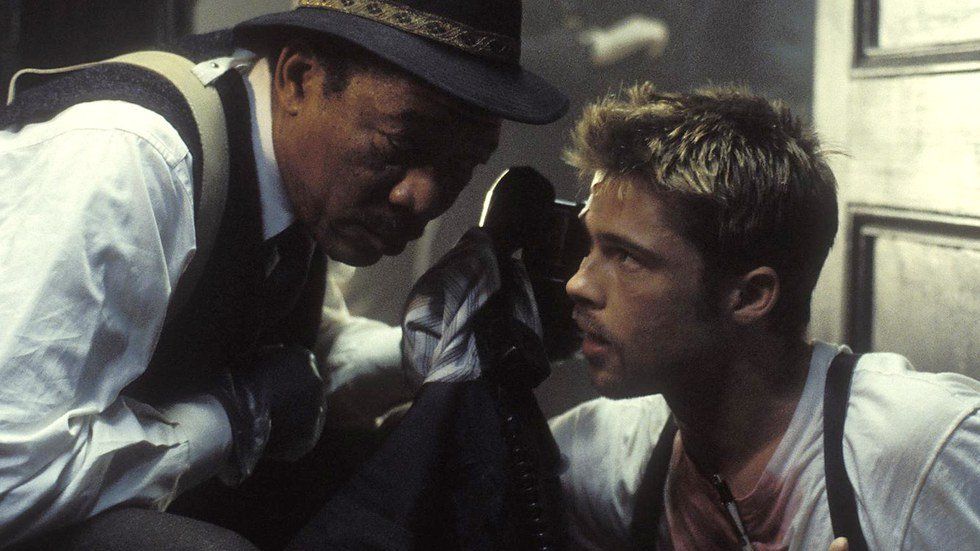
“Seven,” director David Fincher’s ghastly, intelligent, intense, and enticing thriller, is an excellent specimen of filmmaking that certainly leaves its viewers pleased if they are able to reach the horrific end. It tells the story of two New York cops – one is more than ready to end his career, and the other is overly antsy to begin his – and their attempts to hunt down a murderous psychopath who takes inspiration from the Seven Deadly Sins.
The film opens with Detective Somerset (Morgan Freeman), a veteran cop whose investigative methods have long since been outdated, as he meets Detective Mills (Brad Pitt), his replacement. Mills is a naïve young cop with an impressive resume who actually requested to be transferred into Somerset’s department. But because Mills is new to the city, Somerset refuses to cooperate with him, treating Mills as a fresh rookie, as opposed to an experienced officer. The two begin working on a gruesome case, in which a fat man is tied by his hands and feet and is forced to eat himself to death.
His sin was Gluttony. But that is only the beginning as Somerset and Mills are soon put in charge of the situation when more equally creative and disturbing murders spring up involving Lust, Greed, Sloth, and the other deadly sins (one man is forced to rip off a pound of his own flesh; another is tied in bed for a year; and a woman, too proud of her physical beauty, is cut up and given a phone in one hand and a bottle of pills in the other). Somerset, who suspected from the fat man that these crimes were much bigger than thought to be, comes to the conclusion that the killer, John Doe, is using the murders as a form of sermon.
“Seven” is a dark and threatening film despite its subject matter. Fincher presents the story mainly in dim-lit rooms and apartment buildings all in a city that is almost always raining. The darkness is penetrated only by the detective’s flashlights, and the only source of hope and life is provided by Mills’ wife, Tracy, portrayed by Gwyneth Paltrow.
Pitt delivers an excellent performance as Mills, but Freeman shines as Somerset, delivering one of the greatest performances of his career. Somerset’s character is hidden for most of the film, his personal life peering out through tiny scenes in his apartment or in an intimate conversation with Tracy. He lives by himself in a small apartment filled with books. He uses a metronome to help him sleep. When he realizes Doe is basing his murders off the Deadly Sins, he does something few would do, and goes to the library, studying Dante’s Inferno, Chaucer’s Canterbury Tales, and Milton’s Paradise Lost. Mills settles for the Cliff Note versions, a humorous symbol of the partner’s contrasts.
Even with their differences, Mills and Somerset form a strong relationship and a just as successful partnership. But it’s still not enough to outwit Doe, who has the upper hand throughout the entire film, even when the detectives think otherwise. His intricate plan is carefully executed, in one case taking at least a year, and it baffles the detectives. And even at the film’s climax, where he must improvise, he still beats them.
One of the elements that makes this film so unique as a thriller is that the villain is not revealed until the final half hour, forcing the audience to create an image of John Doe in their head. Not an easy task. How do you picture someone as evil as John Doe? How can anyone be as evil as John Doe? Somerset is stuck with the same problem as the rest of us. “if we catch John Doe and he turns out to be the devil, I mean if he’s Satan himself, that might live up to our expectations.” He tells Mills.And once revealed and played out in the film’s final portion, John Doe (the actor playing the role is not mentioned until the final credits nor was he announced in the original ads, so I will not spoil his identity) dominates the screen, and sparks the film’s scariest realization – he’s only a man.

















