The Field Museum and the American Museum of Natural History, leading museums with a stockpile of exotic acquisitions, dedicate entire halls to such cultures in an effort to educate the public on their beauty and history. However admirable, it is unfortunate that oftentimes such spaces leave out individuals of European descent. Brooklyn-based writer Ryan Wong expressed this concern asking, “Where do people of European descent go to learn about their histories?”
("Anywhere else," he said.)
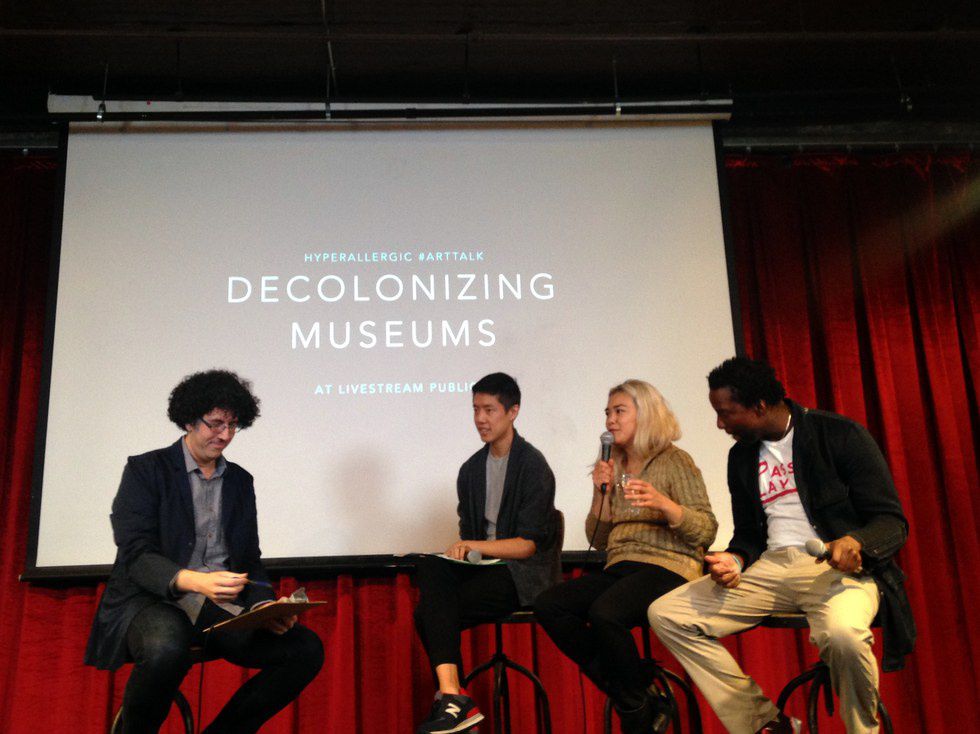
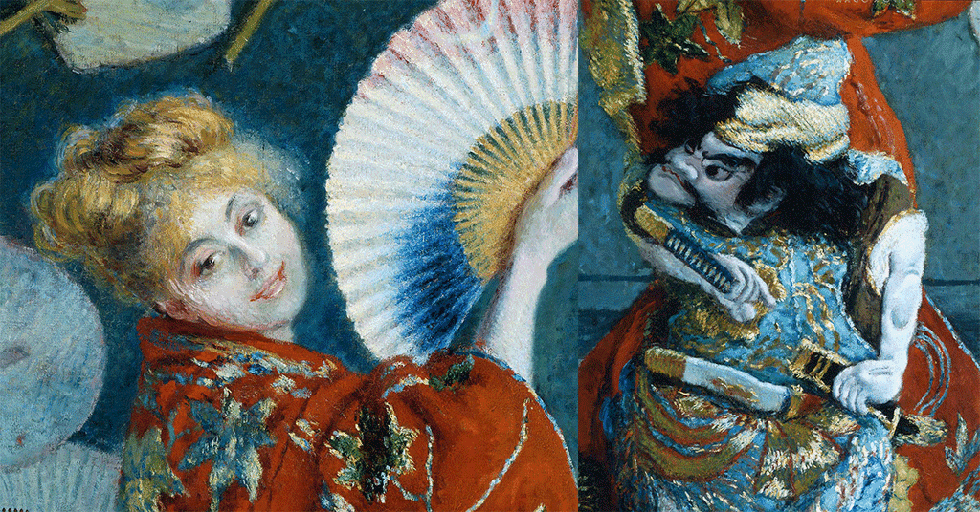
Last Wednesday night, art and culture forum Hyperallergic hosted a free panel on minority representation in museums at Livestream Public. The panelists were Seph Rodney, arts writer and recent PhD recipient from the University of London, Akiko Ichikawa, artist and Japanese-American historian, and Ryan Wong, arts writer and former assistant curator at the Museum of Chinese in America. Joining the discussion via satellite were members from Decolonize Our Museums, Amber Ying and Pampi Thirdeyefell, representing the group who spearheaded protest against the controversial exhibition of Claude Monet's La Japonaise this summer at the Museum of Fine Arts, Boston—the inspiration for the panel.
Before talk commenced, moderator Hrag Vartanian noted that the evening’s symposium would not resolve anything, but spur dialogue in an uncomfortable and overlooked subject—the imperialism inherent in major cultural institutions and how it quietly shapes society at large. His leading, thematic question was this: What would a 'decolonized' museum look like?
Seph, who completed his PhD on how the museum visit is changing, identified a new museology where the visitor is the primary meaning maker. Accordingly, the issue with museums is rooted in structure, not identity. "Surprise me, tell me what it's gonna look like because I don't know. Once you begin to address the structural issues, it's quite possible that what we'll end up with may surprise you."
In a similar vein, Ryan listed five courses a museum can take to 'decolonize' itself, stating that "decolonization is both an end goal, the complete liberation from systems of oppression, but is also a process; decolonization is any step in those directions." He acknowledged that museums would not be interested in his suggestions.
Rather, museums invest in finding new and inventive ways to engage with the public. They are constantly rediscovering and remaking histories. With the Boston MFA, its #KimonoWednesdays simplified the cultural exchange between 19th century Europe and Japan into a game of dress-up. Any institution with a diverse collection can make this misstep of being out of touch.
Accordingly, Akiko identified the Brooklyn Museum as a leader in decolonization. "It can happen because we have so many museums in New York City, right? The MFA, I think, was trying to do something more than it was because it is the Met and MoMA for where it is. The Brooklyn Museum has the luxury of covering other ground. It shows up other museums, how much more diverse you can be, how much more diverse of an audience you can have." She suggests that specialization would help remedy the structural issue of certain museums. Alternative spaces created by and for Asian-American artists, for instance, have given them a voice.
But anyway why do museums matter to daily life?
As authorities on culture, they reinforce certain perceptions of the world and its people. Akiko commented that her parents, coming from the generation after internment camps, would approve of the MFA, noting that "when you see an institution put out something from your home country, of course you're gonna defend it with your life because you don't see it anywhere else. That's kinda part of the problem." Museums deliver the first impression (the token representation) for any sort of 'alien,' faraway culture. Without the right treatment, an entire people (drastically speaking) is dehumanized.
Once Hrag opened the floor to questions, the audience was silent. It was commented that, since the subject was autobiographical and personal, the silence made sense.