

Regardless of your vote for Trump or Hillary in the recent election or your opinion of the outcome of the election, we have a new President who has very extreme positions on every part of the political sphere. For me, as a student teacher, I am constantly engrossing myself in every form of educational hot-topic, with the most recent hot-topic being the President-elect’s stance on education reform.
As Mr. Trump’s website claims, the United States spends about $12,296 on every student enrolled in public schools over their careers. This rounds to a little over $1000 per year per student. In comparison to other developed countries, the United States spends more per student and the return is that our students perform in the bottom half of all national assessments. Let me provide you with some numbers to put things into perspective. According to the National Center for Education Statistics, in 2012 the United States received a mathematics literacy score of 481 (international average was 494), a science literacy score of 497 (international average was 501), and a reading literacy score of 498 (international average was 496). These scores were measured by The Program for International Student Assessment through an assessment taken by 15-year-old students enrolled in public education.
For a country who enjoys labeling itself as the greatest in the world, these scores do not hold up. What our President-elect has deemed best for our country is that public education has failed our children and that we need to seek better education reform.
How are we going to do that? School choice.
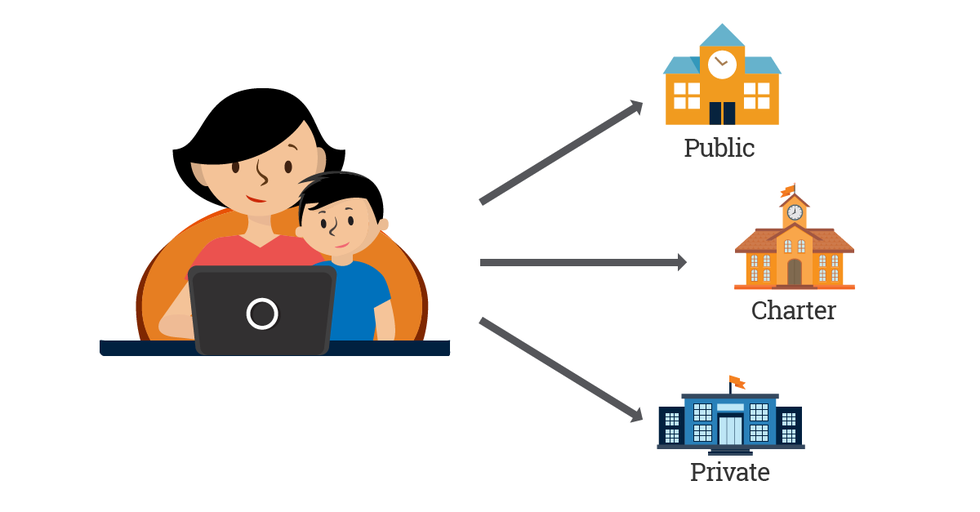
What does that mean? Technically there are two sects of schools; public and private. Public education is a right to all children until they reach the age of 18. This type of school remains free to the public as it is funded by tax dollars raised by each state. However, there is a new type of public school that is becoming increasingly popular, charter schools.
Charter schools have technically been around since 1991, but are slowly becoming more prominent in America. Like public schools, charter schools are required to be free, accessible, and not require “special” entrance requirements. The difference between a charter school and a public school is that charter schools give their school leaders complete freedom in order to help their students succeed, such to benefit the students. Freedom in a charter school is manifested by allowing the school culture to focus on a specific subject. For example, many charter schools have focuses in performing arts, special education, and STEM. It is an incredibly unique opportunity for any student to receive.
Much like public schools, state taxes fund charter schools. This means that anyone who lives in a city that houses a charter school, pays for that school regardless of whether or not their child is enrolled there. The funds that are set aside for public education are now split between public and charter schools. And since charter school leaders are given the freedom to run about with the only requirement to benefit their students, many school leaders open their charter schools as for-profit schools. Yes. Many charter schools are sponsored by major companies and celebrities. Bill and Melinda Gates, Donald Trump, and Oprah, love sponsoring public schools by means of charitable donations which they make to the American Legislative Exchange Council (ALEC), an organization which is better known for limited government.
Why is this a problem for our students? First off, education for all students is an American right, not a means for government to profit. Secondly, as soon as government gets involved, politics of a school becomes increasingly more complicated.
Although it is illegal, charter schools can make entrance requirements. These requirements typically benefit students with high academic grades. Students with disabilities, students with behavioral issues, and minority students are typically turned away. It is easy to see why many public schools can claim that they outperform public schools, have a higher percentage of student be accepted to college, and can close the achievement gap when they cater to a homogeneous population of students.
Beyond this, charter schools perceive themselves to be the best option for any American family. As the brightest students leave public schools for charter schools, public schools are left with low-level students who were unable to join a charter school based off academic premise. Why would any family who wants the best for their child, want to leave their students among those they deem unworthy of academic talent and knowledge?
School choice is a dangerous option for our education system. In a world where schools have already begun to segregate based on academic ability, Donald Trump’s new education plan wants to reprioritize public education funds and invest 20 billion dollars towards school choice.
It is no guarantee that school choice will become governing law across the United States, but it scares me realizing there are more and more people with hindering faith in our public school systems. Are we, as Americans, okay with our schools becoming for profit organizations where our students are being molded by corporations and organizations to produce consumeristic attitudes or are we going to have faith that our public schools are slowly changing and producing better, brighter, and unparalleled students?
Of course, I am not inferring that all charter schools are bad, nor do I want to claim that all public schools will offer the best education. What I do want to infer is that we as a nation need to become more informed. In the age of technology, the answer, "I don't know enough about this" is a wrong answer. Never stop educating yourselves.
















