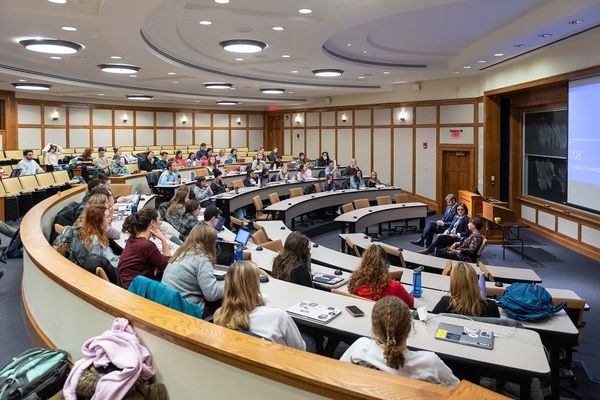


When I tell people I that moved from Cyprus primarily for the opportunity to get a better education, they are confused and ask me, “Wait, I thought that the United States had a really bad education system in comparison to other countries?” Depending on the country and the standards that would be used to scrutinize those nations, in some cases it is true that the United States lags behind, but when comparing the sheer magnitude, funding, and opportunities that the government provides, the majority of high schools and universities in the United States are very equipped to provide a high level of education to any student who wants to learn.
As far as I’ve seen in the last decade of my education, many students become apathetic toward their studies and, frankly, don’t care to try. Rather than attempting to do more, many students point fingers to the teachers, lack of funding, or (my favorite) the grandiose villain called “the system.” The students who I have seen complain about not liking school, not understanding many of the subjects, and generally being pessimistic and negative about their schooling career have been the students who were nowhere to be found during the teachers' office hours, nowhere to be seen during extra credit activities, or nowhere to be heard during Q and A time in class. Maybe it would be more efficient to look at student protocol before blaming the schools, the teachers, or even the system overall.
All businesses have a supply and a demand and schooling can be analyzed in the same way. The supply is the number of schools, and, of course, those can be further analyzed by the quality of the education that they provide. However, much like a business, supply is dictated by the demand. Without demand, there would not be supply. Similarly, schooling is based on the demand of the students. If a student is not the one who is willing to learn and absorb knowledge, supplying that education and forcing students to participate is only going to sour their perception of learning.
The only way of changing student behavior in terms of their academic success is by making the subject interesting to the student, as well as applicable to their lives. For example, I find nuclear energy interesting, but I don’t read or study the subject because I don’t see how it applies to me. However, economics and finance are not only interesting to me, but applicable to what I do. Many times, teachers focus on the idea of making the subject interesting, but never think about applying the subject to the lives of the students. Chemistry is more than just test tubes and explosions, it is the medicine that the student’s grandmother takes. History is more than just old books and lectures, it is the foundation of ideas that sway the current election process. Math is more than just formulas, it is the logical language that allows the student’s iPhone to process FlappyBird. Only when a student understands the power of the subject will he or she have the incentive and motivation to try and do well in it.
Clearly, though, there are many schools and even whole districts that lack in many things, where the inadequacy of education is indeed systematic. Issues that pertain to students may not be the only problem that needs more emphasis, but it's one that I believe that not enough light is shed on. Cultivating the student’s ability to focus and academically drive themselves is the greatest gift an education can provide, so focusing on the student is not only paramount, it's logical.