A fitting indicator of the misery to come, Saddam Hussein was given life by his mother, Sabha, as a last resort after a failed abortion and suicide attempt. When his life ended sixty-nine years later at the end of a noose, so did a dynasty of terror and oppression that managed to wipe millions off of the face of the Earth. In the years following the U.S. led invasion that brought about an end to his reign, Iraq fell into a sectarian war that engulfs the country to this day. With thousands of Iraqi bodies piling up every year and seemingly no end in sight, one might find themselves longing for the simpler time when car bombs in Baghdad were not a regular occurrence and Sunni and Shia jihadists didn't wage war against each other and the wider world. However, this impulse plays favor to an odd Iraqi revisionist history, surely life under Saddam couldn't be this bad?
The point of this article is not to posit that Iraq has changed for the better. I, myself, have never been fortunate enough to visit the country nor am I a citizen, and as an American I do feel a particular guilt as to the collapse of Iraqi civil society resulting from the disastrous war waged by my country and the forces of radical Islam. However, I find that all too often, discussion of Iraq's misery focuses on the aforementioned parties, completely negating the role that twenty-four years of Saddam Hussein as president had in stunting history's most ancient civilization. Was life better under Saddam? I don't know. I can never know and I don't intend to compare rotten apples to putrid oranges, but I do know enough about him and his reign that I feel confident in putting forward the notion that his regime should be studied for years to come as a near-perfect definition of despotic tyranny.
The Republic of Fear
Unlike other dictators of the twentieth century century, Saddam Hussein was neither a brash ideologue who led a revolution nor a shrewd military commander who installed himself in power via coup. Rather, Saddam's contribution to the greater Ba'athist movement was more akin to a hired thug or mob enforcer, as his earliest standout moment in Iraqi history was his orchestration of a failed hit on General Qasim, the military dictator of Iraq, in 1958. A decade later, Saddam would be named Vice President of Iraq by President Ahmed Hassan al-Bakr, himself a cousin of Saddam. Saddam soon began transforming the country, using bloated oil revenues from the 1973 Arab oil embargo to diversify Iraq's economy and expand the civil safety net whilst also creating an ever-imposing mukhabarat (secret police) that united a historically frayed society under Ba'athist tyranny. As he consolidated power and increased his national prestige, it became evident that Saddam was the de facto leader of Iraq. Before long, his position was made official when the ill and aging al-Bakr was forced to step down and concede his position to Saddam, who feared an alliance forged by al-Bakr with Syria would undermine his authoritarian grip.
Saddam may have been president, but he solidified himself as the undisputed dictator of Iraq in the summer of 1979 when he orchestrated a purge of his own Ba'ath party before rolling cameras. In a grotesque display of absolute power, Saddam sat stoically, smoking a large cigar whilst a man was brought in front of the committee between two guards and began reading off a list of names who allegedly conspired with him against Iraq. The "conspirators" were individually dragged out of the panic-stricken room by guards while their "loyal" comrades shouted slogans praising Saddam and his leadership. Saddam, unfazed and still smoking, presented those loyal with the gift of being members of the firing squad that snuffed out their former friends.
This brutality extended to the rest of Iraq's population. Dominating the populace by fear, Iraqi police and military were regularly ordered to use torture as a means of repression, with victims being subjected to beatings, flayings, electrical shock, dismemberment, and rape, often in front of their family members. Whilst no Iraqi was exempt from this cruelty, particular attention was paid to the Shia majority and Kurdish population as Saddam, himself a Sunni Arab, sought to preemptively dissuade ethnic or religious dissent. All throughout the country's Shia south, mass graves dotted the desert, filled with men, women, and children. Iraq's pervasive police state and policy of torture and execution made dissent against Saddam, real or perceived, the antecedent to the most grotesque violence imaginable.
Saddam At War
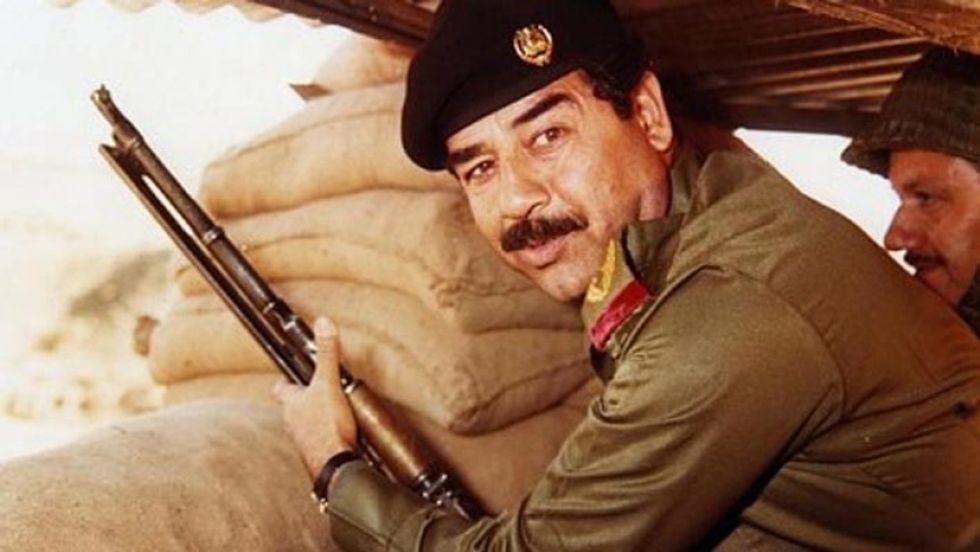
As is common with tyrants, Saddam felt the need to flex his military muscles against other nations several times during his reign as Iraq's president. Worried about the rise of Khomeinist Islamism into ruling power in Iran Saddam launched the Iran-Iraq war in 1980 by invading the oil-rich and Arab dominated Iranian province of Khuzestan. In the eight year war that followed, stalemate and attrition led to the deaths of over one million people and no gains on either side, making it one of the few wars in history where one can argue that both sides were defeated. It was in this conflict that Saddam, facing the much larger country of Iran, first deployed chemical weapons, gassing scores of Iranian soldiers. He continued this garish strategy in the borders of his own country, gassing thousands of Kurds, mostly civilians, to their deaths in order to quell an uprising.
Along with chemical and biological weaponry, Saddam sought to obtain nuclear weapons as well. The campaign undertaken by Israel to destroy the Iraqi nuclear reactor in Baghdad as well as kill off nuclear scientists cooperating with Iraq seems to have pumped the brakes on the ability of Iraq to successfully create a nuclear arsenal, but the questionable nature of the Iraqi nuclear program remained a contentious issue that led to over a decade of crippling sanctions as well as the eventual invasion of the country in 2003.
After the costly war with Iran, Saddam, feeling abandoned by his gulf Arab allies, decided to invade and annex neighboring Kuwait, a tiny country whose oil Saddam coveted. Despite the outcry of the international community, in which both the United States and the Soviet Union condemned and embargoed Iraq, Saddam doubled down, claiming the sovereign nation of Kuwait to be part of Iraq and instituting a campaign of violent suppression and rape against the Kuwaiti populace. The refusal of Saddam to abandon his military conquest of Kuwait escalated into a costly war wherein Iraq lost as many as fifty thousand soldiers to the largest international coalition since World War II, one that Saddam tried to fragment by launching an unprovoked series of rocket attacks against Israel in a desperate attempt to draw the Jewish state into the war and break Arab unity.
Defeated in his foreign military adventures, Saddam Hussein reasserted his might against the Shia and Kurdish communities with genocidal military campaigns within the borders of Iraq. Furthermore, he exported terror to other countries by supporting terrorist groups at odds with rival countries such as the Abu Nidal Organization, a group that specialized in killing Palestinian leaders who advocated for a two-state solution with Israel, and the People's Mojahedin of Iran, a leftist Islamist group intent on the overthrow of the Iranian government. In one bizarre instance, Saddam even tried to have the former president of the United States, George H.W. Bush, assassinated in Kuwait via car bomb, a plot that was unraveled by the Clinton administration.
No-fly zones and sanctions resulting from the aftermath of the Gulf War made Iraq almost unlivable for the civilian populace, yet Saddam continued his brutal campaigns of military-enforced mass murder and suppression of dissent, all while using illegally procured funds to build lavish palaces for himself and his family members in nearly every Iraqi province.
Saddam the Man
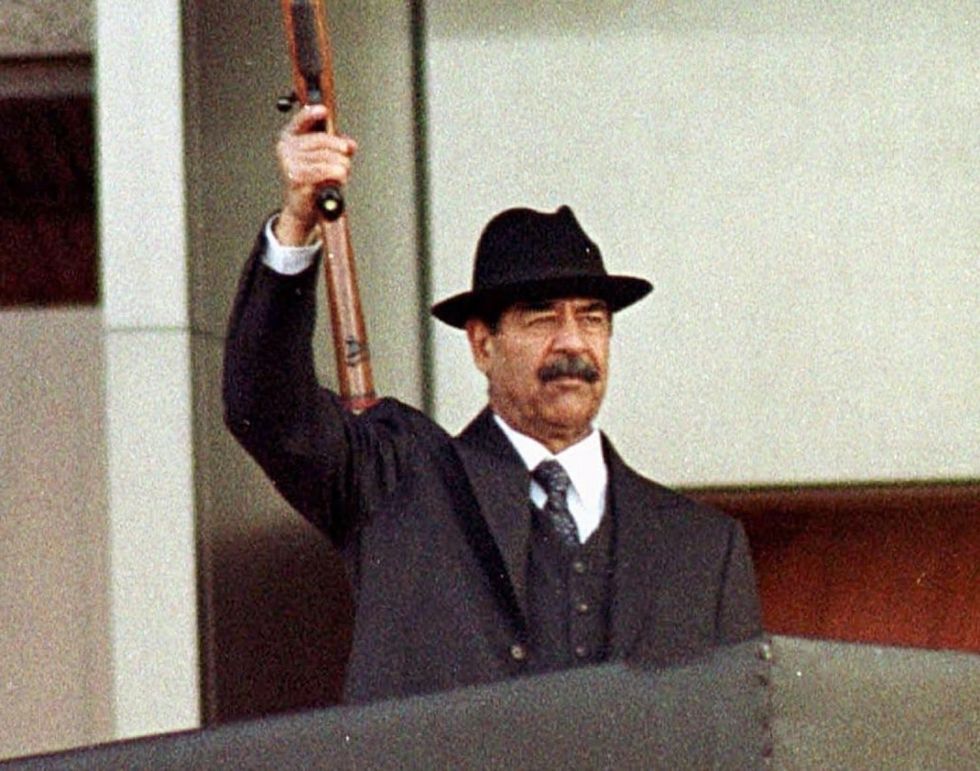
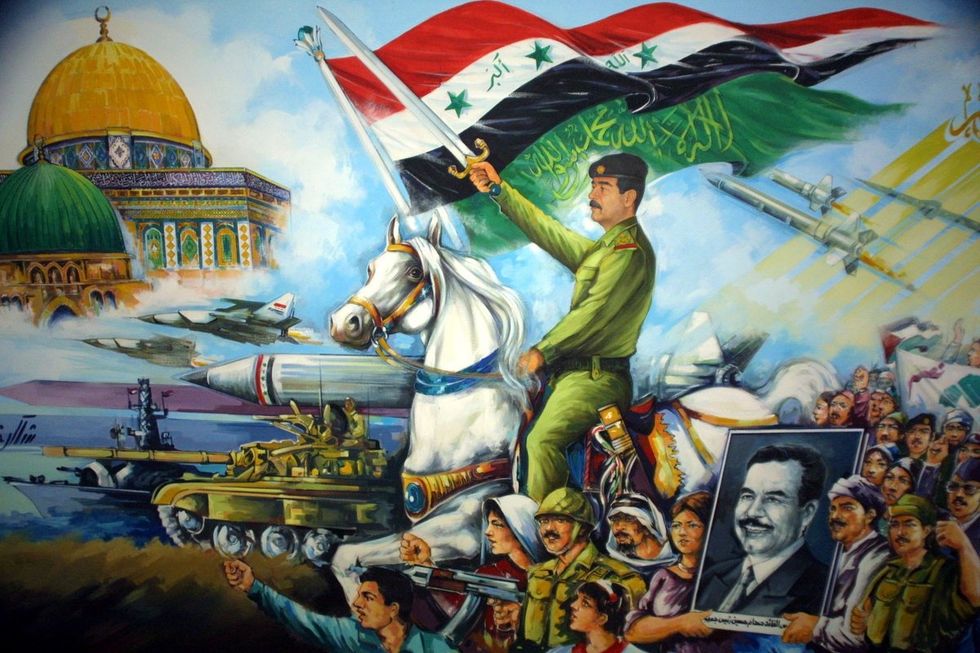
This iconography could be seen all over Iraq, with paintings dedicated to Saddam Hussein becoming the mainstay in Iraqi artistic expression for most of his reign. These were primarily used for political gain, as many murals depicted Saddam as a pious muslim, something he most likely was not, in order to gain support in the more conservative regions of Iraq.
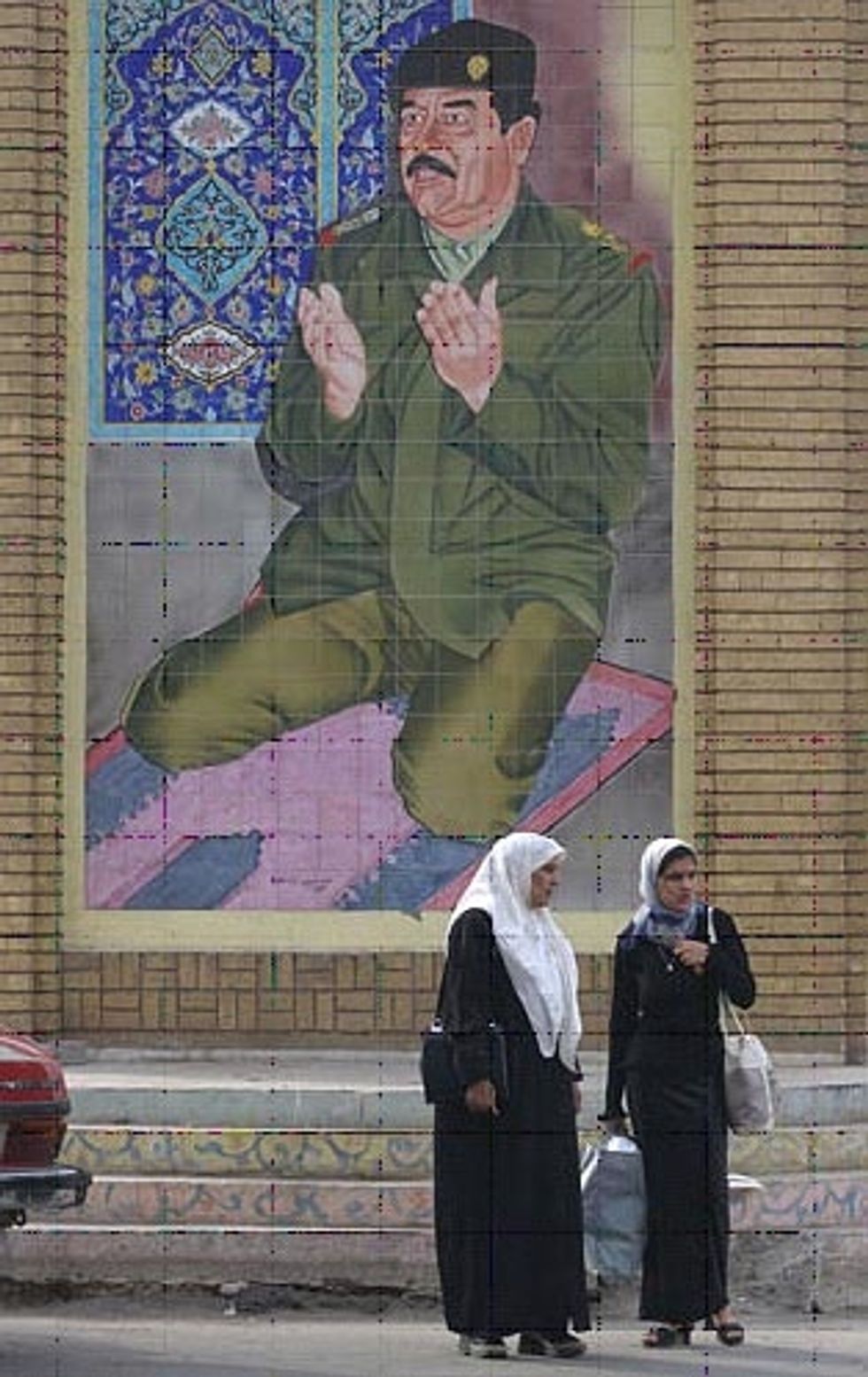
A pervasive personality cult around Saddam functioned as a unifying ideology as well as a tool of oppression, with the Shia neighborhood of Sadr city, named after a prominent cleric murdered by the Ba'athists for his defiance, was previously named "Saddam City". Saddam even erected statues of himself in Kurdish garb, despite waging campaigns of ethnic genocide against them.
The brutality of Saddam was a family trait, it seems, with his ghoulish sons Uday and Qusay, who by many accounts were introduced to violence and torture at a young age by their father. The results show, as Uday is credited with the rape and murder of many Iraqi women as well as the torture of the Iraqi olympic and soccer teams upon losses. Qusay, Saddam's heir apparent, was responsible for suppressing the 1991 Shia rebellion as well as draining the ancient wetlands that the Marsh Arabs called home for millennia.
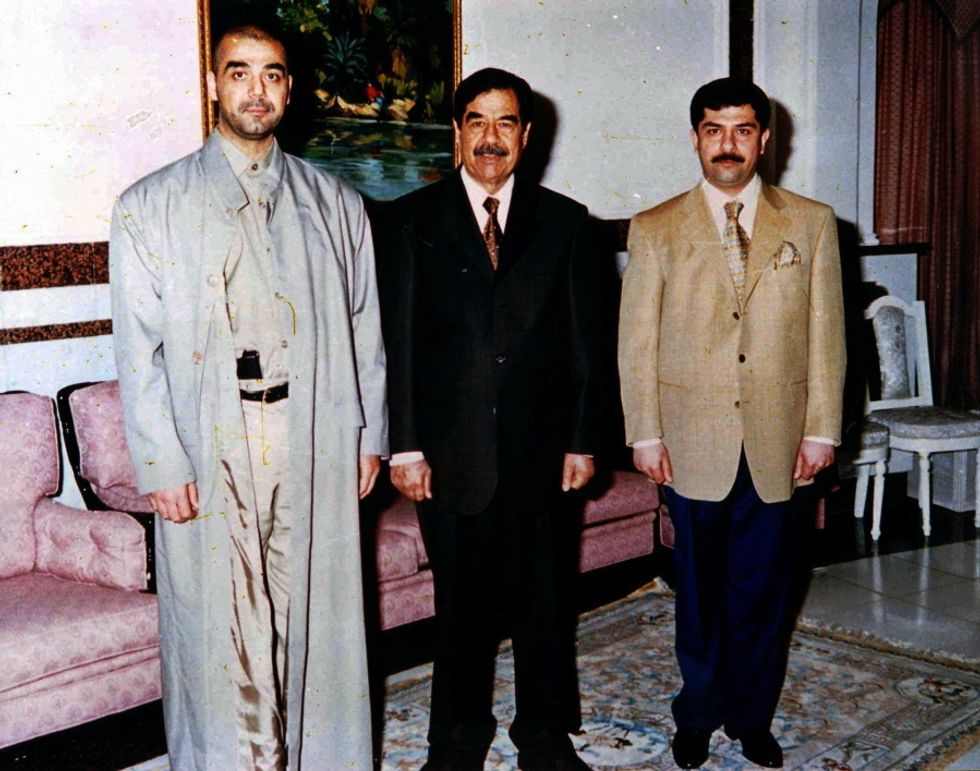 Uday, Saddam, and Qusay Hussein
Saddam's Ideology
The above title is almost a misnomer, as Saddam never had a consistent ideology. Ba'athism at its most basic is a mixture of Arab nationalism and Arab socialism, however Saddamism, or Saddam Hussein-inspired Ba'athism was described by its namesake as a mixture of National Socialism and Stalinist Communism, or at least the dictatorial aspects of these most deadly ideologies. It is frequently stated by those opposed to the 2003 Iraq war that Saddam and Ba'athism are inherently secular therefore the notion that Saddam Hussein would align himself with Al Qaeda is antithetical. The Saddam-bin Laden link is tenuous at best, but the secular aspect can be firmly disputed by Saddam's own actions in the final years of his tenure as President. During the "faith campaign", Saddam re-introduced Islam into Iraq's governing politics, particularly the Sunni Salafist variant of Al Qaeda, making laws that outlawed sodomy and adultery with death and allowed the secret police to behead women suspected of prostitution. The newfound sharia system was still infused with Saddam's personality cult, with a Quran written in (supposedly) his own blood and an updated family tree showing him as a direct descendant of the prophet Muhammad being presented to the Iraqi people. This piety too seems to have been for Saddam's political benefit, as the Arab nationalist movements of Nasser that Saddam initially sought to emulate were being replaced by Islamic fundamentalist ones. However, the impact of this coordination between Ba'athism and Salafism is still felt today, as it formed the ideological and weaponry backbone of the later Al Qaeda in Iraq and ISIS terror groups that plague Iraqi civil society to this day.