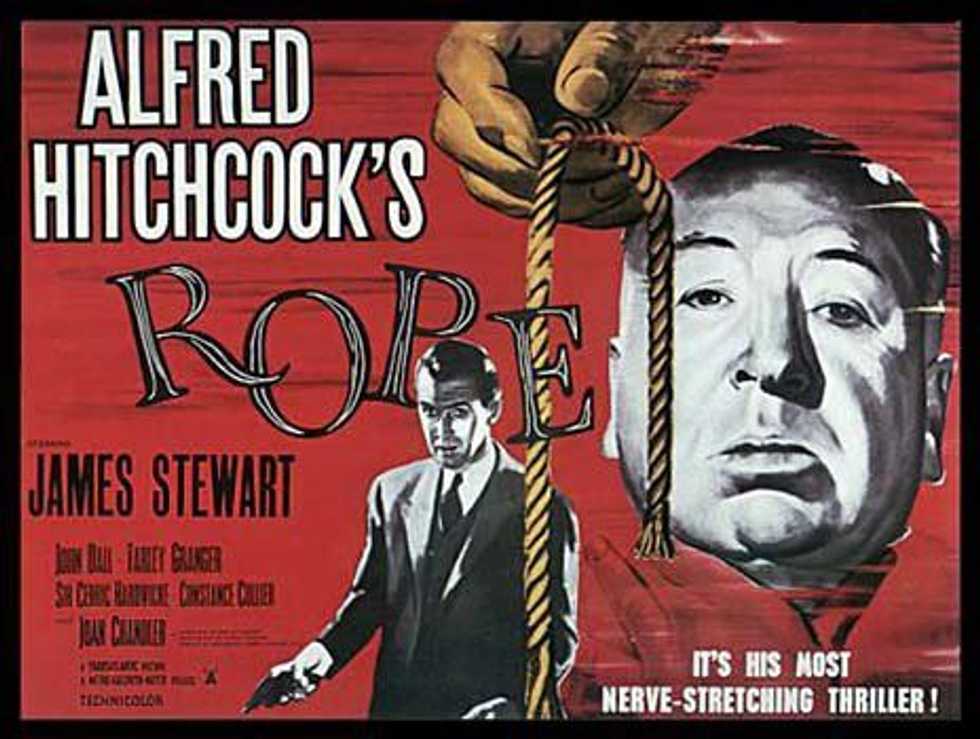
Alfred Hitchcock is known for directing suspenseful and gripping films that will leave the viewer tense until the credits begin to roll. Being the legendary director that he is, he masterfully crafted some of the best and most suspenseful films ever, as well as a few other films which were overlooked and are hardly remembered. One of his lesser-known but still acclaimed films is called "Rope,” and was adapted from a play by the same name. The play was said to have been inspired by the murder of a 14-year-old boy by two college students, who wanted to kill just to see what it felt like. Though the play was inspired by this event, the film offered a darker look into society, class status and human nature.
Though this psychological thriller is now regarded as a classic, at the time it was released it was considered “an experiment that didn’t work.” This article will dive into the contents of the film, critiquing it to discover the meaning behind the film and the implications it brings out about society, culture and human nature.
Set in the 1940s in New York City, and during the time of the 1948 release date of "Rope," the “Red Scare” of the fear of spreading communism was growing and the Cold War between the United States and Soviet Russia was three years in. Taking these historical events into account, the way the film was presented, there was an explicit concept of superior beings and the underprivileged, the latter of whom should be eliminated by those privileged with the power to do so. With the recent victory of WWII, America had flexed muscles when it came to showing off power and authority. With communism spreading, it seemed America was passionate about using that power and authority to wipe out communism, or at the very least, have a fighting chance to contain it, with the United States being perceived as the “superior being” eradicating communism, who was the “underprivileged.”
This idea was portrayed within the opening act when the two main characters, Brandon and Phillip, strangled their friend David to death. As David was friends to those who would eventually take his life, America and the Soviet Union were allies during WWII, but had become bitter rivals during the Cold War.
The film also toyed with the belief about murder being only for a privileged few. "Rope" disturbingly showed Brandon’s thoughts about the matter when the rest of the cast sat down to discuss the very thought. A character casually referred to murder as being an art and went into detail about how with murder, there would be no unemployed people or waits in line. He then joked at making holidays for killing in certain ways, and only specific people should be killed in ways unique to their roles in society. After this train of thought, Brandon then adds, “And the victims: inferior beings whose lives are unimportant, anyway.” It suggests only those with power, authority or have some sort of importance in the world as a whole should live and dictate those who are inferior and can be killed off, since their lives have no importance to society or the world. Brandon later defends his point by stating who the “few privileged” are. They are those with “such intellectual and cultural superiority that they are above the traditional moral concepts [of] good and evil, right and wrong, which were invented by the ordinary average man, the inferior man, because he needs them.” This quote strengthens Brandon’s belief by saying the less important and under privileged need to have a code of morals to live by, since they don't know how to live and are incapable, and don't have the privilege or right to live and dictate as those who are intellectually and culturally superior do.
Hitchcock’s "Rope" gave a dark twist and insight of culture as a whole, and left the viewer with deep concepts to consider about the human heart and their position in society and the world.