


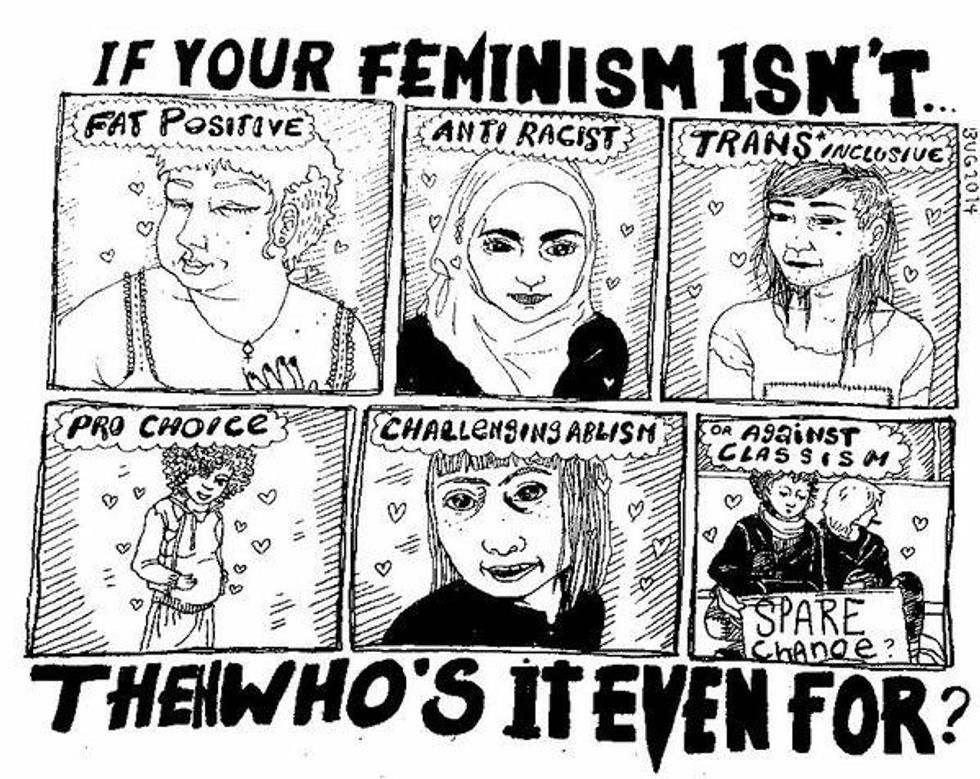
For those unfamiliar with the following piece, from the onset the author proposes that in recent times, feminism has been reduced to something that is a far cry from its original dictionary definition. The author proposes that due to technological advances, the long-standing principles of feminism have been tragically lost, and displaced by wrongful interpretations.
Contrary to this opinion, I belong to the category of people that believe third-wave feminism has allowed us to move past the antiquated dictionary definition of "feminism," in exchange for a more revised and inclusive awareness. However, with that said, we're not even remotely close to where we need to be. There is far more work to be done, inclusion and intersectionality to be had, and progress to be made.
The article cites that feminism has "come down to" women that are more concerned with issues such as the Free the Nipple campaign, and less with issues such as the bloodshed of countless women killed merely for speaking out of turn; as well as men who are not taken seriously when they testify to rape. The article minimizes the Free the Nipple platform by forcing a comparison of severity amongst other feminist issues. Essentially, the idea is this: "Why should we be tackling the sexualization of female nipples, if we've yet to sort out far worse problems?"
The idea put forth in the article is that you're not a true feminist if you're concerned with the Free the Nipple movement, simply because it pales in comparison to the struggles women face on a daily basis in other parts of the world, as well as the struggles men face in coming forward about rape, and thus is shameful to even attempt to validate. However, the logic of this argument isn't new.
We've seen it over and over again, when the time of one issue coincides with another, people become enraged that others aren't devoting all of their energies to the seemingly more important cause. Their expectation is that one should discern which issue is of a greater importance, and allow it to trump the other.
While it's a completely different set of circumstances, we saw this most recently with the coinciding of the Nicki Minaj/Taylor Swift MTV racial criticism and the Sandra Bland case, another demonstration of police brutality. Both came about right around the same time, and immediately were put at odds with one another in the social media sector. Again, the logic is this: "How could anyone believe that it's an appropriate time to pay attention to diversity in the media when there was yet another life added to the mounting death toll of POC by police?" Both issues exist within the same system of oppression, and it is imperative that they are both discussed, but the discussion of one shouldn't have to come at the expense of the other. The assumption made here is that we, as human beings, are unable to multitask and be equally engaged with both issues, but that's simply not true.
By the same token, feminism can't be narrowed down to just one fight. There are many fights to be fought, and often simultaneously. I am a feminist who cares about the Free the Nipple movement. I also care about women in the world who are being killed for speaking up for themselves, just as I care about men who are not taken seriously when they say they've been raped. These are all important feminist concerns. I care about all of them. But does it really serve a purpose to vilify one cause in order to raise awareness for another? Can't we just raise awareness for all three? After all, the nature of human beings is that we have the innate ability to pay attention to various issues all at once, and allot facets of our consciousness accordingly. Meaning that just because I'm speaking on one thing at any given moment, does not mean I have suddenly forgotten about another. People shouldn't have to unilaterally pick and choose what issue they care about most. In doing so, they're forced to forgo one part of their identity for another. While some systems of oppression are indeed worse than others, they aren't in competition with one another.
However, I'm in no way excusing white feminism, which is where I originally thought the article was going to proceed. When white women, myself included, perceive feminism to be exclusively about our gender and nothing else, we're leaving out a big part of the conversation. bell hooks, the distinguished American social activist, feminist, and author once said:
"Mainstream patriarchy reinforced the idea that the concerns of women from privileged-class groups were the only ones worthy of receiving attention. Feminist reform aimed to gain social equality for women within the existing structure. Privileged women wanted equality with men of their class."
While I agree with the original objective and message of the movement, I don't deny that the Free The Nipple movement is problematic. It has good intentions, but poor execution. It caters to and enables convenient white feminism, because it's exclusively about gender differences and gender differences alone. The website is full of film clips with an overwhelming number of white women, that are also thin, cis, and neurotypical able-bodied and their brand is exactly what you’d expect--the same pair of perfect tits that you've seen time and time again reinforced as the only acceptable set of breasts in America. How freeing can a movement be when the nipple you're parading about is one that strictly adheres to ideas of beauty created by none other than the patriarchy itself?
Had the article clarified its reference to the Free the Nipple movement as being problematic and lacking intersectionality, and discussed the need for an ongoing dialogue surrounding the movements that champion equality, yet disenfranchise minorities, that I could understand. The Free The Nipple campaign may have branded the idea of not sexualizing nipples, and I believe in that idea, but not as set forth by their terms.
In the next section of the article, the author gives us a discourse on how she "sees women on the Internet claiming they are feminists, and all they talk about is the unfairness women face in society. Meanwhile, men have to deal with these problems, as well."
Not once, but three times she resorts to this old standby "men have to deal with these problems, as well". But here I must stop you, and contest not the definition of feminism as it stands now, but rather your understanding of it.
The feminist movement has been so sadly misconstrued to the point that men think it's about them, and apparently, so do you. Far too often we represent the "as well" part of the equation, not the principle concern. The entire foundation of the feminist movement is built on achieving social, political and economic equality with men. So how then, do you suppose we should go about working towards that? By sheltering our grievances, for the comfort of men? So that we don't offend them or upset them by protesting our own oppression? What purpose does that ultimately serve? If you're into preserving societal expectations and attitudes as they exist currently, then you're on the right path, but otherwise, it's a futile practice.
As for the point about women forgetting that men get raped and suffer from domestic abuse, again, I disagree. Our movement is the one that speaks to this and speaks for these men, because we exist in a culture that doesn't value the things we've feminized. Rape and domestic abuse have been designated as a predominantly female concern, and thus having undergone either, these men are subjected to denialism much like we are. Only in their case, it is their manhood and masculinity that's called into question.
It deeply saddens me when I hear about male rape, because more often than not, I'm not hearing about it from other men on the basis of discussion and advocacy, but as a retort to hearing about rape happening to women. They don't seem to want to support their fellow men, but rather want to be acquitted from carrying the guilt of rape culture. And there's harm in that. It not only harms the group of men who have experienced rape, because they're being exploited as a defense mechanism, but also further perpetuates the same biases present in the "not all men" philosophy. When you say things like "not all men" or "men get raped" (purely to even the playing field) you attempt to excuse the behavior of that population as a whole.
Much like feminism, "yes all women" wasn't intended to warrant a male response of "not all men", but was purely a device meant to facilitate discussion in a public forum about the systematic disadvantages women face in our society. And this is where it all comes down to privilege. People in positions of privilege are obligated to acknowledge that privilege (myself included), and if I've learned anything from being in a position of privilege, it's that if you're uncomfortable and listening you've got the right idea, but if you're offended and recanting, you're part of the problem.
The article's take on "privilege" is that "feminism has turned into a word meaning that all men are privileged, which is definitely not the case". And you're right, feminism has turned into word meaning that all men are privileged, because they are. We aren't talking about "privilege" in the context that someone would call a person of affluence, but rather an inherent privilege men are granted simply for being men.
Let me put it this way, I'm a white woman. Therefore, I have white privilege. It's not a matter of if I feel I've been privileged throughout my life, but rather the fundamental privilege I've been endowed with upon being born white. Just because I've endured my own struggles, does not mean I don't still reap the benefits of being white. Whether or not your feel as though you're privileged doesn't matter. It's not something that's up for debate, it's something that just is. When someone employs the phrase "not all men", or "not all white people", they're taking the path of least resistance, one that's been carved out for us by our privilege. It's not about having our ego personally attacked, and it shouldn't feel that way. We should feel uncomfortable, but that shouldn't stop us from hearing out the people who have been oppressed. It's not about you, and all of the time that men, white people, and other people in positions of privilege waste trying to affirm that they're actually the good guys, is just playing right into the hands of privilege.
I'm not going to shame you for wanting "meninism" or "manism" to be a real thing, but I do lament it. If the "need" for meninism isn't a testament to how far off we are in being truly understood and achieving parity, I don't know what is. But I must insist that it already is a real thing. Urban Dictionary defines it as the “unilateral law which states men are superior to women; that which allows men to be men." This should sound starkly familiar, but it's more commonly referred to as the complete history of our world. Meninism is simply a knee-jerk reaction to the feminism movement receiving attention in our society. This term didn't need to be coined, because gender inequality has never existed for men, and thus has never been a barrier for them.
In conclusion, the article rejects the idea that underarm shaving and promoting curvy women as beautiful are feminist movements; on the grounds that shaving is "fashion trend," and curvy women don't have to listen to those ads about losing weight. Again, allow me to clarify what these movements are trying to accomplish, and why they are necessary.
I was skeptical at first about your mention of shaving underarms, and questioned it's relevance, as this has been a common stereotype of the feminist movement in the past, but have decided to explain it anyway. You say that it's not against the law to not shave your underarms, and this is true. Women understand this. Those with unshaved underarms may be regarded as the stereotypical feminist, but their shaving protest is merely to defy the gender norms of body hair. And while I say defy, I truly believe they're just trying to normalize both sexes as having body hair, by proposing that hair doesn't have to be incorporated into the construction of gender.
As for curvy women, I don't agree that they can merely ignore ads about losing weight. They can have positive body image without the approval of society's measure of their worth, but can they really ignore it? Positive body image is a gradual process women slowly inch towards as they grow, because the older we get, the more transparent these ideals become. I don't know about you, but in my experience, positive body image for women hardly ever seems to be commonplace. Because from the time we're born, we've been conditioned to never be satisfied with our bodies. Despite the fact that these messages the media disseminates are merely part of a capitalistic ploy, the results are inconceivably detrimental. If we derived our entire understanding of the world by what's in the media, one might not believe that curvy women, POC, transgender or people with disabilities even exist. So weight discrimination as it pertains to curvy women is absolutely a feminist issue. Do you propose that these women shouldn't protest their own exclusion, which in essence is the denial of their existence? I know it's not of popular opinion to challenge the status quo, but it's essential to normalizing the media. Changing the way we perceive certain groups of people is the first step in working towards equality for them.
In the end, the author repeats her opening statement that true feminism is hardly around, and if we, feminists, carry on with such behavior, it was cease to exist completely. I urge you to answer this: what do you define true feminism as? Because from the looks of it, the definition of feminism hasn't been lost along the way, but perhaps your understanding of it has.
Maybe in your quest for true feminism, you should refer to one of your previous statements, which of all the things I disproved of in this article, was the only I agreed with. You suggest that "men and women should be fighting together for equality. More men should raise their voices without fear of being told they are not manly." That's all feminism is, a fight for equality. The concerns you condemned need to be realized and acknowledged as valid, and with a little help from our friends. It's imperative that men hear us out, that white women hear out WOC, that cis women hear out transgender women, that conventionally thin women hear out curvy women and that able-bodied women hear out women with disabilities. And without fear that it undermines their own existence. As Georgina Jones said in an article on Bustle, "the unconscious ignorance of diversity is one that we cannot allow within any feminist movement in 2015."

















