

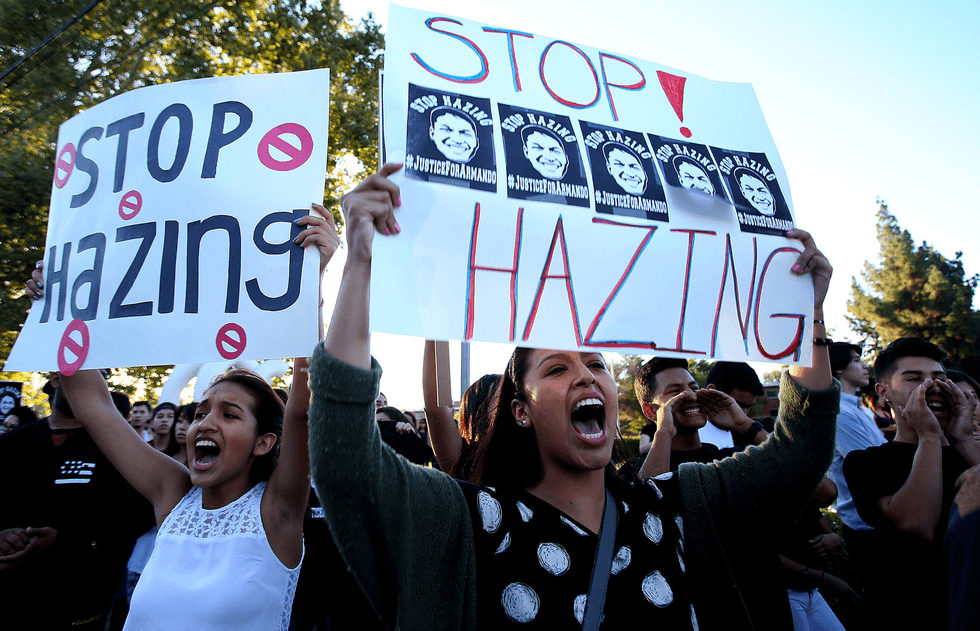
Recently, a content creator with our beloved Odyssey shared an article declaring his support for the hazing of new members of Greek life on college campuses. He claimed that hazing within these organizations builds familial bonds among pledges (people who are attempting to join an organization and are most often the victims of hazing), makes the initiation process more exclusive and teaches members to respect their fellow sisters or brothers. Upon reading this article, I was infuriated that the author could be in favor of such a serious and potentially dangerous activity. I believe he made the mistake of having no regard for the lives disrupted or lost because of hazing incidents. To say that the pros outweigh the cons shows a complete misunderstanding of how to build real, meaningful relationships during pledging, or just how serious the effects of hazing are.
Let me begin by differentiating between hazing and pledging. Hazing, as the original author mentioned, is subjection to actions such as harassment, ridicule, emotional upset and other such unpleasant experiences. Pledging, on the other hand, is experiencing certain activities unique to a particular group to see if someone is a good fit for that organization and to see if s/he is dedicated to becoming a member. Pledging is how you “earn your letters,” per se. Hazing is being emotionally and physically abused.
I must point out that I myself am not a member of Greek life. However, I have many friends who are and I fully support the camaraderie and sense of community that my friends feel in their organizations. My school is small and our fraternities and sororities are all local, or unique to our campus. This means that all members know almost everyone who has ever been a member. More importantly, this means that all organizations are held to strict standards during pledging activities. This past year, my campus has faced an unfortunate incident in which a couple of organizations were accused of hazing. The news shook my school. Everyone was affected in some way, and a Title IX investigation was launched immediately. I feel that my college handles these reports with the seriousness that they deserve. First and foremost, everyone should feel safe in college. Pledging may be exhausting, but it should never make someone feel as though their life or well-being is threatened.
The gentleman who wrote the original article noted that hazing builds camaraderie with the people suffering with you. You earn a certain appreciation for the people you’re going through the “suck” with, as he put it. I absolutely agree that pledging does and should be a sense of brotherhood or sisterhood. However, I don’t think that individuals need to be subjected to ridicule and abuse to feel a connection to the people beside them. Friendships are ultimately about one’s character, not shared experiences. Yes, going through Hell together may forge bonds, but why must they be built out of intentional and prolonged suffering?
I think the most surprising argument provided in the original article is that hazing earns respect. He writes that the consequences of stepping out of line to talk back to a superior were not worth the satisfaction of showing disrespect. This implies that the mindset during pledging is, "I do not want to suffer the backlash of defending myself. Therefore, I must have respect for the people hazing me."
This is not respect; this is fear. Respect would be choosing not to speak out because your superior doesn’t deserve the harsh words you’re thinking. Fear is cowering away from someone who is abusing you. If this can be called respect, then it is some corrupt version thereof. No one who humiliates someone in public has the right to be respected. They have the power to be feared. Respect is earned. Fear is imposed. To think differently is to have sympathy for one’s abuser.
Toward the end, the author admits that hazing can go awry and that some tragedies have happened because of hazing. He offers a plan to keep organizations in check to make sure this doesn’t happen. However, he also says that anyone who is the victim of hazing became one by choice. People chose to be hazed in order to prove their worth. Although some people have died or have been emotionally scarred, the benefits of hazing outweigh these tragedies. He even says that to ban hazing would be “like making cars illegal because someone crashed theirs and hurt themselves and/or someone else.”
First and foremost, how dare you undermine the deaths of innocent victims for the sake of some pranks? No one chooses to put his or her life on the line to join a group, nor should anyone be expected to. People choose to pledge; they do not choose to be subjected to torture. More importantly, hazing is extremely problematic because, when it’s done correctly, people suffer. Human beings humiliate, ridicule and abuse their fellow human beings for what? Some letters on a t-shirt? If we want to use a car analogy, that’d be like making cars illegal because people use them only to strap other people in and put a brick on the accelerator. If something is designed with the sole purpose of harming other people, that should absolutely be banned.
Ultimately, I think the responsibility to remove hazing falls on the school and the organizations thereof. Yes, it is your God-given right to be hazed if you want. It is not someone else’s God-given right to make you think that torment is the only way to join their club. The fact that we even consider having acceptable levels of hazing such as verbal harassment shows that we need a values shift in our culture. We find ourselves on a slippery and dangerous slope when we begin to gauge appropriate ranges of abuse. No one should be made to feel as though they have to agree to this to join a group. If we say the pros outweigh the cons, we must admit to the fact that there are cons, and they are serious. The same benefits can be earned from other activities, and no one has to die.
Finally, I am writing this response not to say that the pros do not outweigh the cons, but to show that to even weigh the two means our culture needs to reevaluate our treatment of others.