In defining what a constitutes a “gang,” I personally rely on the characteristics of a given group, for the most part. A "gang" is not simply a group of people organized for one common goal, as it may be formally defined; instead, when I hear about a group being referred to as a “gang,” I think what, I believe, the average person thinks: it is a group of people organized (to some degree) in order to commit criminal acts. I do, however, take my definition a few steps further. I believe a gang is that very same group who also relies on each other, internally, for a living. They commit crimes either together, for each other, or to further a sort of agenda.
A gang is a subculture of its greater society, which operates under its own laws and guidelines. These laws and guidelines may very well contradict those of its greater society, as the gang may have different or opposing views on morals and justification. As a loose example, in the United States, pre-meditated murder is illegal and viewed as inherently evil, something we call "malum in se," Latin for Evil in and of itself. Conversely, within the “gangster” subculture, a person may believe that killing a member of a rival gang is absolutely justified and for multiple reasons. (i.e. stealing from, injuring, killing a member of the gang or their family.) Although they understand that the act is against laws written by a body of government with greater actual power than that of their gang.
To condense into a sort of list, I believe the characteristics of a gang are:
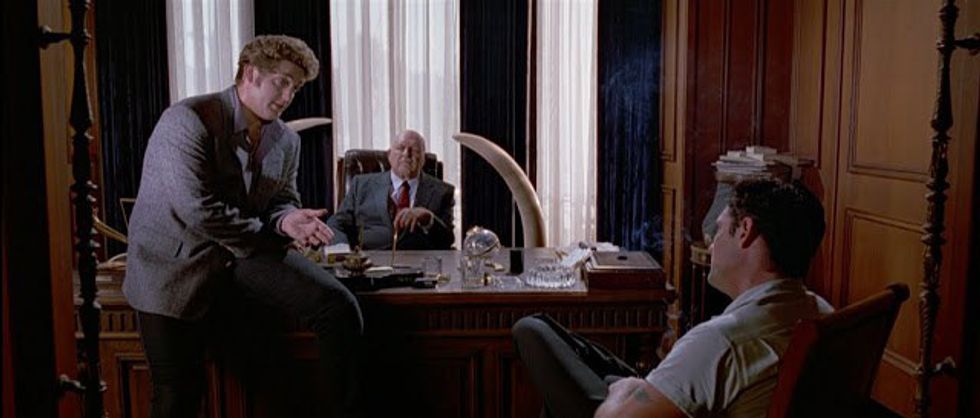 Consistent of a hierarchy; from Leaders/Kingpins to delegated “captains” to street soldiers and everything in-between.
From this picture from a scene in Reservoir Dogs, the hierarchy is relatively clear: Joe Cabot (seated behind the desk) is the leader, almost Godfather-esque; Nice Guy Eddie, Joe's son (sitting on the desk), acts as a captain--a sort of supervisor-- for Joe's criminal syndicate; in the chair, Mr. Blonde (revealed in this scene to be Eddie's life-long friend, Vic Vega), acts as an executor, essentially what would be a street soldier in a gang.
A group of individuals who commit criminal acts for themselves, each other, and the general group, as well as its hierarchy
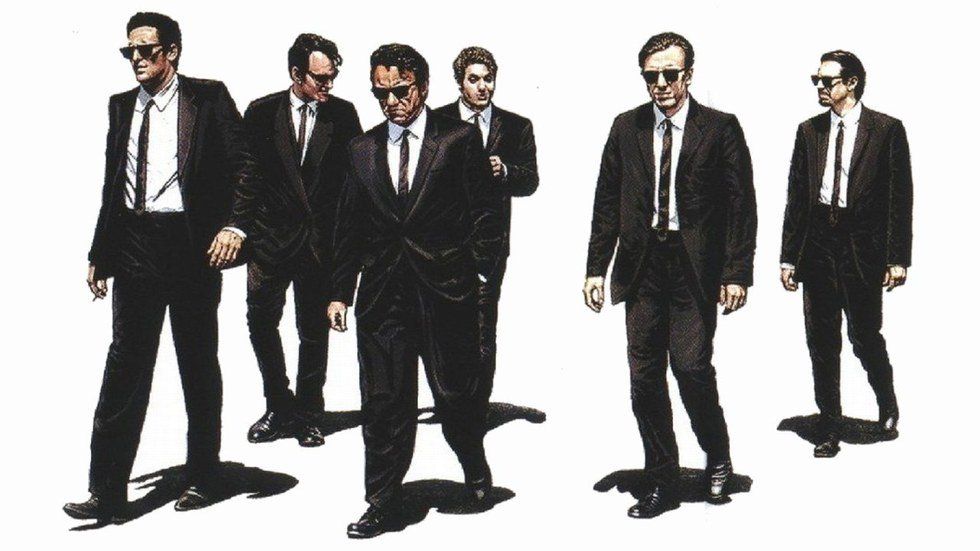
In Reservoir Dogs, the group of men pull a heist, stealing a large shipment of expensive diamonds from a jeweler. Like many street gangs, everyone gets a cut of the payoff, with the highest superiors making off with the largest cut. In some street gangs, however, the participants in the crime would take nothing, but the superiors will take care of the lower-level members with living arrangements, food and drink, partying, "off-duty" drug and alcohol use, clothing, jewelry, vehicles, weapons, and even prostitutes, among other things.
Rely on each other and each other’s criminal acts to live and survive
Have their own, typically unwritten laws
In Reservoir Dogs, the participants of the heist are requested to never reveal their names to anybody. The only two people allowed to know names are Nice Guy Eddie and Joe Cabot, who handpick the participants themselves.
Street gangs on the other hand, may require that members wear only their gang's colors, commit crimes against only rival gangs, and to never assist in any law enforcement investigation, among other unwritten lawss.
Are not “contracted professionals”
Unlike the group in Reservoir Dogs, who are, basically, contracted professionals, members of street gangs are not typically requested by a superior to participate in one big crime, earn a big part of the money, and then lie low for a long time until they feel the need to participate in another crime.
Members have taken some sort of oath and/or participated in a canonization for membership
It is unclear, but it could be assumed that in Reservoir Dogs, the members had gone through some sort of process in order to have gained the trust of Joe Cabot. Mr. Orange (revealed later in the film to be an undercover detective) only needed to talk his way into joining the group for the heist. Rights of passage may have been different, but it can be inferred that each member had a criminal record and a mutual respect with Joe and Eddie Cabot.
In a street gang, members often need to fight their way in and/or commit a felony, in order to gain the trust of their superiors.
In organized crime, a member may have to fit a long list of criteria and take an oath. For example, members of La Cosa Nostra (the Italian Mafia), swear by the Oath of Omerta, a code of silence, punishable by death if broken.
Live together as a sort of community or a community-within-a-community
Often, gangs "own" a neighborhood; even large pieces of cities. In other words, gangs run certain territories within a community. Many people who live within those territories are either part of the gang, family of a gang member, or are, in some way, entrusted with keeping quiet about gang activity, whether by payment or threat.
Are symbiotic and/or commensal (to some extent) in relationship
To further explain, a gang’s upper hierarchy hardly, if ever, parts, negotiates, or empathizes with or for its own members; if a member does not want to “live the life” there are often negative repercussions for that member, which could be anywhere from a beating, robbing, or murder of the member or their family/loved ones. As far as a gang’s symbiotic/commensal relationship, I mean that people join a gang for a multitude of reasons, whether it be protection, a source of income, a “family,” or the possibility that they were forced into it somehow. These people, in a manner of saying, leech off the gang, while the gang itself leeches off its members, especially street soldiers. The members join for personal gains, the gang uses them to stabilize their turf, expand their turf, bring in more money, et cetera. In larger gangs, members don’t very much care for the upper hierarchy, because they simply do not know them, but will still be loyal to them and their closer community of gang members; meanwhile, the upper hierarchy does not very much care for a simple, low-level street soldier- that is, until they do something worthy of note to them. In some regard, gangs are mutualistic, symbiotic, and commensal subcultures and communities.
Now, with respect to the film, Reservoir Dogs, the characters with colorful names are not quite gang members in the same scope of the definition I provided above. Instead, the characters acted as well-trained professionals, and neither of them seemed to actually know each other. Aside from “Nice Guy” Eddie Cabot and his father, the group of men seem more to be an off-shoot of a gang, as they may have their own “legitimate” lives outside their organized criminal activity. Perhaps the men are leaders of their own regimes within a greater gang, run by Joe Cabot and his son Eddie, that much is not quite clear within the context of the film. In that regard, sure, the men can certainly be considered gang members, but not so much in this particular plot.
The characters adhered to certain characteristics, which I listed earlier, including the establishment of a hierarchy, and the commission of crime together and for the benefit of themselves, each other, and the hierarchy. Again, it is not clear whether or not any of the colorful members took some sort of oath or canonization earlier on in their lives to belong to a greater gang or if they are simply contracted professionals for criminal odd-jobs, like the diamond heist depicted in the movie. They may, indeed, be contracted professionals, the whole lot of them, but that much is not known. The group does have their own written laws, which can be seen in their actual running-thru of the plot to steal the diamonds; Mr. White, most specifically, justifies the heist by telling Mr. Orange that the people inside will likely not do much to stop them because “they are insured out the ass,” and therefore can afford the major theft. Mr. White also reveals that assaulting people within the store is justified under certain circumstances, and it is to be done professionally, albeit criminal in nature.
In my opinion, the title of the film is indicative of the group. The men of the group are the “Dogs” and they belong to a “Reservoir,” in that they are at Joe Cabot’s disposal to organize and direct in criminal activity. They may not be a gang in the ordinary sense, nor under my own definition, but they exhibit certain characteristics of a gang and the behavior of gang members. The “Dogs,” much like the average family’s pet dog, will listen to and act on commands of their masters, or, in this case, their leaders, Joe Cabot and “Nice Guy” Eddie. The “gang” depicted in the film could be defined as a “covert operations” gang, in that they are insured not only by carefully-planned, relatively swift “jobs” (most probably typically major heists like the one depicted in the movie) in which they are very unlikely to be identified by witnesses, and will likely be out of the area before law enforcement could catch anyone, but they also do not know each other, and are told not to reveal any personal information in the case that there may be a “rat” or a turncoat amongst the group at any given time. This also contributes to the characteristic that they have their own internal laws and guidelines, and therefore contributes to the argument that men may be, at least loosely, considered a gang. Only “Nice Guy” Eddie and Joe Cabot are constants within the group, and adhere almost entirely to my definition of what constitutes a gang. At the same time, Mr. Blonde (Vic Vega), actually did time in prison and denied a nullification of his charges in order to protect Joe Cabot from an indictment which could have destroyed the assumed gang he runs.
So, in short, I believe some characters in the film exhibit a great deal of gang behavior, where others exhibit much less. Do I believe that the group depicted in Reservoir Dogs is, indeed, a gang? Not entirely, but I do believe that they could be considered a professional “covert operations” style of gang, if anything at all.