


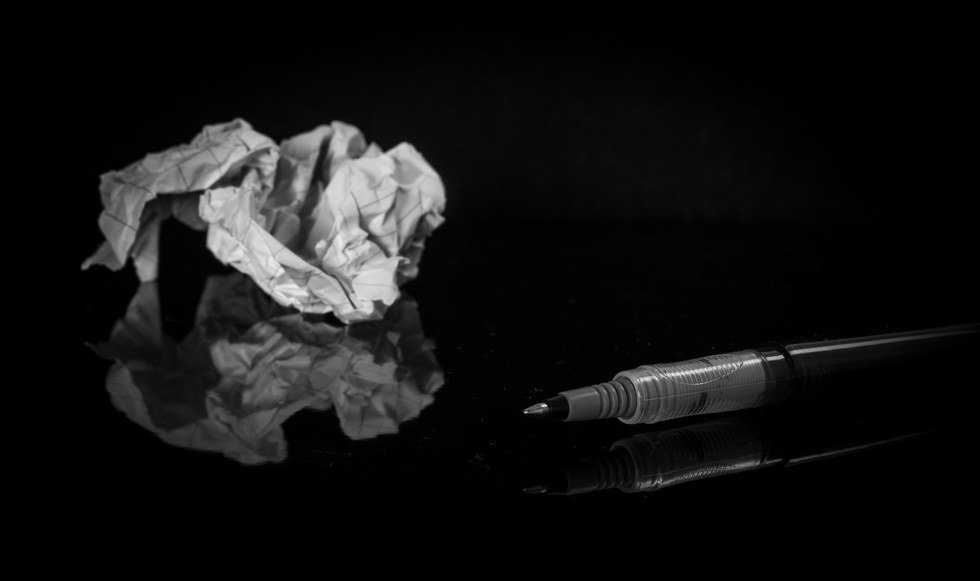
There comes a time in every writer’s life where they’re just staring at a blank page. The lines on the paper seem to scream for the ink of the pen, but nothing. Fingers dance along the keyboard, but nothing escapes the ends. Every so often though, the mind’s lightbulb flickers to give hope of a creative vision…. Then just as soon disappears with the ghost of its story.
Once upon a time…. No, that won’t work.
There once was a brave knight…. Garbage.
The flow of the creativity current is blocked when a common enemy makes its way into a writer’s path: Writer’s Block. This natural occurrence is a fiend that many face when attempting to conjure up a story, an essay, or an article. The disease it causes leads to the cease of words on the page, resulting in an abrupt halt in the writing process.
I think that one of the most common causes of writer’s block comes when the author, writer, or poet is simply just writing to impress their audience. If you are writing with the only intention to gain the approval of someone, you will forget what you love to write about. Your passions won’t become your own, but the audience’s. With this mindset, you will constantly be perfecting your ideas and throwing out original creations that you believe to be great.
Sometimes finding inspiration can be like searching for particles in the sunlight. You can see them, but how do you get a hold of them? Writer’s tend to think that the things they contribute to the world have to be awe inspiring, or have to impact the world in a way it hasn’t been touched yet. This is inevitably another great problem that contributes to writer’s block.
Yes, the main reason we write is for the audience, and of course we all want to write something that will forever be embedded in the world’s history of literature. But when we forget our enjoyments and separate ourselves from our passions, our works can become meaningless to not only ourselves, but the audience.
“Writing is something that you don't know how to do. You sit down and it's something that happens, or it may not happen. So, how can you teach anybody how to write? It's beyond me, because you yourself don't even know if you're going to be able to. Sometimes I'll sit at that typewriter for fifteen minutes, you know. I don't go up there to write. The typewriter's up there. If it doesn't start moving, I say, well this could be the night that I hit the dust.” -Charles Bukowski
The typewriter is never going to type its own story, and the pen will never write its own sentence. It is up to us though to gain the momentum to push past our writer’s block and enter a world of our own where we will type to our heart’s content. So, let’s take a second to remove the block that our audience has placed, and focus on our own passions for writing.















