
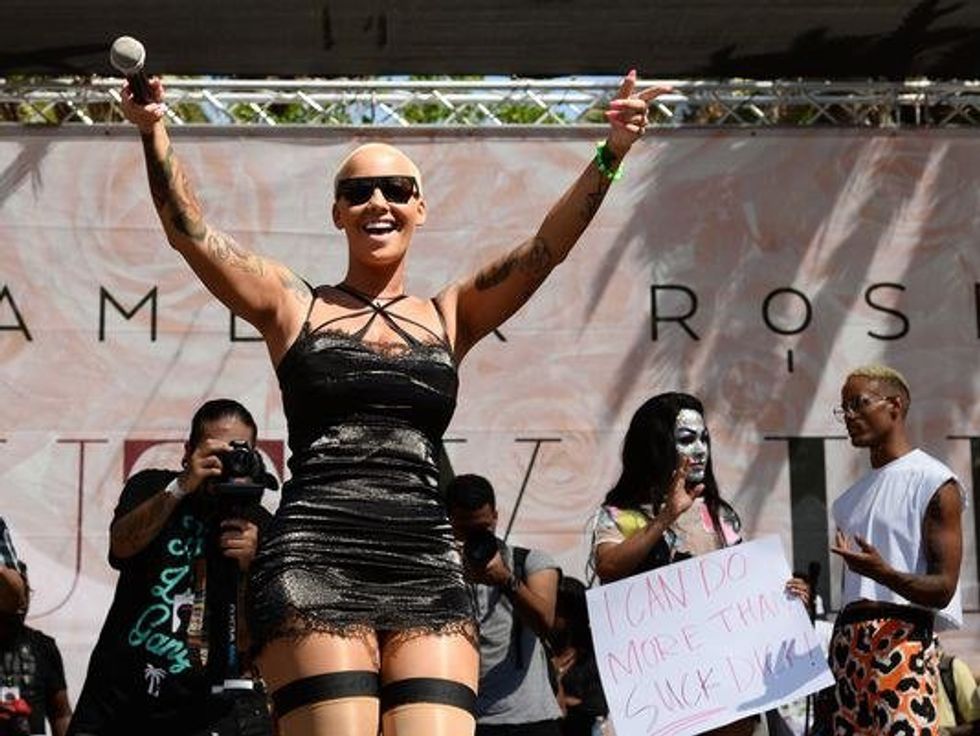
On Oct. 3, 2015, Amber Rose, an actress and model well known for her celebrity relationships, hosted a Slut Walk in Los Angeles, California, in the Pershing Square. It started at the intersection of 7th and Olive Street. This walk has been occurring since 2011, "after a Toronto police officer told a crowd of college women that if they wanted to avoid sexual assault, they shouldn’t dress like sluts." Such language often causes victims of sexual injustice, victim blaming, derogatory labeling, and gender inequality to avoid seeking justice and feeling comfortable with themselves.
Many have debated Muva Rose's, Amber Rose's nickname of social media, recent campaign because of the way in which the actress has gone about making the movement known. Ms. Amber was dressed in an all black lingerie outfit carrying a sign that read "Strippers have feelings too", and her participants chose to wear what they pleased, which may have included a little to nothing at all.
A singer-songwriter by the name of Gabby Mooney expressed her disagreement with the movement on Facebook, stating, "This #amberroseslutwalk is a shame. Instead of it being about defending rape victims...it's turned into these crazies wanting to b topless. So what they are saying is that we should all walk around naked and that'll prevent rape? I'm sorry...but I'm confused. Maybe we should teach boys to respect women, instead of women degrading themselves? That's an idea." While on the other hand, people like me, who support the rights of women and recognize double standards worldwide, would most likely disagree with Mooney for multiple reasons, which include:
1. WE HAVE THE RIGHT TO OUR OWN BODIES.
We all have the right to our own bodies, yet that is often altered or "controlled" through our families, the law, and medical restrictions. Women are often the most criticized for their appearance and the choices we make with our bodies. According to Amnesty International, we all have sexual and reproductive rights that include the right to make decisions, seek and receive information regarding sexual activities/conduct, decide whether and when to have children, have access to safe abortion, have a choice of our intimate partner, and to live free from any sort of discrimination.
2. EMPOWERMENT OF MARGINALIZED GROUPS IS NEEDED.
The definition of a marginalized group is a group that has been placed in a powerless or unimportant position in a society or a group. All groups of people can be marginalized depending on the setting or condition. For example, men can be marginalized in a room full of feminist women. Those of the #LGBTQ community can be marginalized in a room full of discriminatory heterosexuals. Blacks can be marginalized in an office that is predominately white, and so forth. Therefore, we all deserve equal opportunities and treatment no matter our preferences, outlooks, or desires of expression.
3. WOMEN ARE NOT THE PROBLEM;SOCIETY IS.
The role of women and our importance has been of great debate since the beginning of time. We have had to fight for our rights since 1848, with the Women's Rights Movement that didn't end until 1920, when the 19th Amendment to the constitution was ratified. Women, particularly white women, were granted the same rights of citizenship as men. Since then, the value of women and the rights we have as a whole have continued to be under debate in this patriarchal society. We live in a "man's world," but that's quite intriguing when women are who continue life upon this Earth. Right?
4. SEXUAL INJUSTICE IS VERY COMMON ON COLLEGE CAMPUSES.
Rape is the most common violent crime on college campuses. 1 in 4 college women will be the victim of sexual assault in her academic career. Solving these sort of cases is the hard part since students are afraid to speak up if the suspect is someone they know/trusted, the process is dragged out, or she is looked at as a the reason for her attack. The issue reflects on the insensitivity most campus officials show when dealing with cases of this nature.
5. GENDER INEQUALITY IS STILL RELEVANT.
One of the most recent examples of gender inequality is the report of gaps in pay for men and women who perform the same job. In 2014, women working full-time in the United States typically were paid just 79 percent of what men were paid, a gap of 21 percent, according to AAUW.org.