


“Everyone’s a feminist unless it comes to Taylor Swift” is a phrase I’ve seen floating around social media for the past three to four years. But it’s not a completely accurate statement. Why? Because if your feminism doesn’t extend to Taylor Swift, then it isn't being extended to people who need it more than she does.
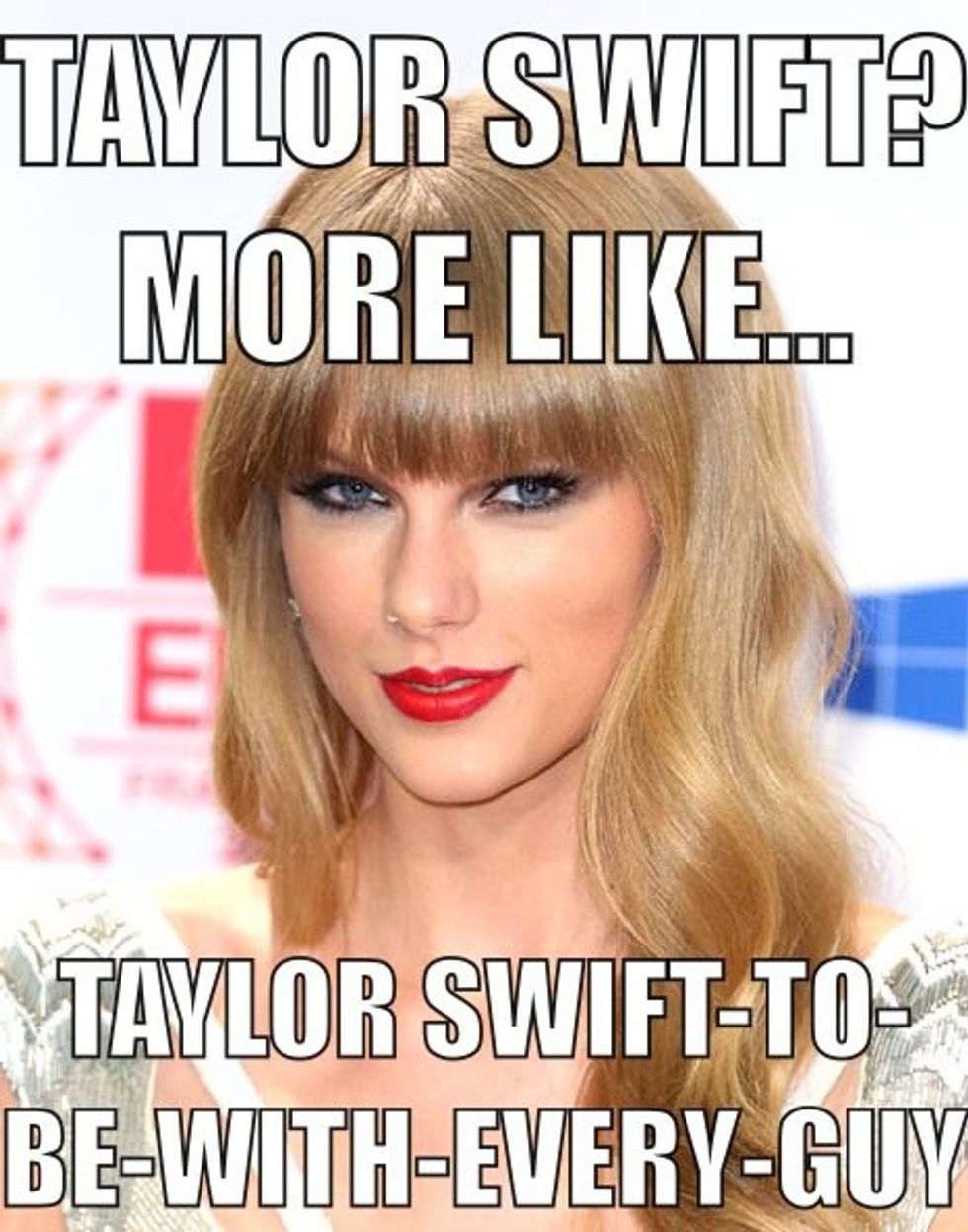
One of the many obstacles women continue to face is objectification. The concept of objectification is spread and internalized through mass media, especially in advertising. More often than not, this objectification is sexual. It's rather easy to sexualize and ridicule someone when they aren't perceived as a human being. The intensity of objectification a woman will face in their life is based on their characteristics – race/ethnicity, gender identity, sexual orientation, and social class, to name a few.
Yes, it’s true that women like Taylor Swift–who are cis, able-bodied, wealthy, and white–don’t stand to gain much from feminism simply because they are already privileged. At least, they are here in the United States and other countries where they constitute the majority. So what’s the big deal in shaming her for her love life? What’s the big deal in laughing about her sexual assault case (the origin of the "Taylor Swift will sue you" meme)? She’s doesn’t have much to lose from people making crude comments about her, right?
Wrong. Slut shaming in any form contributes to rape culture which impacts all of us.
Slut shaming, according to the Oxford Dictionary, is “the action or fact of stigmatizing a woman for engaging in behavior judged to be promiscuous or sexually provocative.” Make note of the fact that it’s behavior that is judged to be promiscuous or sexually provocative. No factual or common sense basis needs to be evident in order for slut shaming to take place, which allows it to be justified in any context. There is no safe space – any place can become the scene of slut shaming.
 (Photo credit: Pinterest)
What does slut shaming–and sexual objectification–have to do with sexual assault?
According to the Oxford Dictionary, sexual assault is “the action or an act of forcing an unconsenting person to engage in sexual activity; a rape; (Law) a crime involving forced sexual contact, variously defined as inclusive or exclusive of rape.” Despite America's status as one of the best countries to live in, an American is sexually assaulted every two minutes in the United States. One in six (16.6%) women will be sexually assaulted in their lifetime, as well as one in thirty-three (3.03%) men. For transgender people, the risk is even higher at 21%. And these are based on current stats, which are an underrepresentation because the total number of sexual assaults is unknown.
A study by the American Psychological Association researched the effects on women of sexual objectification theory, which "postulates that many women are sexually objectified and treated as an object to be valued for its use by others." Sexual objectification was found to be a regular occurrence for many women, which often led to psychological "self-objectification, habitual body monitoring, body shame, internalization of the thin ideal, lowered introceptive awareness, and disordered eating among both lesbian and heterosexual women."
Here's a segment of the findings:
"...many women
also experience more extreme forms of SO via actual sexual victimization
(i.e., rape, sexual assault, and sexual harassment; Fredrickson & Roberts, 1997).
For example, research indicates that one in four women have been victims of
rape or attempted rape, and more than half of college women have experienced
some type of sexual victimization (Fisher, Cullen, & Turner, 2000; White,
Donat, & Bondurant, 2001). Females’ self-reported experiences of sexual
victimization are related to more self-objectification and body shame (Lindberg,
Grabe, & Hyde, 2007) and adverse psychological outcomes, including depression
and post-traumatic stress disorder (for reviews, see Fitzgerald, Drasgow,
Hulin, Gefand, & Magley, 1997; Koss, Bailey, Yuan, Herrera, & Lichter,
2003). The intersections of gender with other sociocultural identities may
place some subgroups of women at increased risk. For example, several studies
have found that sexual minority women report more experiences of sexual
assault in adulthood than their heterosexual peers and that the majority of
perpetrators are male (Balsam, Rothblum, & Beauchaine, 2005; Moracco,
Runyan, Bowling, & Earp, 2007; Tjaden, Thoeness, & Allison, 1999)."
Sexual objectification is a fundamental contributor to rape culture. Slut shaming is an exercise of sexual objectification and therefore normalizes its toxicity. When someone slut shames, they are perpetuating this normalization.
So why is slut shaming still acceptable when it contributes to a culture ridden with sexual assault? And if slut shaming is as normalized as sexual objectification in the United States, how can we expect the rest of the world to do better?
The United States is the most influential country in the world. If Americans fail to treat women well, then the rest of the world will watch and imitate. Progress is already being threatened with the election of Trump. Already our voices and agonies are being rejected, as the treatment of his accusers indicates. The jokes and off-handed comments aren't worth the normalization of a culture so persistently insidious and easily denied.
So next time you think about slut shaming anybody, whether it be Taylor Swift or another person, ask yourself:
Is it worth perpetuating rape culture for the sake of a few laughs, likes, or retweets?