
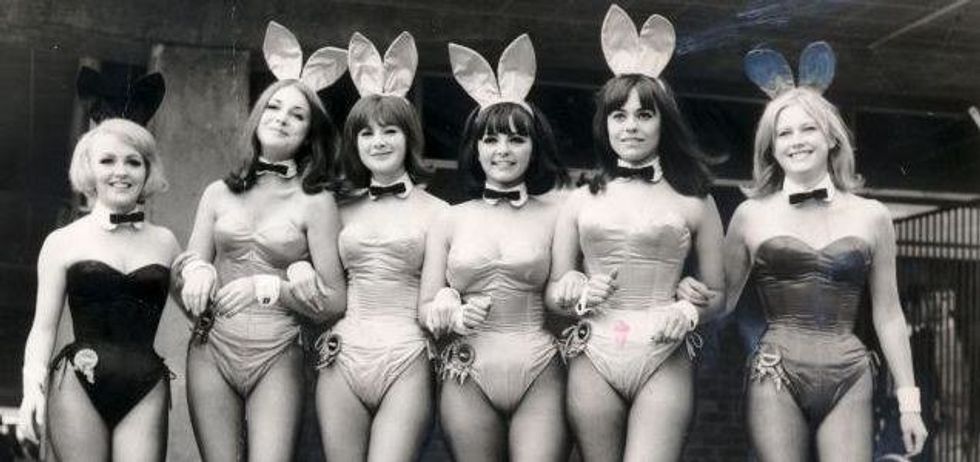
In October 2015, Playboy made headlines when representatives announced that they would be committing an act contradictory to the iconic magazine’s longstanding purpose. As of March 2016, Playboy would no longer be publishing nude photographs or centerfolds.
Many questioned this business act; how does a publication built around and upon showcasing the nude female form suddenly ditch it’s plastic covers and put pants on?
The classic publication was first founded in 1953 by Hugh Hefner, who was then only 30-years-old and living in Chicago. He had not yet adopted his signature bath robe look.
The first issue came out in December of ‘53 and featured Marilyn Monroe as the first beautiful cover girl and busty centerfold. The magazine would go on to emerge as a cultural symbol and its silhouetted rabbit logo would become among one of the most recognizable, within the likes of Pepsi or Nike.
Even family films such as “Home Alone” and “Adventures in Babysitting,” featured scenes with a subtle reference to the mag, a comment on its cultural power. Circulation for the magazine peaked in the 1970s and the running joke and assumption became that every college man, businessman and working man (and sometimes even young man) had a secret stash of Playboys or a coveted copy pressed between his mattress and box spring.
The highest selling issue was in November of 1972, with over seven million copies sold. In 1994 Playboy.com was created, and the bunny empire only continued to grow with clubs opening across the country, licensed products and a notorious mansion.
However, Playboy was anything, but just a picture book of full frontal and breasts. The magazine was also known for its long form journalism articles, particularly its interview section. You've heard sitcom characters defend their stash of nudie mags by claiming they "only read 'em for the interviews," and this is not invalid! Over the course of its more than 60 year run, the magazine has featured interviews from many notable celebrities and figures including Martin Luther King Jr. (Jan. ’65), Steve Jobs (Feb. ’85), Jimmy Carter (Nov. ’73) and O.J. Simpson (Oct. ’03).
Today, according to The Washington Post, the Playboy Empire receives the majority of its earnings from licensing than the magazine itself. As reported in a New York Times article, “Playboy’s circulation has dropped from 5.6 million in 1975 to about 800,000…according to the Alliance for Audited Media." However, “detailed figures are not kept for adult magazines.”
The decision to get rid of nudity was decided largely in the hopes that revamping the magazine would help sales and readership by attempting to change its target audience and appeal to millennials in the 30-year-old age range, as opposed to the massive 18 to 80 age gap it encompassed before. Getting rid of nudity also allows for the once NSFW publication to move from the back row for adult magazines to be next to other similar SFW male magazines such as Maxim and GQ.
According to one report, “web traffic quadrupled after the use of clothed models for the site.”
Among the removal of nudity, Playboy also has ended their popular jokes section, discontinued certain cartoons, expanded the centerfold into a pictorial shoot, and now prints on higher quality paper.
In an era where naked images and porn are easily accessible online for free with a simple click, it’s difficult to exclusively sell sex in a magazine form anymore. (It should be noted however, that Playboy does still offer nude photos and pictorials for members of its Playboy Plus club – at a price of $9.99 a month -- $2 more than the magazine’s newsstand price.)
So How Does the New Playboy Stack Up? A Brief Content Analysis
Armed with the knowledge that I wouldn’t immediately be greeted by a set of knockers upon peeling back the cover, I decided to read the new revamped issue.
The content of the magazine that I focused on the most can be divided into three sections: photos, articles and advertising.
The cover features a scrubbed minimalist look with only the title across the top and a Snapchat style photo. The model’s outstretched arm makes the photo appear as if she is the photographer and taking the picture on her phone selfie-style. The rest of the photo shoots featured expand upon this intimate take and provide the reader with an almost boyfriend-like perspective of the models with soft lighting and lazy rumpled bedsheets and steamy showers as backdrops.
For example one photo is taken from behind the model as she lays in bed and stares toward the window; it’s the kind of view and glimpse of her curvy silhouette that you’re only going to get if you roll over and wake up beside her in bed—the boyfriend perspective. The models’ private parts are covered up, yet they are still suggestively posed and the lightening, carpet (hello, shag), and (rare) clothing choices all allude to a 1970s vintage feel. The models are all young and their bodies display a natural, non-plastic-surgery induced look. A far cry from the stacked babes of issues past. Despite the lack of real nudity (other than a few butt cracks and side boob from women) the few cartoons displayed are crude and graphic in style and do still show anatomical representations.
The articles are still on an eclectic collection of topics from alcohol, movies, fiction pieces, politics and style. The interview section is also still intact with a notable public figure and are written in a lengthy style feature. Some changes include the addition to a column by James Franco (perhaps an attempt at star power to entice potential readers?) and a new female sex columnist named Rachel Rabbit White (yes, that’s her real name) to provide an enthusiastic female voice and commentary on sex. There is also an article on facts about nudity and a feature on modern sexuality, both relevant topics on the overhauled publication.
However the most interesting detail, lies in the advertising. The advertisements feature a tongue-in-cheek humor about the magazine’s removal of nudity and interact with the reader in a sort of meta- fashion. The first ad by Dodge uses vehicles as censor banners over woman (headlights over breast and the car’s rear over another rear) and uses the tagline, “the spirit lives on.” Another ad of a bottle of Evan Williams Kentucky Straight Bourbon Whiskey promotes, “we haven’t changed a thing.” Perhaps the scene stealer of advertisements, though, is the one on the back cover that shows a bottle of Stoli Vodka without the cap on and the tagline, “the only topless photo in this issue” making the magazine’s self-awareness about its changes a bit more witty to the reader and less apologetic.
So far, the April and May issues that followed March's initial nudity-free content followed similar patterns with more 1970s feel pictorials and less cheeky-toward-the-nudity-removal advertising. The last page from each issue also ends with a photo from the vintage Playboy era; a nod to the past while the new magazine’s format streamlines into the future.
Readers, fans and critics of the magazine will have to wait and see how the changes affect the magazine in terms of sale and readership and who know, maybe they’ll have to bring back a special edition nude centerfold issue someday. Until then, the bunnies are donning more than their trademark ears and tuxedo cuffs and readers are finally tuning in for “just the articles.”