


There are many assumptions made because of race that may be true in some cases, but are mostly false. Things such as the negative stereotypes that all Asian men have small packages, or that Caucasian individuals are privileged, or that African American's have a higher chance of being illiterate and dumb, etc. The list goes on and on. Obviously most of these are statements which sensible individuals would find ridiculous. But one assumption that could be made about all races (that couldn't be more untrue) is that individuals aren't interested in others that are outside their race. The dating app Coffee Meets Bagel is stated in the article "The Dating App That Knows You Secretly Aren't Into Guys From Other Races" by Kate Notopoulos to believe the assumption that individuals would prefer to date within their own race.
The article gives examples of individuals who put "no preference" on the individuals they would possibly want to date but end up getting only people of their own gender when they would like to meet individuals of all genders. The reason for this, according to Coffee Meets Bagel, is that "our data shows even though users may say they have no preference, they still (subconsciously or otherwise) prefer folks who match their own ethnicity. It does not compute 'no ethnic preference' as wanting a diverse preference. I know that distinction may seem silly, but it’s how the algorithm works currently." Down below is an image of the data collected from men who only preferred one race.
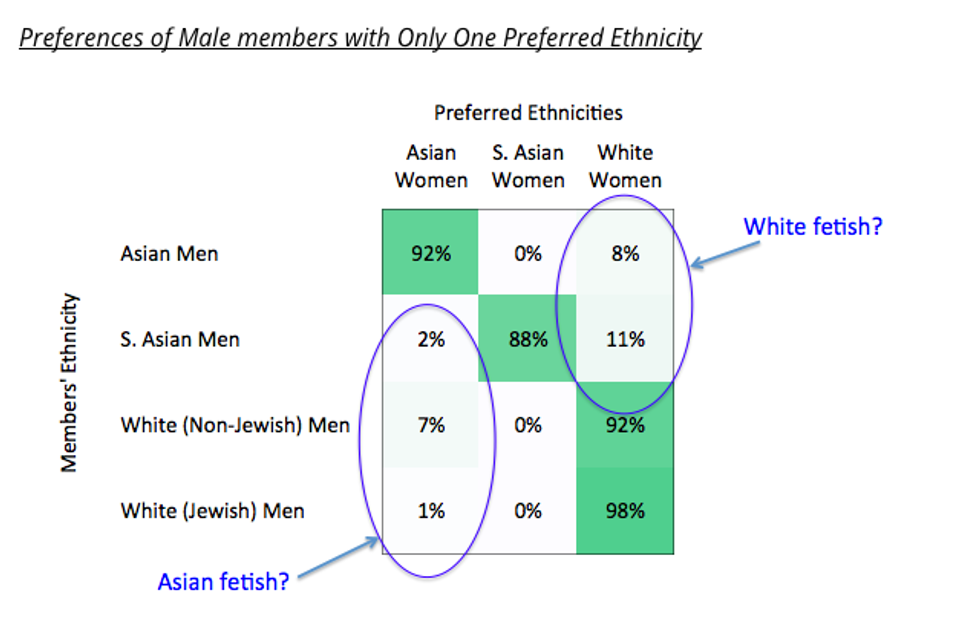
Naturally, going off of just this data Coffee Meets Bagel would assume individuals prefer their own race. But the data shown gives little details, such as how many men were included in the collection of data. It could very well be a very small number, providing insignificant and incorrect data to work off of.
This kind of subtle racism is seen in other dating sites, and also seen in some individuals belief systems. I can personally say very confidently that I tend to like males from other races than my own. Everyone has their own preferences, but the fact that such large scale assumptions are made may offend many. Should we be more concerned about this underlying racist algorithm, or is it so insignificant that it no longer matters?
It's always interesting to see where in the world we still find racism. Some places are unexpected. Although this example is not too extreme, there are many cases in which racism is unacceptable and needs to be addressed. It is an issue which has long been a major concern and will continue to be. Even if we feel that we have progressed, will there always be these tiny alcoves where racism hides?
Although I provided some background information of the article, there is still more to know. If you are interested in learning more of the details, here is the link! http://www.buzzfeed.com/katienotopoulos/coffee-mee...

















