With the recent opening of the third installment in "The Purge" series released this past Friday, my mind has began to wonder why movies like this have haunted and disturbed audience members to their core. As I re-watched the first movie, which premiered almost three years ago now, I was not any less shaken when the credits flooded the screen than I was the first or second time.
For those of you who have never seen "The Purge" or understand what it's all about, let me give you a quick overview. In this social science fiction thriller, "New Founding Fathers of America" have rescued a collapsing nation by installing a civil cathartic Purge. Occurring March 21 and 22, all crime, including murder with Class 4 weapons or lower (so excluding bombs, grenades and bazookas) is legal between 7 p.m. and 7 a.m. the following morning. Police, the fire department and all medical personnel are unavailable during these hours. While the outcome of the Purge involves unemployment rates dropping to 1 percent, low crime and a strong economy, one has to ask at what cost are these seemingly desirable effects won?
The Purge is said to do so much good, however it is a way to control the population. There are so many in the nation who aren't able to afford proper protection, including so much as even a house. The Purge effectively takes out the lower class and homeless population, leaving a upper and middle class with low crime rates. These lower classes are seen and presented in the film as parasites and people who are useless to society, therefore the Purge is sold as the perfect way to "better the nation."
Now, while there is gore and heavy suspense, those two are only the building blocks of what makes this movie so terrifying. It stays in people's minds, first and foremost because it demonstrates the fragility of life. With one gun shot, one stab of a blade, memories, thoughts, feelings, an entire life is thrown away. Audiences can't help but leave the theater reminded of how precious their own lives are and just how easily they can be taken away.
To me, however, the scariest part of the entire film is the fact that the people, particularly in the first "Purge" movie, that attempt to commit these savage crimes are just normal people. They are not thugs or drug dealers, but apparently Ivy League students and upper-class neighbors and "friends" of the main characters of the movie. These people aren't scraping to get by, but instead thriving and enjoying some of the finer things in life. This acknowledgement points to the fact that when given the chance, human nature will in fact "release the beast," regardless of class, race or gender.
I am reminded of the novel "The Lord of the Flies" by William Golding, in which innocent school boys wash up on an island and are forced to learn to survive. The boys faction off into groups, and by the end of the novel have regressed into creatures so much darker than the reader could've imagined. These same boys who once wore coats, shorts and drank tea together become animalistic as they hunt, crack skulls and brutally murder animals and each other. This novel reflects on the idea that in their most basic sense, and under the right circumstances, humans can and will shatter expectation and will regress to a darker, more violent aspect of human nature.
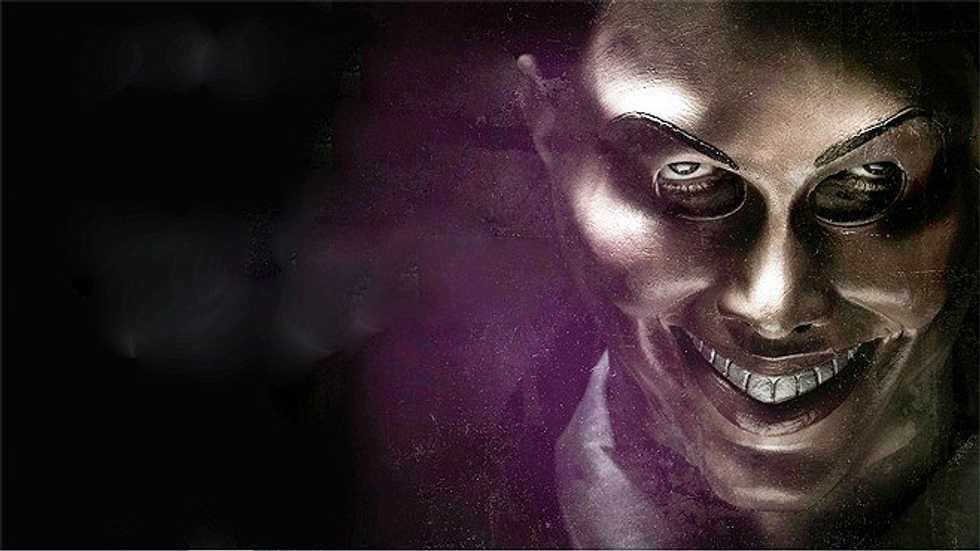
So, that being said, it is not the immediate threat of danger, the blood, the people popping out or the scary masks that terrifies the audience, but the fact that this darkness is living in every single one of us. This darkness lives in your family, your group of friends and neighbors, and in fact, could emerge at any point without warning.