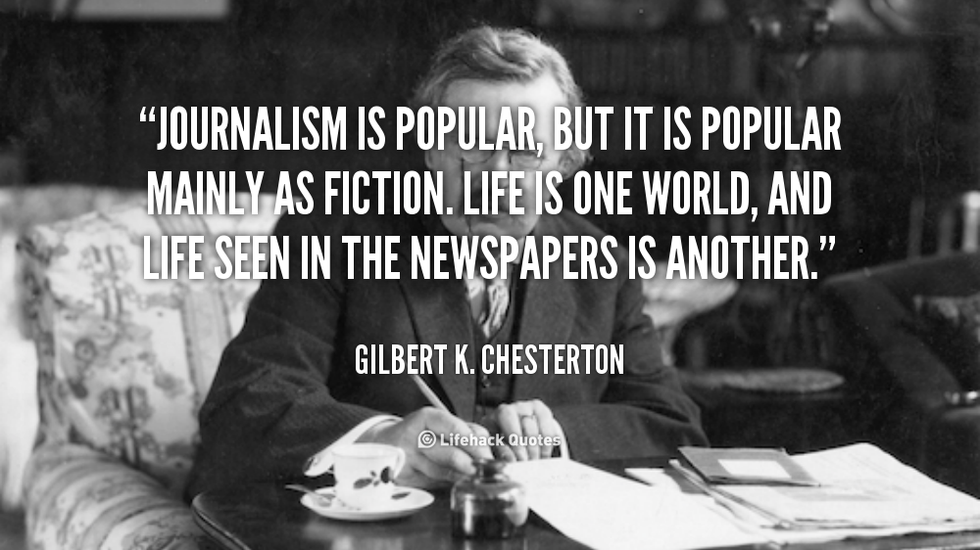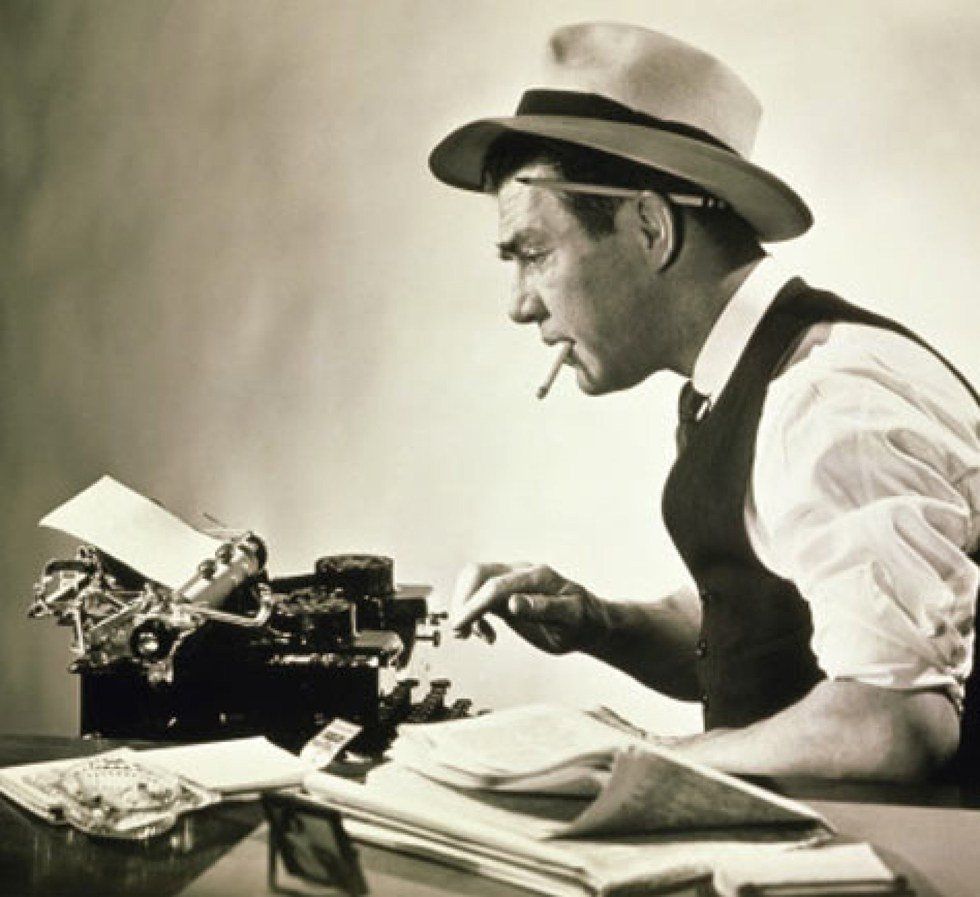
More often than not, the most favored option is not necessarily the best. Yet, these days, popularity usually wins out against reason.
Websites and news sources like Buzzfeed and Cracked have made an explosive rise in standing over the last three years since they began using web videos as a primary means of broadcast. According to expandedramblings.com, Buzzfeed boasts a DMR average of over 175 million daily visitors to their website as well as their pages on YouTube. Most of this traffic consists largely of college age students, for some as their primary means of a news source.
I sat down with long-time writer/editor Richard Meyer, renowned for his work and achievements in the writing world, and discussed the merits and detriments of the constantly evolving form of contemporary journalism. To put his input in perspective, Meyer's background spans over 50 years of experience where he spent 14 years at the Associated Press as a national news-features writer and White House correspondent, 28 years at the Los Angeles Times as a roving writer and piece editor, and is currently operating as the Senior Editor at Blueprint, a UCLA publication. Meyer has also won several awards including the National Magazine Award, the Sigma Delta Chi for magazine reporting, the Merriam Smith Award for deadline writing, the Worth Bingham Award, edited two Pulitzer Prize winning pieces, and has been a two time finalist of Pulitzer Award for his own articles.
The interview went as follows:
Ito: "So, Rick. Considering how much writing experience you have and all of your accomplishments, how do you feel about the change in medium from print to the internet for news publishing?
Meyer: "Well, I mostly go on official news sites and stay away from social media. That's not to say that 'official' means you have a statement in bold text that lists you as so, but I see it as both good and bad. The good part of using the internet is that there are so many more ways to access resources and contacts than how we used to do it back in the day. There is a wider audience, which means that significantly more perspectives and experiences can be applied at once."
Meyer quickly followed up with the claim that because there is a larger viewership, there has become a larger demand for publishing which has led to a diminishing of publishing quality. The question of accuracy came into discussion as we moved into addressing opinionated pieces.
Ito: "It seems like you have seen a lot of articles in your editing career that sort of push that boundary of what is acceptable in the eyes of the 'professional' journalism world. What would you say is the most important thing that a writer can do?"
Meyer: "As an editor you need to demand accuracy. The internet has sped up the news cycle that mitigates against simple mistakes that cater to one-sided arguments. There is a saying that goes, 'time is the enemy of accuracy.' When you are a competitor, a serious one, [if you] post first you'll get the eyeballs and the attention that you want. However, if you get it first, get it right! I see a lot less of that these days."
Ito: "What do you mean?"
Meyer: "Well, I mean that writers are human, they make mistakes. But if that happens, correct it publicly and honestly [sic]. An example would be the Hillary Clinton investigation mistake that happened recently. Some of the bad habits on the internet bleed into print during that headlong rush. That just goes to show you that even old writers make mistakes too [laughs].

Read about the aforementioned debacle via The Atlantic.
Meyer took a moment of pause and sipped his coffee to consider something to balance out what he had just stated.
Meyer: "I think that above all, a writer should show fairness. It is important to show all sides [of an argument] and include as much information as appropriate. Let the reader decide where they stand. You can trust your readers to decide who is right, but you need both sides to let them do so. A lot of it has to do with the tone of the piece. Most stories have sarcasm featured as a main part of the writing. It's like the amount of snark is as if being so [snarky] makes you smart, but it doesn't make you smart, it makes you a smart-ass."
Ito: "There seems to be a lot of that these days. It's hard to go a full day without seeing some news that is horribly skewed into a perspective while making fun of opposing views."
Meyer: "It doesn't need to be a serious tone all of the time. But if not, it needs to be genuine humor, not snark. Some websites don't do anything but aggravate. They just go out and seek what will get reactions and give all without any care of the results. It takes time. Get on the phone, do your research, be a real reporter."
The two of us continued to exchange examples of good and bad articles that we had read. I brought up Megan Crayne Beall's piece about marital engagement at a young age. He simply returned with this:
Meyer: "Just because it applies to your generation doesn't mean it's not significant. That's a personal and important piece. It's important for parents to know the values of their kids. They should read pieces like that."
Ito: "That's heartening to hear you say that. Okay, then let's talk about personal pieces. Do you have a problem with them? Why do you think there is so much appeal to readers my age?"
Meyer: "First of all, I'm not necessarily against them. It takes many kinds, you know what I mean? However, I think that it's because it takes less work to understand them [personal articles]. Top 10 lists are pretty straightforward, while pieces on Hillary Clinton requires concentration and analysis. It's not just your age group, mind you. My generation was in the Hearst Era and we had similar stuff. It doesn't take much to wrap your head around fluff pieces. 'Sensational stories' are purely sensational."
Ito: "What constitutes a 'sensational story'?"
Meyer: "It's a story with very little consequence in general. Like stories on the Kardashians, who have very little [real] effect on you and me."
Ito: "Do you think that people feel compelled to follow the Kardashians and other celebrities because there is a feeling of need to be like them?"
Meyer: [laughs] "Perhaps. I think you can attribute it to the 'holy sh*t factor'."
Ito: "Uhhh. . ."
Meyer: "The 'holy sh*t factor' is when you read or see something and say, 'Holy sh*t! How stupid is that? Yet there is still a desire to fixate on whatever drops out. You know?"
Ito: [laughs] "I see. So when exactly did personal pieces become okay to publish? Like Dear, Abby where peoples' personal stories would be shared on a very intimate level."
Meyer: "Advice columnists have been around for a long time. Hollywood gossip columnists have been around for a long time. Yet, it once again comes down to content and fairness that determines how acceptable the piece feels."
Meyer: "As for when, maybe about 20 years ago? Even the Los Angeles Times had personal pieces inching their way toward the front page. However, back then it was more stories about small towns with a then-versus-now comparison. That's what made it personal then. Those were good stories. They were about the change in the face of America, and that had significance."
Ito: "You seem to say a lot in every statement you make. In you opinion, what do you think can be done to change or stop the way that journalism has declined?"
He takes another sip of his coffee and flags down a waiter.
Meyer: "Things that I've written and were drawn toward are often heartrending. They're touching, inspiring, and meaningful [sic]. Modern writing is often self-indulgent. I don't think that you should eliminate popular subjects. We need to find a balance on websites, and in print, and find significant things. We can read them for warm, fuzzy reasons, to inspire emotions, to be informed. The reasons vary, but they need to be balanced with what is provided."
Meyer: "I am appalled by how much goes into publishing without real editing. Simply posting your own stories without that second or third set of eyes is bad. On the other hand, no editor should be inserting their own opinions or writing to a piece that is not theirs. In the end it takes experience and know-how to distinguish a good piece from the rest. It takes the desire to do better. It takes time."