


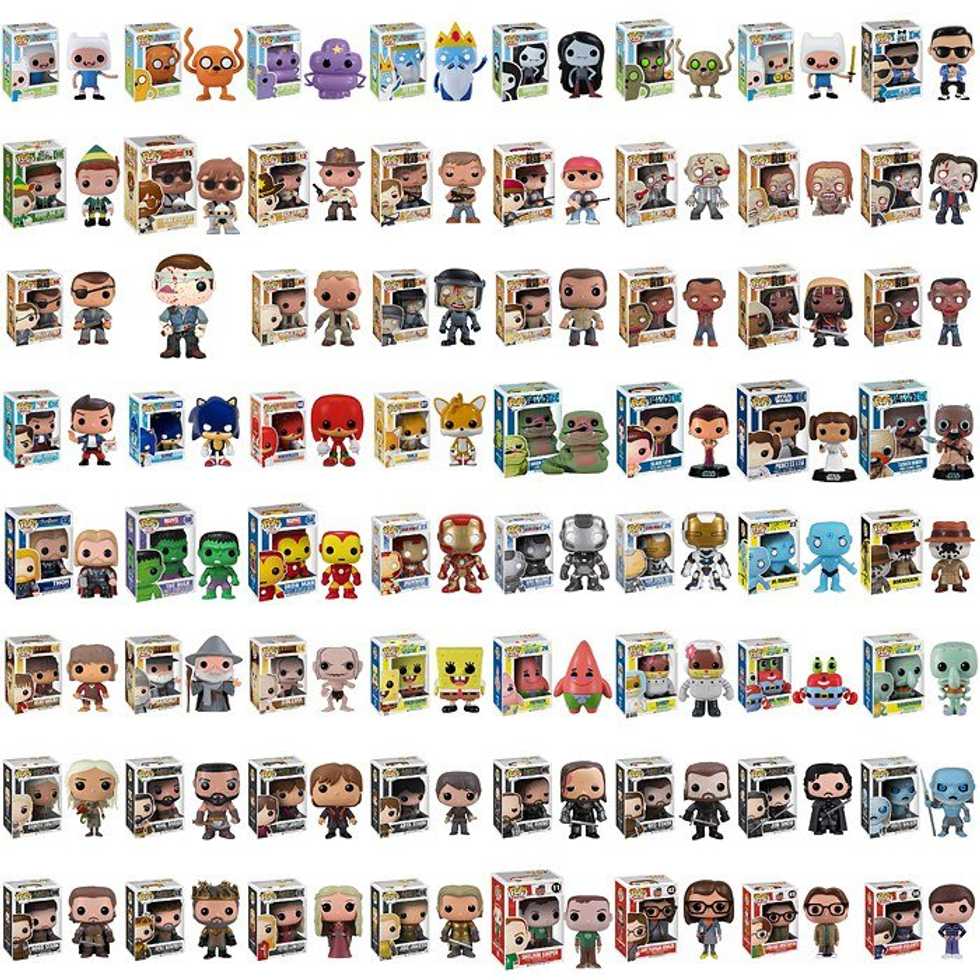
They're everywhere. In hobby shops, to big-box stores, to independent vendors online and at flea markets. The collectible Funko Pop line has without a doubt become one of the highest-selling items in the last few years. Virtually everything has been made into a Pop, from Star Wars to Beauty and the Beast to Tupac. If it exists in popular culture, you can almost bet there is a Funko Pop available. However, these vinyl representations of film/television/comic characters were almost considered a one-off product, maybe getting some distribution to the specialty stores. Within just a few years, Funko has evolved from a small licensed-based company to a massive, multi-million dollar corporation.
Funko
was established in 1998, when Mike Becker was in the market for a
bobblehead of the Big Boy mascot. When none was found for an
affordable price, Becker formed the company, producing items for
properties such as Dick Tracy.
Usually, it was just fast food mascots – simple PVC bobbleheads,
using his own money and his own time to craft each one. Oftentimes,
he would not be paid as much as he quoted, but continued to push
through, slowly gathering more and more licenses and increasing the
production from inside his garage to small factories. Over the next
decade, Funko slowly rose to power, spreading overseas for production
costs. Becker eventually sold the company to collector Brian
Mariotti, and he began trying to redesign the company and its
products. In 2005, Mariotti was looking into even further expanding
the company's product from just bobbleheads of pop culture. After
developing different ideas, Funko met with DC Comics in 2009, who
also agreed that the company needed a new look for themselves. Making
four “concepts” of Batman, Batgirl, and Green Lantern to sell at
the 2010 San Diego Comic-Con, the largest convention in the country,
Funko started “seeing a different group of people” stopping by
the booth, even though early response was less-than-perfect. The
company still held belief that the series could work, and worked to
spread out from just their two early designs. The “Funko Force 2.0”
line of vinyl figurines was given a new name, something easier to
remember and print – Funko Pops.
Later
that year, two major television programs debuted, and each production
had a deal with Funko. The Walking Dead and
Game of Thrones became
ratings giants, both continuing to this day. The Pops began selling
left and right – people wanted to own a tiny Daryl or a Ned Stark.
The DC Comics line also increased slowly, starting with six main
figurines. Despite a lukewarm reception at SDCC, the Pop line grew
exponentially. New licenses came in, including Star Wars
and Marvel, both of
which were full bobbleheads, unlike the connected heads of the other
lines. Disney also joined in, with Pops based off their iconic
princesses and Pixar films. Video game companies, musicians/record
labels, new films and television programs all jumped on the Funko
train. Ranging from main characters like Spider-Man and the Lone
Wanderer from Fallout 3,
to minor ones such as FN-2199, also known as “TR-8R” from Star
Wars: The Force Awakens, nearly
everything is produced in the Pop style. Within a few years, Funko
Pops were accounting for 75% of the company's annual earnings.
Just
recently, Funko released three Pops, for the upcoming Presidential
election – Donald Trump, Bernie Sanders, and Hillary Clinton all
are official Funko Pops. The Golden Girls
are hard to find, collectors asking hundreds of dollars for a set of
all four. The suggested retail price is just under ten dollars,
allowing collectors to easily fill shelves of something that they are
fond of. Even with some diffuculty getting to the big leagues, Funko
continues to produce Pops for SDCC and New York Comic Con. Only
instead of trying to sell four rough prototypes, they're making
chrome plated Stormtroopers. There is a Pop for everyone, and it does not look like Funko will be slowing down anytime soon.














