
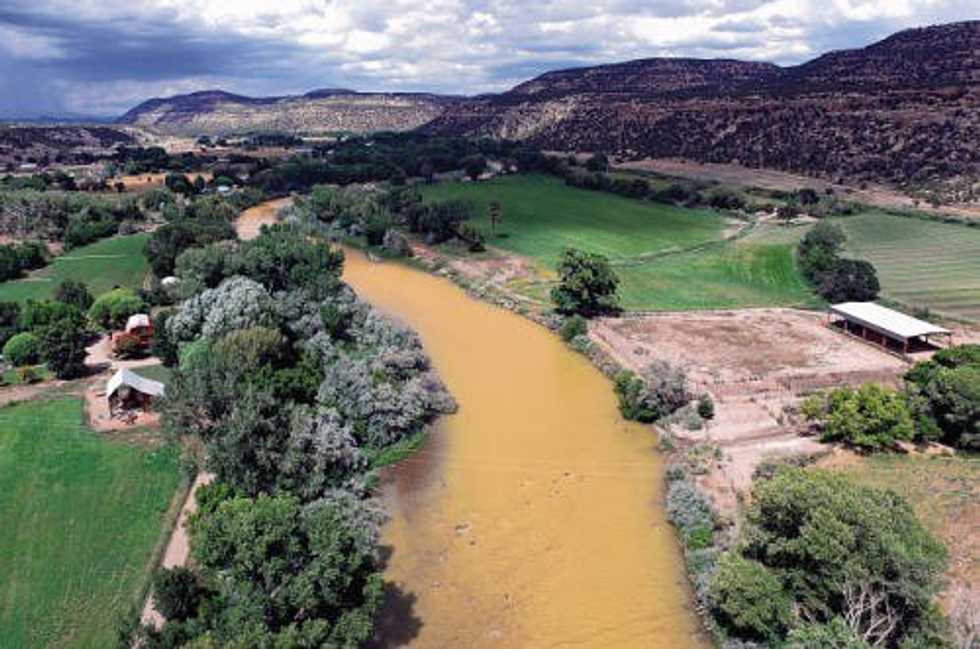
On Aug. 5, the Environmental Protection Agency (EPA) spilled three million gallons of chemical waste from an old gold mine into Colorado’s Animas River, which flows from Navajo Nation, Colorado, to New Mexico. The EPA is a federal agency dedicated to "protecting human health and the environment," and the waste spilled was equivalent to 19,984,172 pints of beer and filled with heavy metals like lead and mercury.
Gary Herbert, the Governor of Utah, said the accident was "preventable," and the EPA has taken full responsibility in a situation where the extent of the damage may not be known for years. The river is vital to residents, livestock, and crops alike and so, after Utah declared a state of emergency, panic was understandable among residents who rely on the river.
This is a complex incident with various repercussions and problems being tossed into both the general public’s interest and the political sphere. Besides the obvious or immediate problems like how to clean the river or how to get water to the residents, livestock, and crops reliant on the river, etc. we must also consider problems that arise on a broader horizon.
With the political scene buzzing in lieu of the forthcoming job opening for President of the U.S., Republican and Democrat candidates alike seek to have their voice heard on issues that they think may cause someone to throw their lot in with them. Republican candidate Dr Ben Carson slammed the EPA expressing his wish to fine them heavily for their mistake. Initially it may seem as though Dr. Carson is acting with environmental protection as his motivation, however would fining the EPA really make amends for the damage done?
After all, taking away money from the agency trying to protect the environment, despite its past mistakes, doesn’t seem a logical method for ensuring better protection of the environment and human health. Note that at no time am I making an effort to excuse the mistakes of the EPA, which I do believe need to be dealt with in some way, but I do not see sense in removing funding and still demanding a service. I think that the initial step should be to demand more of the agency. A revaluation of procedures and personnel could potentially lead to improved performance, which is what, I’m sure, everyone wants from the EPA.
Despite this, it’s easy to justify Dr. Carson’s opinion and say that he is working with the interest of improving the EPA and protecting the environment exponentially, only with negative reinforcement, rather than positive. However, Dr. Carson has also stated that he wishes to rewrite the mission statement of the EPA to include "working with businesses and industries to write environmental regulations."
And anyone with any experience or knowledge of industry and business’ attitudes, especially in America, towards environmental issues will know that they could not care less about protection or conservation, and see profit as the only goal with regards to nature… and everything else. Working with business and industry to write laws pertaining to environmental protection is equivalent to having Donald Trump write a feminist propaganda - it just won't work.
It now appears that Dr. Carson is operating with intent of financially harming the EPA more so than protecting the environment. This seems to be part of Dr. Carson’s plan to overhaul the EPA and introduce more industry friendly penalties, fewer fines, and cost benefit analysis when making regulatory decisions.
Dr. Carson smacks of utter hypocrisy when he demands high fines for the EPA since all of his efforts seem to be in the hope of reducing fines for private businesses. This hypocrisy is most apparent after he was quoted as saying, "one wonders, if this accident occurred at the hands of a private business owner, or even an individual property owner, would the EPA be as forgiving as they have been of themselves? I think not." Double standards Dr. Carson? I think so.
Rep. Rob Bishop chairs the House Committee on Natural Resources, an entity which "considers legislation about American energy production, mineral lands and mining, fisheries and wildlife, public lands, oceans, Native Americans, irrigation and reclamation" and consists of 44 representatives – 26 Republicans and 18 Democrats.
In other words, this is a committee with a lot of jurisdiction in a lot of different areas, all of which are vitally important in environmental protection. This committee will be investigating the spill and determining what action should be taken against the EPA. Therefore, they have the difficult task of choosing a punishment which will fairly reprimand the EPA for its mistake, but will not hinder them from performing their duties.
That is if they are of the same opinion as me and believe that there is no sense in financial repercussions and only wish that the EPA performs better. However, looking at Rep. Bishop’s track record, it is clear to see that we may not see eye to eye on this issue. A quick glance at his standout political moments bring to attention his actions in 2011 when he introduced an amendment that would have prevented the Bureau of Land Management from spending federal funds on the National Landscape Conservation System (NLCS), which is a 30 million acre collection of lands in 872 areas and considered to be the crown jewels of the American West.
Bishop later withdrew the amendment after harsh criticism from environmental groups that claimed the spending restrictions would decimate the NLCS and were an affront to environmental conservation and protection. He also led the charge on a bill that allowed US Border Patrol the authority to override specific environmental laws to allow them greater access to highly trafficked areas. His actions do not reflect a man who has any interest in protecting the environment, but rather a man with little concern for it.
The cases of Dr. Carson and Rep. Bishop are clearly part of a bigger problem; the problem is that America doesn’t take seriously the issue of environment. The fact that these two men carry so much influence and power over an issue like this, yet are shown to have beliefs and interests that compel them to act in the complete disinterest of what they should be fighting to protect, more so than almost everything else, should be both embarrassing and terrifying for the American and global population.
As long as people more interested in the protection of monetary wealth than the protection of natural wealth remain in power, America will never be able to work effectively in the conservation and protection of nature. Therefore, things must change; and I am sure, if the American population are enlightened on this issue, they will.