


Women, time and time again are readily willing to mutilate and alter their bodies, in the effort to achieve what society deems as a perfect body. Whether it may be eating disorders, plastic surgery, or foot binding or things as simple as shaving and putting on a little makeup, women always seem to find an outlet to change their natural selves. We are taught from a very young age that appearance plays an imperative role in how we are viewed, particularly by men. Women are taught to aspire to marriage and to imagine a future dependent on a man, from a very young age. Self-harming and body mutilation are very much apparent in literature as well. In Grimm’s fairytales and Sexton’s writing, women are always denoted as the helpless character, willing to change herself in the efforts of pleasing a man.
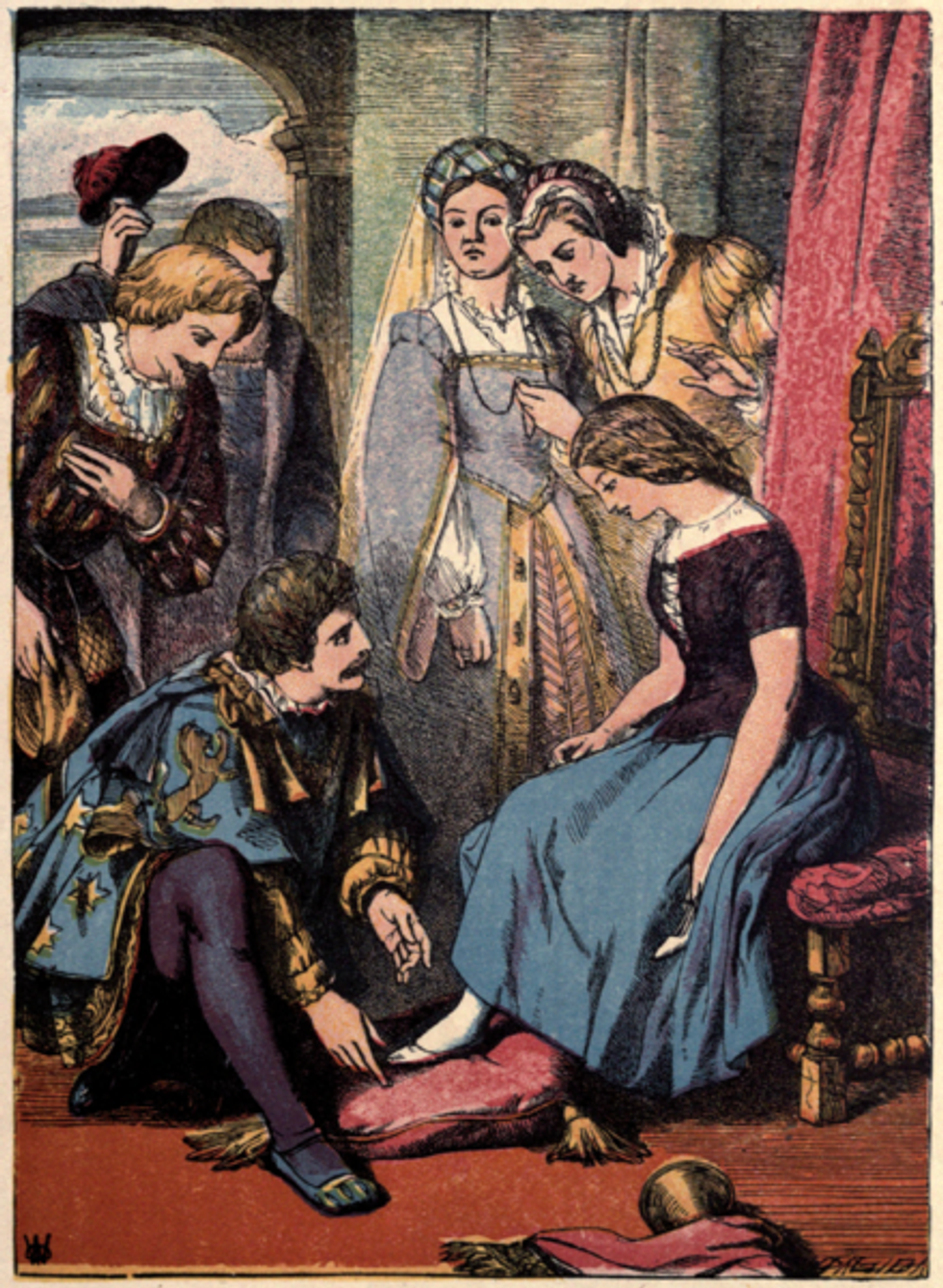
In Grimm’s “Cinderella,” the evil stepsisters, as well as their mother, were eager to find a man to satisfy their money-hungry and power seeking needs. They felt so passionately about pursuing this dream that they were willing to harm their bodies in the hopes of achieving their goal. The prince road throughout the town in search of his mystery princess with her missing shoe. The stepsisters were confidently ready to be the perfect match as they knew they had pretty feet. The eldest attempted first as “…she could not get her great toe into it, for the shoe was too small; then her mother handed her a knife, and said, ‘Cut the toe off, for when you are Queen you will never have to go on foot.’ So the girl cut her toe off, squeezed her foot into the shoe, concealed the pain, and went down to the Prince.” The same process repeated with the younger sister, as her heel was too large in fit in the shoe. The stepsisters were so readily willing to cut off a part of their limb, inhibiting their ability to walk, all to impress a man. The three ladies were obsessed with the idea of a rich and handsome prince to ensure their happy endings.
Women are viewed as property, as reflected in Anne Sexton’s satirical poem. The King threw a ball that lasted three days for which his son, the Prince, would choose a wife. It was a sea of women, all who pined for the attention of the young Prince and a chance to live the wealthy life in the kingdom with him. Sexton describes the ball as she writes, “Next came to the ball, as you all know. It was a marriage market.” The women at the ball were essentially being sold for marriage. It shows how the women were like pieces of property at a market and the prince was the customer perusing around in search of what he liked best. The prince took a liking to Cinderella and became frustrated when she ran away at the end of night one and night two. He was extremely intrigued to find out who his mystery maiden was. Sexton tells of his plan, “However on the third day, the prince covered the palace steps with cobbler's wax and Cinderella's gold shoe stuck upon it. Now he would find whom the shoe fit and find his strange dancing girl for keeps.” The prince seems more like a manipulative predator and not a charming gentleman, as he tries to capture Cinderella. Sexton describes the prince as a definitive desire to have Cinderella as his sole possession to do whatever he fancies. She describes Cinderella almost as a doll that the prince can have to play with and control.
Self-mutilation of the female body is not only evident in literature, but through society throughout the ages. Women have made themselves subject to bodily abuse by craving to fit the mold of society’s perfect body. This is the central theme of Wioleta Polinska’s article , “Bodies under Siege: Eating Disorders and Self-Mutilation among Women.” Polinska shares, “Among all the self-mutilators, the male to female ratios range from 1:2 to 1:20.” The author feels that dangerous body-altering practices are pursued the quest of beauty and acceptance, particularly by men.
Another popular route to a beautiful body is plastic surgery. Author Wioleta Polinska writes of how popular women’s magazines encourage their readers to consider plastic surgery. McCall’s subtitle of an article on cosmetic surgery, “Now that plastic surgery has gone mainstream, it has become a viable option for every woman." McCall writes, "Women undergo 89 percent of all plastic surgeries -- 100 percent breast augmentation, 99 percent of thigh lift, 95 percent tummy tuck, 96 percent of buttock lift.” This is not only evidently today, but in the past as far back as the Middle Ages. They mutilated themselves with knives, whipped themselves with chains, wore crowns of thorns and gorged themselves. They experienced humiliation, elongated their bodies and burned their skin.
A more serious way in which women, of the Chinese culture, mutilate their bodies is through the process of foot binding. It is another way for females to harm themselves in the efforts of obtaining society’s desirable attractiveness. The British Medical Journal shares of the steps of attaining the revered small feet. “The operation is begun by placing the end of a long narrow bandage on the inside of the instep, carrying it around over the four smaller toes and taking them under the foot. After several turns with this object, the bandage is turned so as to compress the foot longitudinally. At the end of the month, the bandage is opened, when the skin is often found ulcerated, or gangrenous from pressure, and one or more toes are not infrequently lost.”
The writers of the medical journal also share that the first binding takes place usually from the ages of five to seven-years-old. The most disturbing part of this painful act is the fact that is occurs more than once. These women suffer, as it effects not only their entire foot, but their ankles and legs. “At night the girl lies across her bed, putting her legs across the bedstead, so as to make a pressure under her knees, and thus benumb the parts below them. If the feet firmly bound, and the girl young, they will cease to ache generally in about two years, the parts then denominated dead.”
This horrifying procedure lasts for two years, killing the muscle and skin of the knee and below. The British Medical Journal also shares with the reader that the size of the new ankle is approximately the same of one’s wrist. By the end of the process, the woman’s leg, below the knee, is said to be really no more than skin and bone. It is astonishing to the lengths which these women will go to in order to acquire what their culture deems as attractive.
Self-mutilation, or the altering of one’s body, is not just through drastic acts like plastic surgery or foot binding, but in small ways as well. The fact that women are constantly shaving, putting on makeup or tweezing their eyebrows serves to show that we are always changing or fixing things about ourselves. For what reason is this? I myself, as most women, shave. My question is who deemed it that shaving different areas of your body makes one appealing. Most would prefer having smooth legs, but it is because we grew up with that preconceived notion. A shaver, according to Herzig in her article, “Unshaven: Arm-Pit Feminists and Women’s Liberation,” is seen as a masculine tool. “For both advocates and critics, unshaven armpits and legs served as a symbolic reminder of women’s labor -- in this case, the repetitive, expensive and often invisible labor of maintaining hair-free flesh. The question of whether such efforts were a trivial nuisance or the very embodiment of women’s oppression.” It costs women a lot of time and money to keep up with being well kept. Why do men not have to shave to be considered attractive or appealing? Some men’s unshaven looks even prove to be a main feature in their good looks.
A big influence to our understanding of beauty and how others perceive us is magazines as well as the models in them or on television. “We treat television as a constant visibility, or panopticon, and examine fat female depictions. We focus specifically on women because the media panopticon is infused with patriarchal beliefs, and therefore women learn to see and judge themselves through men’s eyes and according to men’s criteria.” Why isn’t natural considered beautiful anymore in this post-modern culture? Susan Hopkins, in her article “Living Dolls: femininity, subjectivity, postmodernity,” shares with her readers that she feels girls and young women take pleasure in imagining unreal selves. Hopkins also writes, “If there is no authentic self, multiple identities can be visited, tried on or trashed.”
It is common for women to keep changing their looks to try and fit the mold for what our generation considers the next look. This process, I feel, almost strips one’s own identity. A woman tries all of these different personas and in an instant, takes it off and puts on a new one. Women, as I am guilty of this myself, fantasize over celebrities and models and their perfect seeming looks. Hopkins discusses how, in the past twenty years, girls have embraced supermodel hysteria and desperate fascination with the ideal female form. “With her ‘dolls eyes, doll hands, doll feet’ the model has become a super impersonation of contemporary femininity. For the young in particular, the model is the image of an idealized self a site unreal and unreasonable ambition. At the same time, the model is the facialized body of our postmodern culture, the glossy surface upon which our shaped illusions are cast.” We are an image based society and Hopkins concludes her article with the idea of girls being raised on image culture and the fact that power is through one’s appearance.
As a society, we still respect these stories and continue to watch them. Especially in regards to Cinderella, there have been numerous remakes. We endorse this narrative, and similar stories, and the messages they convey. The weak princess is always in need of her savior, which happens to be a male character, the prince. It is refreshing to see that newer stories and movies, especially for young children, are changing their typical narrative that most people know and would expect. Even in Beyoncé’s song "Flawless," she sends out a strong message about how women are taught to aspire to marriage and that if they are too successful, it is threatening and unattractive to a man. Singer, Chimamanda Ngozi Adiche, featured in Beyoncé’s song says, “But why do we teach girls to aspire to marriage? And we don't teach boys the same? We raise girls to each other as competitors, not for jobs or for accomplishments…Which I think can be a good thing…But for the attention of men.”
It is imperative for women to know that they do not need a man in order to have their happy ending, and to never change themselves to please anyone.

















