

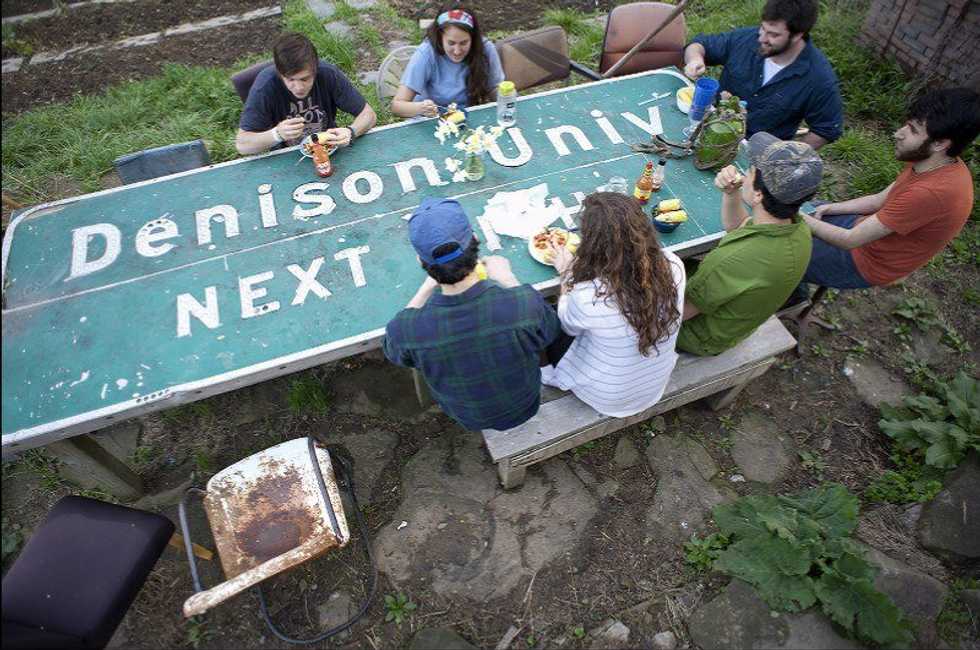
We often look to high-powered individuals and political figures with great merit to bring the most change to our societies. However, when the underlying forces against change are so strong, it is rather difficult for one person to change the culture of a society through one speech, word, or address. At a Ted Talk conference, Derek Siver describes the concept of a movement and says, “The biggest lesson, if you noticed — did you catch it? — is that leadership is over-glorified… If you really care about starting a movement, have the courage to follow and show others how to follow.” (How to Start a Movement) Reflecting on this statement as a college student, I believe that the most promising food activism is found starting from the grassroots. Thus, through small, informative gestures around the Denison campus I believe that we can stand as a united front against the culture of industrial eating.
However, some say simple dedication is not always the answer. Much of it is our plain lack of control over these issues, which makes it difficult to promote change. In an interview with Sarah Piper, Sustainability Coordinator here at Bon Appetit, she discussed her personal difficulties in bringing in local food to the Curtis Dining Hall due to strict regulations.
“A bit of it is policy — like due to farm bill subsidies, subsidized oil and water — and government regulations rigged toward helping agribusinesses, I’m having trouble sourcing local chicken that isn’t 5x more expensive,” Piper said.
Because of these subsidies, processed foods that are hurtful to the environment and human and non-human animals on this planet, are artificially less expensive than their sustainable counterparts. However, it is still a matter of small-scale activism that can help to overcome these setbacks. As students, we have the power to lead in the form of campaigns and projects to gain awareness, whether that is starting a “locavore at Denison” social media account, getting people to post pictures of themselves eating local food, or organizing school trips to the farm. As students, we have the power to direct our activism around these issues — it’s only a matter of choosing to exercise it.
Denison University dining options serves as an excellent example of how to break away from unhealthy eating habits, and is one that should be emulated by many institutions. In my interview with Piper, I learned a lot about Denison’s efforts to promote healthy eating- much of which I was unaware. Many of the dining hall menu items have Farm to Fork stickers, which she encouraged my friends and I to choose along with local cereals and soda rather than the industrial options, due to the efforts of a Denison senior project. According to the Denisonian, a student-run newspaper here at Denison University, “Denison’s food service provider, Bon Appetit, presented chefs and diners alike with the 10th annual Eat Local Challenge… Lunch in Denison’s dining halls only used food grown within a 150-mile radius of campus. Not only did the meal’s fruits, vegetables, and meat products come from nearby farms; everything, including cooking oil and even soda, had to be locally sourced”(From Farm to Fork). Although The Eat Local Challenge at Denison only takes place once per year, it is a strong representation of a commitment to local farmers, and more so a promise to buy locally produced food.
It is one for thing for college students to advocate for sustainable and locally produced food but another for them to live the lifestyle. At Denison, students at the Homestead are living and breathing a different culture. Located on about ten acres in a wooded valley, a community of Denison students has dedicated itself to a sustainable and environmentally responsible lifestyle. The students are using organic gardens, orchards, beehives, and chickens to grow their own food along with a variety of organic farmers, monthly co-ops, greenhouses, and the local grocery store to source their food (The Denison Homestead) Also, the homesteaders are required to partake in manual labor including tending their gardens, raising livestock, and cooking (The Denison Homestead) There’s something about the physical application that makes the Homesteaders more appreciative of their own consumption. As for those who are campaigning in favor of this lifestyle, it is worth acknowledging how the industrial culture would change if we lived the lives of Homesteaders. Although it is still an evolving experiment, it shows a unique commitment to this movement, and is inspiring to its own future as an eco-friendly and sustainable community.
As a college student, there’s only so much I can do as an individual in regard to changing America’s industrial food culture. However, by showing my support and advocating for this issue at Denison, I can hopefully encourage others to meet me halfway.
Citations:
https://www.youtube.com/results?search_query=how+t...
https://news.denison.edu/2014/09/from-farm-to-fork...