


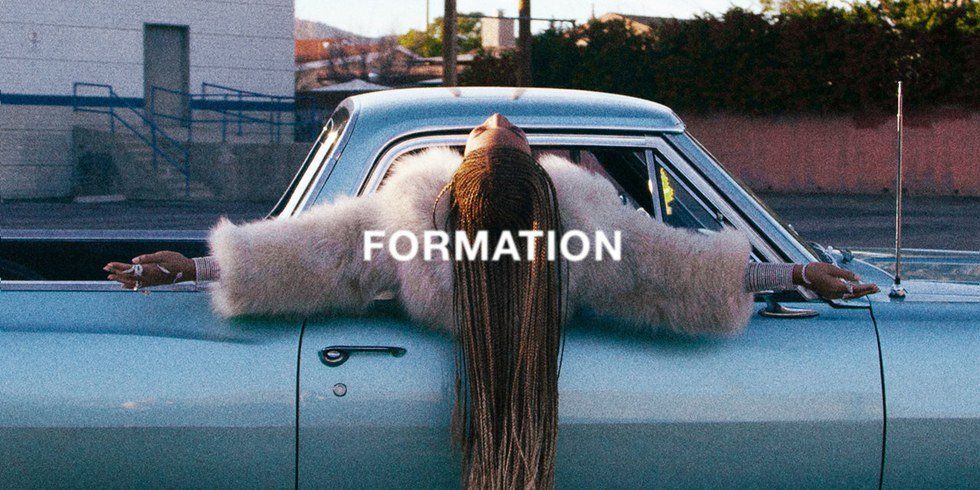
There's a seat with your name on it if you have anything to say about Beyoncé's new song, video, and/or Super Bowl performance that promotes any number of your views including but not limited to: the "I Like My White Privilege, But Refuse To Acknowledge It" agenda, the "Anti-Black Lives Matter" corporation, the "Reverse Racism Exists" group, the "She's Only Doing This For Attention" bandwagon, the "This Only Values Sex/Promiscuity" ideal, the "Pro-Black = Anti-White" campaign, and the "I Don't Get These References So It Sucks" parade. There are more, but I'm sure that these are enough to help you realize if you have a seat with your name on it or if you're standing in the front row.
Before I get into this, I want to state something:
It is OK to not like the song as a musical composition. But, you must acknowledge the socio-economic/political issues that Beyoncé has addressed with this track, video, and performance. It's okay to not like the song in general, as long as you understand and appreciate why others––Black southern women, in particular––do and as long as your meaning of "general" doesn't include turning the song into something it's not.
I know there are many other articles that say what I'm about to reiterate, but apparently it needs to be said a couple more times.
The song and video unapologetically celebrate Blackness and southern culture. Being from Philly, I almost feel like this song isn't even for me. The most relation I have to having "hot sauce in my bag" is loving that one Aqua line from The Cheetah Girls, but that's okay. I also know that the term "bama" doesn't apply to my northeastern culture, but that's also okay because I appreciate the way Beyoncé took a term that was originally insulting and reclaimed it for her and for everyone who may have been called a "bama" before. You can be mad that your Givenchy dress game is not up to par or that you don't own the various outfits that Bey wears throughout the video. But you can't get mad about (I mean you can, but I honestly don't care and neither do my fellow sistahs) is the promotion and celebration of Black culture, especially Black women's culture. I am here for the hair salon, the Black praises in church, Red Lobster, and the command that us Black ladies slay. Because we do slay. The Black female empowerment in this song is so strong, it laid my edges all by itself.
A part of Beyoncé's exclaimed love for Black women is her shout out to the parts of us, physically, that we should love. In pop culture, more often than not, when we see a part of a Black woman's body "appreciated" (this is a nice word, because it's closer to fetishized or sexualized as a part of the objectification of women and the obsession with the "foreign" body without an obsession with sticking up for or appreciating the "foreign culture"), it's the things that are "easy" to appreciate in society because of how often they are "well received" (I'm putting these in quotes because of my last parenthetic statement). But, in Formation, Beyoncé glorifies the wide array of hair styles and the overall hair culture of the Black female community. She's helping people realize that having nostrils akin to Jackson 5's, is a part of one's natural beauty and they should welcome it. These are two aspects of the Black body that have been ridiculed, negatively stereotyped, etc. These examples in Formation are more important than mentions of Black bodies have ever been since India Arie's "I Am Not My Hair" because it's easier to find a woman whose more insecure about her big nose or her natural fro than her big butt.
The song also calls out the way in which a disenfranchised people are still being oppressed and silenced. She blatantly makes a statement about police brutality against Black people. With a moving representation of "Hands up, don't shoot" headed by a young Black boy in a black hoodie commanding a police line to surrender to him, Beyoncé has the Black community contemplating the actuality of a future in which systemic racism is accurately and efficiently addressed and those who murder others don't get to walk free. A world in which the words "thug," "riot," and "terrorist" aren't saved for those with the darker skin. A world in which we aren't filled with sadness when the little boy in the video reminds us of Tamir or Mike or Trayvon or the other Black bodied souls we have lost due to injustice. What this is, is a call to action. She even released the video on Trayvon Martin's birthday, during Black History Month, and the day before Sandra Bland's birthday. Can you feel the pride oozing out of us all? What this is, is an acknowledgement of what people with a platform like Beyoncé's are too scared to state. What this isn't is an anti-police anthem. What this isn't is an anti-white anthem.
With the sinking New Orleans cop car and the acknowledgement of the horrors that happened in NOLA during and after Katrina as well as the acknowledgement of "bounce" music (most notably represented by the sampling of Messy Mya's voice), Beyoncé is bringing to attention the ignorance that happened in New Orleans. The time when Black people were ignored, when Black people were left to fend for themselves, when the government did nothing, when nobody who was supposed to do something did anything for the people who needed it are called into question. The cop car is not symbolic of an anti-police agenda, it's a symbol for what they did to help those who needed it during/after Katrina. It's a symbol for their mistakes, it's not one of ours. Beyoncé is subtly empowering Black people and asking the questions we've been wondering ourselves like "What did happen in New Orleans?"
As an artist, Beyoncé's job is to craft a reflection of her reality for an audience to digest. Beyoncé's reality as a southern Black woman is what is represented in this song and video. She's telling us she's not ashamed of it and we shouldn't be either. We're not saying that Beyoncé is the face of the Black Lives Matter movement. We're not saying that Beyoncé is even an activist. We are not so naive as to think that one song or event marks someone as the face, leader, spokesperson, or activist for a movement. All we are saying is that Beyoncé is giving us the chance to be happy in our skin and to appreciate our melanin and our culture that others have been either stealing or stifling (you should know who you are). Beyoncé is a Black woman from the south who wants you do know she's bout dat life and being bout dat life ain't such a bad thing. She's representing a people, who are being rejected at every turn, in an arena where no one can ignore her (**cough** Super Bowl **cough**). And if you have a problem with her Black Panther tributing, Michael Jackson emulating, Black Pride celebrating agenda, then you should ask yourself why she might want to celebrate these things. You may also want to do a little research before you start making assumptions or spewing wrong information. Like for instance, criticizing the Black Panther Party for it's so-called "militancy," but not having a single thing to say about the Ku Klux Klan.
Beyoncé is just letting us know that we, Black people and Black women, have the potential to be great and successful, as great and successful as Bill Gates.
If you have the time and you still disagree, I encourage you to either stay in your seat that should be permanately fixed in your lane, or educate yourself on the other ways in which Beyoncé represents Black culture in "Formation." From the praise of Martin Luther King, Jr. with the newspaper cover to the difference between Beyoncé and her ladies wearing white on the plantation to wearing black on the plantation with her middle finger up to all the people who want to try her, she's making moves. And if you're wondering if she knows, she's aware that she's that Queen B since she caused all this conversation.
**Also, if you think that Beyoncé is exploiting any group here, I would look up a history of her charity work.**

















