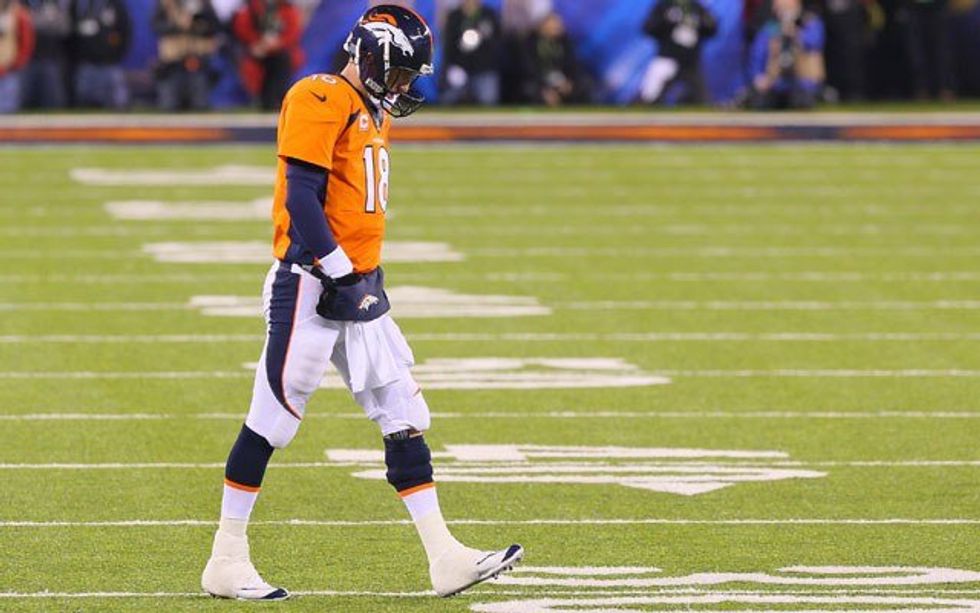
When a report from Al Jazeera near the end of last year brought allegations against Peyton Manning for using illegal substances, I paid minimal attention. Tony Dungy, Manning’s former coach, said he “would be shocked if it was true,” referring to the report. I echoed this sentiment and basically wrote off any attack on Manning’s integrity. I mean… he’s Peyton Manning. He just wouldn’t do that. But last week reawakened a fear that Peyton Manning, one the best role models in all of sports, is a charlatan. Manning is now facing charges of sexual harassment from a case that was supposedly settled years ago. While the efficacy of such an old tale (the case was settled 14 years ago; the incident occurred 20 years ago) seems suspect, I’m concerned. As the old saying goes: where there’s some smoke, there’s some fire. There is now definitely smoke swirling around Peyton Manning. We are waiting to find the fire.
Manning’s plight is incredibly disheartening but all too familiar. Athletes across the spectrum have been revealed to be cheaters, frauds and morally bankrupt. Tom Brady, Manning’s storied rival for much of his career, couldn’t escape this infamous title. Spy-gate I and II along with deflate-gate will forever resign Brady, fairly or unfairly, to an ignominious legacy. Barry Bonds doped his way to the top of baseball. Tiger Woods’ persona of a family man shattered to pieces. Lance Armstrong, for so long a cancer-conquering hero, turned out to be one of, if not the, greatest sports frauds of history. Even Walter Peyton, the legendary Chicago Bears running back, after whom the NFL’s Man of the Year award is named, died helplessly addicted to painkillers. The list feels endless. And Manning, once the great moral anomaly, looks set to join the rank and file of tarnished athletes.
But perhaps not. Perhaps the media is the fraud. It’s possible that Peyton Manning gets cleared of all of these charges and is able to prove his integrity. Yet, this necessitates a different axiom. If Peyton Manning is 100 percent clean, why did the media and those suing him seek to tarnish such an excellent career? Why do people want to be “the guy that takes Peyton Manning down?” Is our society addicted to vilifying role models?
Thus, I feel caught in a catch-22. Is it worse to have corrupt role models in the limelight of our society? Or is it worse to have a society looking to smear any good man that comes its way? Perhaps we have both.
I realize that thus far, this has been a raw, emotional and probably slightly unfounded article, for there are good role models in sports; in fact, I already mentioned one, Tony Dungy, at the beginning of this piece. Names like Stephen Curry, Troy Polamalu and Kaká do seem to poke holes in my dreary commentary, but I will say again, where there’s some smoke, there’s some fire. And sports heroes, far too often morally bankrupt, are fumigating our culture.
Luckily, the preceding paragraph is not the end of the story. While initially it seems like we can’t do much to reverse the trend, we can. We can resolve to not be that poor role model. Resolve to be accountable. And when we mess up, to take responsibility. I know it’s cliché, but we can be the change we want to see in the world. For, in a matter of moments it seems, the role models of our society dissipate into new ones. And if society beckons us into the limelight, let us not disappoint the watching world. Let us vanquish the corrupting fire.