

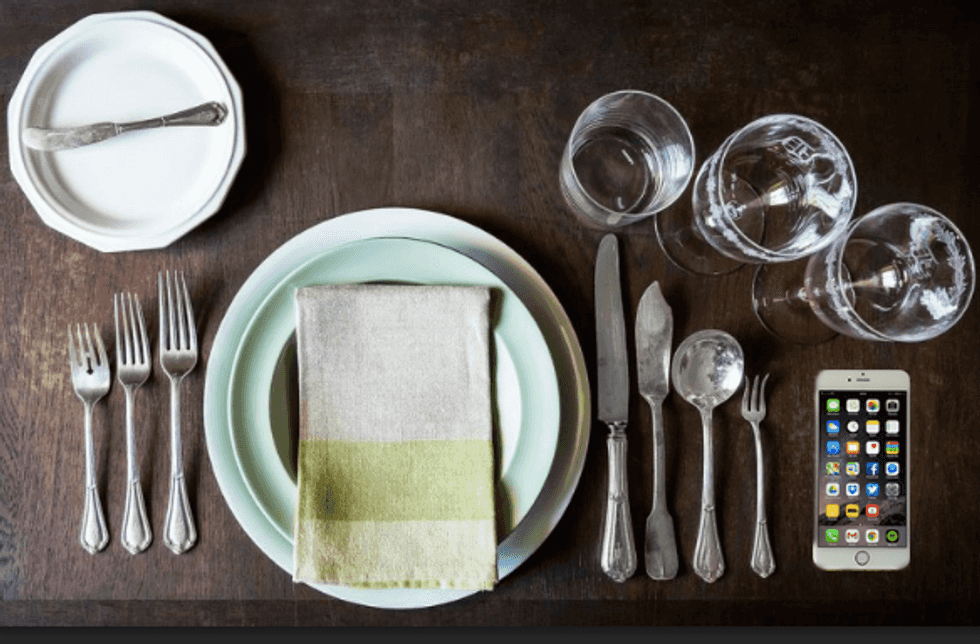
I blew out my birthday candles and looked up. I did not care that all I saw were cameras flashing, videos recording, and my friends SnapChatting my birthday wish to their friends (superstitiously, this must be the equivalent of speaking your wish out loud). I know now, that in that moment, I had lost the game: the game of self-control.
In a recent Business Insider article, it was determined that your device can too perform the very same operations as its downloadable applications. Your phone can also complete a task, (and many, many more) in a fraction of the time that you would spend attempting to accomplish on your own. Arguably the most unsettling fact, is the regularity that which we allow our phones to make the decisions we cannot, or do not want to, make.
Picture this: you plan to meet your academic advisor the Tuesday of the following week, and the next available appointment is two months from now. Monday comes around and you realize you have a paper due in 24 hours. You immediately text everyone on your contact list for notes or last-minute peer review. Not only do you completely rearrange your priorities, but also you temporarily choose to forget the task that doesn’t make the cut; in this case, the meeting (the hypothetical ‘you’ in this situation was me, freshman year). I neglected my advisor in devoting my attention and motivation to what I deemed as the more important task.
To avoid repeating this same mistake sophomore year, I set a reminder on my iPhone (groundbreaking, I know). I set it, however, to notify me of my appointment at the precise moment and place where I would walk out of my class Tuesday morning (now you can, gasp). Your iPhone can detect your location more precisely than your mom can when you’re out past curfew. Although I didn’t have a paper due this time around, I was focused on the steaming latte that would soon fix my groggy-morning mind. Preoccupied, there was no chance I could have remembered my meeting without the assistance from my unfailingly reliable iPhone.
A survey conducted by a University of Pennsylvania Professor revealed that of two million people asked to rank a set of skills by their respective strengths, self-control consistently landed in last place. This exceedingly substantial verdict illustrates the fact that no matter how much we try to remain rational in decisions, our brains will inevitably suffer from biological consequences. Whether you must make a choice to omit a less-critical option in favor of another, or to receive a type of instant gratification (you would pick coffee too), our phones are always there to provide an obtainable error-free alternative in making the decision for us.
My friend uploaded the birthday video she took of me from across the table. I commented on her post, “Love you, thank you for this! (Plus kiss-face Emoji)” In fact, all twenty of my guests’ Instagrams received this same response from me. Like the candles that I just blew out, my appreciative words too lost their flame. Disturbingly, my comments demonstrate that I endorsed the presence of iPhones as fundamentally necessary. At the time I thought, how else would I have thanked my friends for celebrating? Or rather, if the dinner had lacked iPhones altogether, was it even my birthday to begin with?
Now, I can’t help but smile with satisfaction at the times I forget something, or when I can’t find any evidence on my camera roll from last night’s party. These are my own reminders, notifying me that my phone isn’t always in control.