

Note: This is part five in a multi-part series. For what came before, see part one, part two, part three, and part four.
On June 12, a gunman in Orlando managed to take 49 lives at Pulse, an LGBT nightclub, in what is considered the worse mass shooting in United States history. As it's always been, the country provided knee-jerk reactions about the gun argument before the EMTs had time for a smoke break, as Joy-Ann Reid and Chuck Todd did on "Meet the Press" just hours after the event took place.
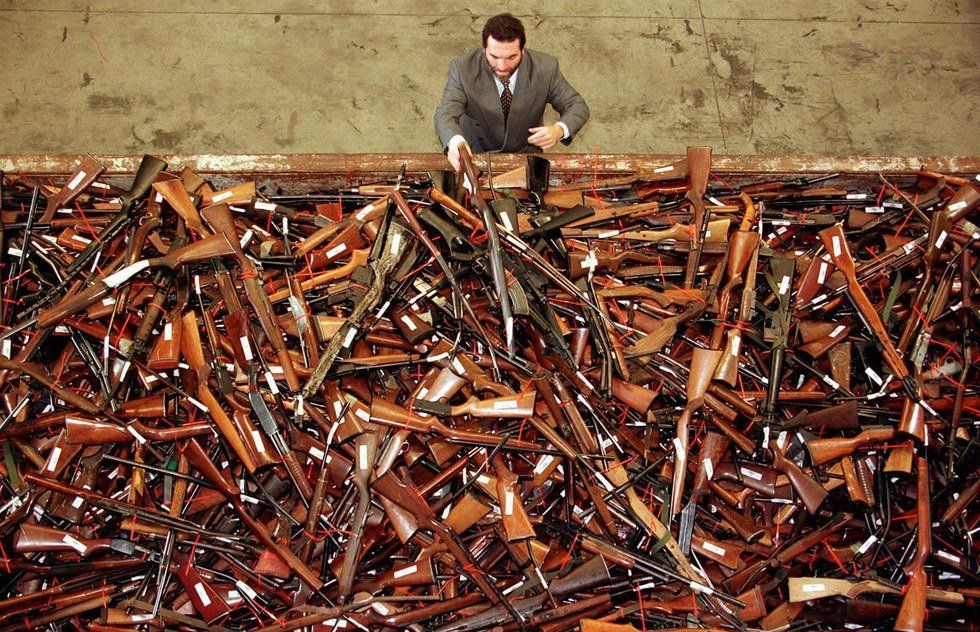
The responding arguments on social media, as usual, were extremely polarized. Gun control advocates point out international examples of strict laws, like how Australia hasn't seen a mass shooting since the Port Arthur Massacre resulted in extremely strict gun laws being passed and how Japan has an extremely low gun death rate, (one of the lowest in the world, even) and extremely restrictive gun laws.
While Australia did see about a 59 percent decline in homicides (and a 65 percent drop in suicide) after the passing of the National Firearms Agreement, the homicide reduction isn't so significant given context: there were only 0.37 homicides per 100,000 people in 1995 and 0.15 per 100,000 people in 2006. The country isn't immune to illegal firearms, either -- it's estimated that there are at least 250,000 illegal guns within the country.
Although Japan has kept itself at the bottom of the 'countries with mass shootings' list, it isn't immune to violent crime. Between mass murder incidents in Matsumoto, Osaka and the Akihabara district of Tokyo, Japan has had its fair share of mass murder. However, what's notable about these incidents is that they are rare and do not exceed more than eight deaths.
We could compare ourselves to these two countries and we could learn some lessons from their methods. However, a wide array of factors (including cultural differences, population size, geographic location and socioeconomic status) show that we are just simply not the same as either of them, which would mean that adapting their methods outright would show a lower rate of success than they had, if at all, because other countries with restrictive gun laws haven't had the same results.
France, Norway, England, and Russia have had their fair share of mass shooting incidents within the past 20 years. In the last year and a half, France has had two terrorist attacks involving illegal firearms. Norway suffered a massacre that resulted in 80 deaths in 2001. Britain's most recent attack left 13 dead in 2010 and Russia dealt with a three day terrorist school siege in 2004 that left over 300 people dead, 186 of which were children.
While the gun control advocates look to the places that fit with their ideals, pro-gun supporters reference how Chicago sees the highest murder rate in America despite having some of the toughest gun laws or how Switzerland has one of the lowest crime rates in the world due to mandatory military service, a gun culture revolving around respect and safety and unrestrictive gun laws.
These statements aren't fully wrong, but they're not fully right, either. Chicago, although home to the highest homicide count of any U.S. city in 2015, does not count as the highest murder rate (that is, deaths per 100,000 people) in America (that title belongs to St. Louis, with 49.89 murders per 100,000 people).
On the other hand, Switzerland is relatively low on the gun crime front, but it's certainly not the lowest; the aforementioned Japan ranks far lower. Military service is mandatory for men and they do have the opportunity to buy their weapon at the end of their service but ownership is far from mandatory. Swiss laws are considered lax by European standards but by American standards, they're still restrictive. The Swiss gun ownership rate might be ranked as third in the world but it's not mandatory for their houses to have weapons and they're still not immune to mass shootings, as the 2001 Zug massacre would demonstrate.
The truth of the matter is that for so many reasons, comparing our laws to that of other countries is not the solution. We can take some ideas and principles from them but ultimately we are simply not them and they are not us. Even within our own states and subcultures, it's difficult to compare results like we do with Chicago to the rest of the country. What we really need to do is look at all the facts in our own country and stop spinning them to fit our biases.