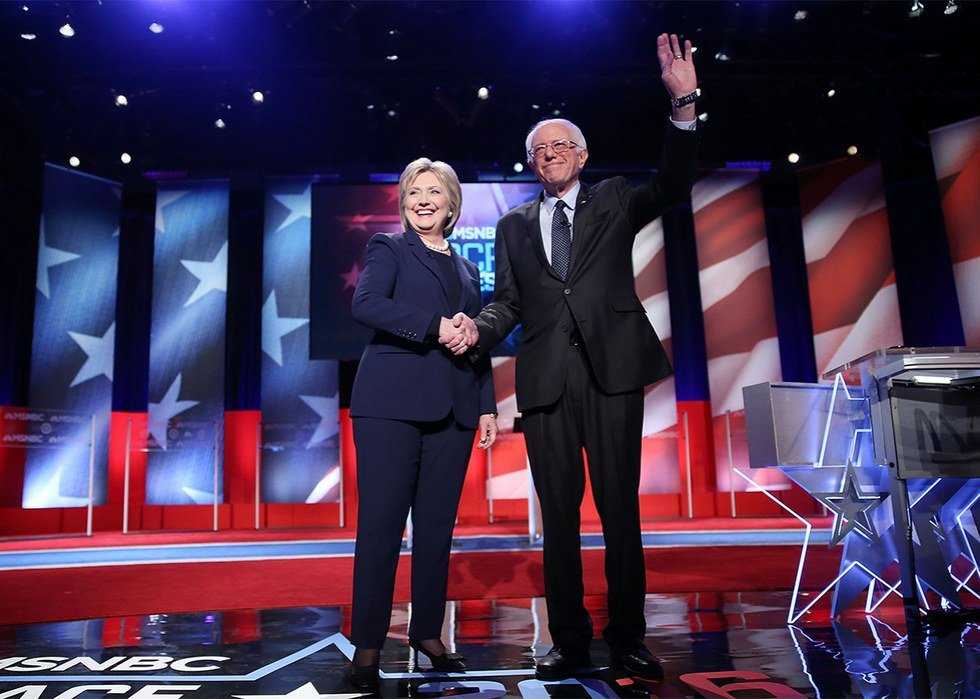
Last week in Durham, New Hampshire, Former Secretary of State Hillary Clinton and Senator Bernie Sanders faced off in the sixth Democratic debate of the election. The two stood on what many viewers would consider an empty stage, juxtaposed to the packed Republican debates.
The Durham debate shed a new light on the Democratic candidates. For the first time in the 2016 election, both Clinton and Sanders spent a considerable amount of time attacking each other.
Clinton used debate time to respond to Sanders’ recent attack video that, without mentioning the Secretary’s name, highlights how “certain politicians” have accepted speaking fees from big banks such as Goldman Sachs. The former Secretary of State exclaimed, "If you've got something to say, say it directly, but you will not find that I ever changed a view or a vote because of any donation I ever received."
The two candidates also engaged in several other disagreements. Sanders continued to press Clinton on her ties to Wall Street. Clinton countered Sanders’ claims that she is not a progressive by stating, "a progressive is someone who makes progress."
Despite these moments of conflict, what stood out in the Durham debate last week was each candidate's continued respect and grace for the other. At the end of the night, despite their differentiating policies and rising pressures following a virtual tie in Iowa, both Sanders and Clinton continue to promote unity within the Democratic Party.
Nearing the end of the debate, when moderator Chuck Todd asked both candidates hypothetically if either would consider choosing the other as their running mate once securing the nomination, the candidates stressed the need for continued Democratic wholeness.
Clinton responded to the question. “Well, I'm certainly going to unite the party… If I'm so fortunate as to be the nominee, the first person I will call to talk to about where we go and how we get it done will be Senator Sanders.”
In a similar tone, Sanders added, “I agree with what the Secretary said… And as I have said many times, you know, sometimes in these campaigns, things get a little bit out of hand. I happen to respect the Secretary very much, I hope it's mutual. And on our worst days, I think it is fair to say we are 100 times better than any Republican candidate.”
Sharing another firm handshake, the sixth Democratic debate ended in a similar place it started, with both candidates eager to emerge on top in the upcoming weeks.
When examining the current GOP field, I doubt we will be seeing any moments such as the one shared by Sanders and Clinton any time soon.
Since Iowa, the GOP has further separated. Senator Ted Cruz’s win in Iowa has highlighted the growing influence of The Tea Party. Also, although Businessman Donald Trump finished in a “humbling” second place in Iowa, the candidate’s extremely conservative platform also strays from the past GOP norm that was more popular in the past two elections.
Marco Rubio, who came in a close third place following the Iowa Caucus, has been deemed the mainstream candidate in the eyes of the media. As of last week, Rubio currently has received the most endorsements out of any other GOP candidate. He has been backed by two GOP Senators, five members of the House of Representatives, as well as former Senator Rick Santorum and Governor Bobby Jindal, both who recently dropped out of the GOP Presidential race.
Yet despite his growing support, according to the most recent Huff Post Pollster, Rubio maintains his third place ranking in the national polls. Also as of last Friday, anti-feminist Phyllis Schlafly, who recently endorsed Donald Trump, issued a lengthy report stating that Rubio has “betrayed us all.” According to Schlafly, Rubio’s Republican platform does not do the party justice. “He said he was against amnesty and against the establishment. And once he got in, right away, he became an agent of the establishment.”
Despite Sanders or Clinton’s varying levels of progressivism, Democratic Party unity is not at stake; but for the GOP, the plea for extreme conservatism continues to fragment the Republican Party.