Pop quiz time!
1. Are you a fetus, an infant, or under the age of 18?
2. Are you of the genus "homo" and the species "sapien"?
3. Have you registered to vote?
4. If yes, do you plan on voting in the upcoming presidential election?
If your answers are "no, yes, no, n/a", I have a bone to pick with you (unless you've been wrongly denied your right to vote, of course. But that's a talk for another day). And if you've answered "no, yes, yes, no", keep reading: this one's for you. To you, I ask this: why don't you plan on voting? Let me predict your response:
"I'm a busy person. Do you think I have time for that?"
According to a poll from the Census Bureau, 28% of those polled didn't vote in 2014 because they were "too busy." Granted, it was not a presidential election, which generally draws more than just general elections, but I digress. Chances are if you say you're too busy, you just really can't come up with a better reason and think it's a suitable excuse. Actually too busy and not capable of making it to the polls on election day? See if your state has any early voting options. Voila! Crisis averted.
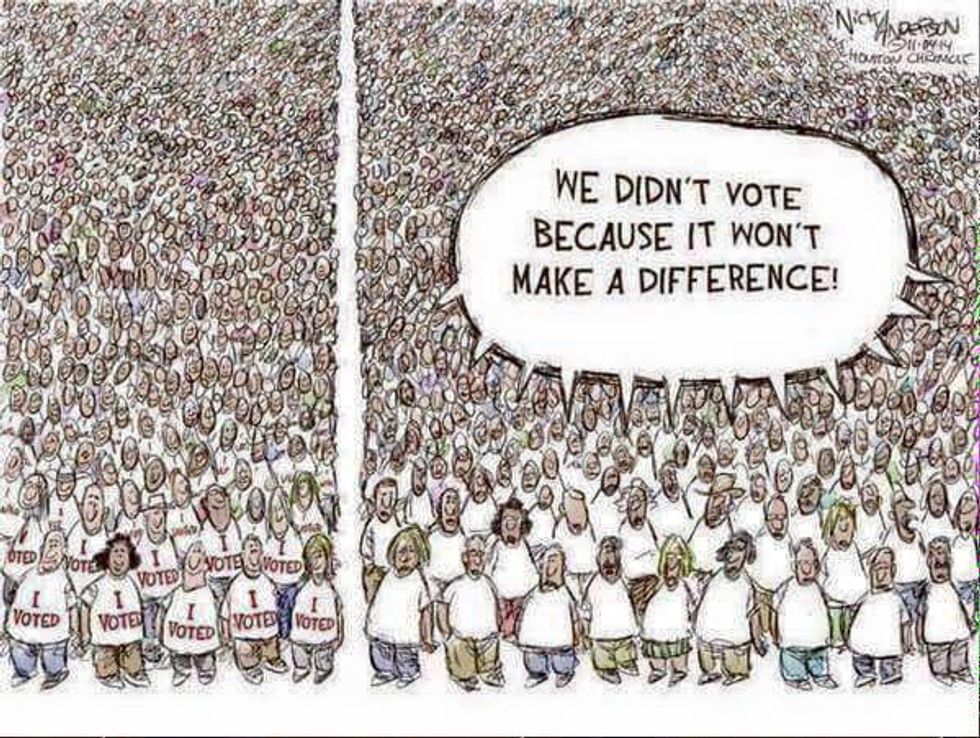
"I'm one person! My vote won't make a difference."
I hear this all the time. People try to excuse themselves from voting simply because they are a singular person and cannot single-handedly choose the next president. Yes, keen observation: our nation is (somewhat of) a democracy, not a dictatorship. Therefore, it relies upon the opinions of the people to decide upon who is put in charge. That is exactly why you should be voting: you are a singular person in the United States of America, and you have the privilege of contributing to change in your country. How great is that? Aside from the advantage of this opportunity, which not everyone in every country has, there's the fact that if enough people are thinking like you, you might wind up with a result you don't like. Of course, that's always a possibility, but if you want to complain about the result, at least, be able to say you tried to prevent it.
"I don't like any of the candidates. It's not worth it."
"Sanders is too radical." "Clinton's a flip-flopper." "Trump's a racist." "Carson is a robot trapped in a human's body." Chances are, you're going to find something you dislike about any candidate. People are flawed, and since politicians are humans (for the most part), it's only fair to expect that they might be for something that you are against, or vice versa. So what are you going to do? Sit back and potentially compromise the things you care about because of a simple disagreement? Here's a tip: find the person whose political beliefs are most aligned with your own, in spite of any differences. (Try the "ISideWith" quiz. It's an easy way to figure this out.) For example: like Sanders' policies on redistribution of wealth, but skeptical that it'll be enough for people of color? Great! These conflicts are perfectly valid. However, it's important to advocate for whoever would best represent most of your interests, rather than just focusing on what could use some work: we'll work on that when we've actually chosen a president.
" I live alone in a cave amongst the bats and bears and therefore care nothing about the nation I live in or the people within it."
Fair enough. Enjoy your dinner of crickets, kind stranger.