
“The nature of injustice is that we may not always see it in our own times. The generations that wrote and ratified the Bill of Rights and the Fourteenth Amendment did not presume to know the extent of freedom in all of its dimensions, and so they entrusted to future generations a charter protecting the right of all persons to enjoy liberty as we learn its meaning. When new insight reveals discord between the Constitution’s central protections and a received legal stricture, a claim to liberty must be addressed.” - Justice Anthony Kennedy
June 26, 2015 was possibly the gayest day ever. Two years to the day after the Supreme Court struck down the Defense of Marriage Act, LGBT people celebrated a historic day for equality: a day that gave them the right to marry whoever they wanted whenever they wanted. It was a step in the right direction.
See, the thing that confused me about allowing gay marriage was why it was seen as any different than “regular” marriage. I just don’t get it. Why do we, as a society, constantly feel the need to legally insert ourselves in other people’s lives. People should be able to love whoever they want, marry whoever they want, and flaunt that relationship however they want--regardless of whether they are gay or not. LGBT should be treated as what they are, which is people. A simple concept to grasp, I know, but it’s become clear recently that it’s foreign to more people than you think.
Let’s get one thing straight: and that is, no pun intended, that I’m straight. Even so, when I see that several states have passed anti-LGBT laws, I have a problem. I’m sick of the fact that, despite “separation of church and state,” some states now allow businesses to deny services to gay couples because of religious or moral issues. It makes me immensely angry that someone else's’ bias beats out my own sister’s ability to enter a state without knowing where she can or can’t go due to who she loves. I hate the fact that, in some people’s minds, my sister is not their equal, that one of my best friends did not deserve to be awarded the same rights as “normal” straight people.
“Injustice anywhere is a threat to justice everywhere.” - Dr. Martin Luther King, Jr.
Let’s take a look at the states that allow prejudice and hate to be legal.
North Carolina introduced a new law that, one, banned any legal protection against discrimination based on sexual orientation in the workplace and, two, requires people to use bathrooms for the gender listed on their birth certificates. The Bathroom Law, which goes against the right of transgender people to use the bathroom of the gender they identify with, was put in place to combat possible sexual assaults by people under the guise of being transgender. Okay, North Carolina, okay.
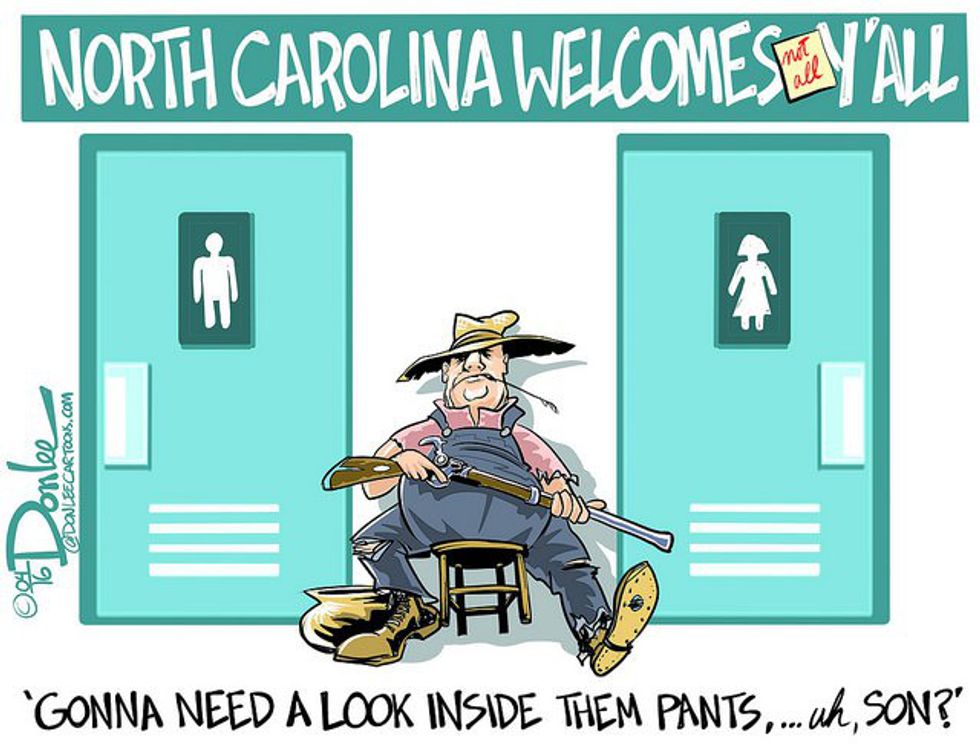
Based on cold, hard facts, the person most at risk in a bathroom is a transgender person. And just to prove a point: friendly reminder that at least three senators have been arrested for sexual misconduct in a bathroom, while the number of trans people is zero. It gets even better, because the new law also bans any city from passing anti-discrimination laws. In simple terms, discrimination is both totally legal and pretty much encouraged at this point.
Let’s move on to good old Mississippi. Their new law allows people, companies and businesses to claim a religious reason to deny service to gay couples or transgender individuals. You may think, like I do, that it’s not right to deny a person food at a restaurant simply because they are gay. But it’s not just about food. A doctor does not have to provide treatment to gay people, if it goes against his religious beliefs. So basically, using family again, if my sister were to need serious medical attention and she went to a doctor who didn’t want to help her because she is gay, that’s perfectly okay in Mississippi. How does that make sense? In the Hippocratic Oath--the oath taken by physicians in order to practice--blatantly states things like “I will respect the privacy of my patients” and my personal favorite, “I will remember that I remain a member of society, with special obligation to all my fellow human beings, those sound of mind and body as well as the infirm.” All fellow human beings, not just straight ones.
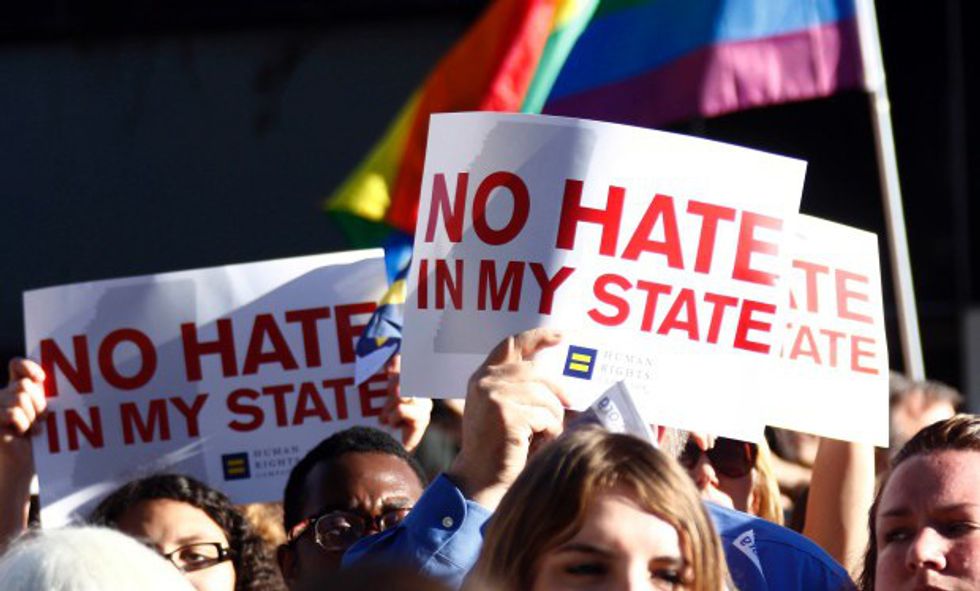
Supporters of Mississippi’s law, called a Religious Freedom Law, see anti-discrimination laws as discriminatory toward conservative Christians, many of whom believe that homosexuality or anything not “straight” is morally wrong. Are you kidding me? Are these not the same religions that preach to love your neighbor as yourself?
Georgia is the next state. Their law is technically only a bill. The legislature voted yes, but the governor still needs to approve it to become a law. The bill is kind of similar to Mississippi’s in saying that religious organizations shouldn’t have to provide service that don’t align with their faith. This is mostly focused on gay marriage, though. Religious leaders don’t have to wed a gay couple. But other wedding-related workers--caterers, bakers, florists--can also refuse to work at weddings between same-sex couples.
These laws are being passed without a fight.
In North Carolina, online-payment company PayPal plans to cancel an operation center, something that would have added $3.6 million and 400 new jobs to the local economy. PayPal, as well as 120 other business leaders, signed a letter to the governor not only protesting the new law, but pledging not to create any new business venture in the state until the law is repealed. The NBA also cancelled the 2017 All-Star game, another economic blow. And Bruce Springsteen even cancelled a concert in North Carolina saying the laws were like an “evil virus” and has called supporters to challenge the law.
In Mississippi, the law experienced much of the same backlash. Ellen DeGeneres summed up the big issue, saying, “This is not politics. This is human rights.” Huge companies that employ thousands from Mississippi condemned the law, including MGM Resorts, Nissan, and Toyota. New York has quickly become my favorite state in all of this. They not only banned state trips to Mississippi because of the law, but Mayor Bill de Blasio paired up with nine other mayors to form an all-mayor anti-discrimination group.
In Georgia, the Human Rights Campaign urged Hollywood to stop filming in the state, as it would be a huge blow to their economy. The NFL suggested that no Super Bowl would be held in Georgia if the law is passed. The NCAA and several Atlanta sports teams also condemned the law. Over 500 business, including at least 21 Fortune 500 companies like Apple, formed a group dedicated to vetoing the bill, called the Georgia Prospers.
The backlash to these states’ law is even causing states like Louisiana and Indiana, with older anti-LGBT laws, to reconsider their previous rulings.
You’d think states like Mississippi in the south would want to erase the permanent stains on its disturbing record with civil rights, not add more. These laws are signing away the rights of individuals and families, and reinforcing a pattern of hate and injustice.
I could easily say that, as straight person, this doesn’t directly affect me. But it affects the ones I love, and the ones they love, and that’s close enough for me to be deeply troubled by how easily these discriminatory laws were put in place. It’s so easy to take my rights for granted, because they’re not constantly threatened like those of the LGBT community.
My dad once had a shirt that said "Homosexuality was once diagnosed as a mental illness. Homophobia is the real disease." That quote rings true as rampant homophobia and blatant discrimination plague our nation today, and, time and time again, the progress made in the LGBT community suffers another setback. I don’t think it’s too much to ask that all people are treated with the dignity and respect they deserve, and until these laws are repealed, that will never be a reality.