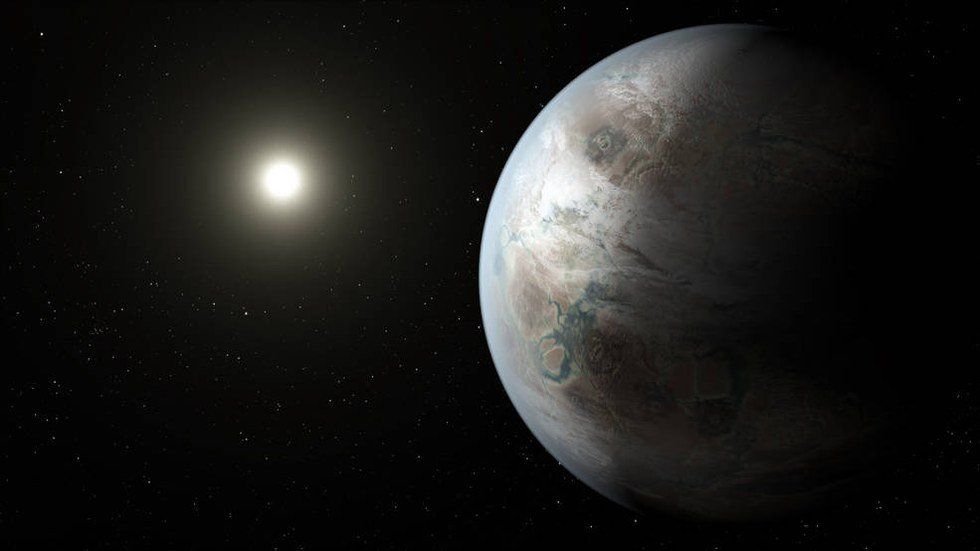
On Thursday, July 23, NASA confirmed the first near-Earth-planet, Kepler-452b. The find occurred during the Kepler mission, the goal of which is to survey the Milky Way Galaxy to find planets that are in or near the habitable zone. The discovery of Kepler-452b brings NASA's total of confirmed planets to 1,030.
NASA's Science Mission Directorate associate administrator, John Grunsfeld says the Kepler exoplanet explorer has discovered a planet and star which closely resembles the Earth and our Sun. They are excited to say that they are getting closer in finding Earth 2.0.
Kepler-452b is 60 percent larger than Earth, and its 385-day orbit is only 5 percent longer. It orbits a planet star similarly to our Sun; only it is 4 percent bigger and 10 percent brighter than ours. Not only is it bigger than Earth, but Kepler-452b is 6 million years old, and its planet star is 1.5 million years old.
NASA has yet to calculate an estimate mass of Kepler-452b and now can only rely on models which shows that it is five times bigger than Earth.
The University of Texas at Austin McDonald Observatory, the Fred Lawrence Whipple Observatory and the W.M. Keck Observatory, were able to confirm the planetary nature and refine its brightness and size.
Kepler data analysis lead at NASA's Ames Research Center, Jon Jenkins, says this discovery will give them a better understanding of Earth's evolving environment. Jenkins, who led the team that discovered Kepler-452b says, "It’s awe-inspiring to consider that this planet has spent 6 billion years in the habitable zone of its star; longer than Earth. That’s substantial opportunity for life to arise, should all the necessary ingredients and conditions for life exist on this planet."
Sadly, the Kepler-452b is located 1,400 light years away in the constellation Cygnus.
I'm still certain that NASA will find ways to find more information on Earth's bigger and older cousin. This discovery gives hope to astronomers and to us that there is a possibility of life on other planets.
On July 23, Jenkins said, "Today, the earth is less lonely." I'm excited to what new findings NASA will find in the future about our galaxy and Kepler-452b.