


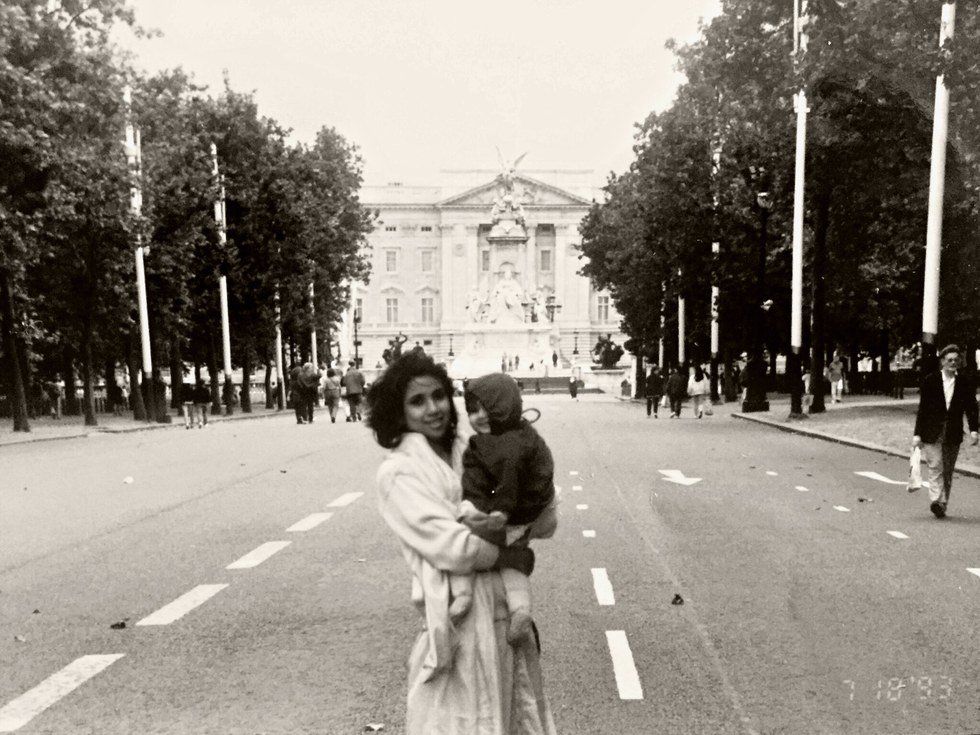
If there was ever a person I felt a disconnect to growing up, it was my mom. Unlike a lot of young girls, she wasn't my best friend and we weren't very close. And even though I was related to her, I didn't feel like I could relate to her.
My mom was raised in Bangladesh, and lived in a four story house amongst cousins, aunts, uncles — and wild monkeys, whom she would spend many evenings playfully poking with a stick and chasing after. She would walk a mile to school every morning, and had teachers that would all too often make her stand up on a chair as punishment for being loud and laughing too hard in class. When she grew up, she had an arranged marriage and in their early twenties and with one suitcase in hand, she and her husband moved to the United States to create a better life for themselves and their future children.
Needless to say, her life was much different than mine turned out to be.
I lived a relatively normal life growing up, or at least a life that felt normal. While my parents were strict, I was able to get away with much more than my siblings, as middle children often can.
But the life I was experiencing however, as a young American girl with an immigrant mother who barely spoke a language I knew better than any other, I did not feel was one that she could understand, which is what made our relationship a bit distant. In a way, I was trying to balance two worlds. One that included my friends and school, and the other was my life at home with my family. I wanted to keep them separate, and so I did. Or at least attempted to.
I remember being in the seventh grade, at a grocery store with my mom. We were in the frozen foods section at one end of the aisle, and a kid I knew from class was with his mother at the other end. I was standing around, silently wishing that they wouldn't walk near us, for fear that my mom would say something and sound "non-American." I didn't want my two worlds to collide and the walls I had built around each to crumble.
But they did come closer, and right at that moment, in her broken English, my mom asked me to go get a carton of milk from the aisle over.
The harmless question resulted in my classmate giving me a look of absolute shock, with a possible hint of disgust. And I can't say why the face of sheer ignorance made me comply to my mother's request in the way that I did — which was escaping my embarrassment as fast as possible and hiding out the milk section until he was gone — but it had.
Being young and on a quest to be "normal," whatever that meant, I shied away from what made her unique; what made me unique. And thinking back on it now, the only thing I have to be ashamed of was all the times I felt embarrassed by my mother's accent and tried to hide and (literally) run away from it.
She was then and is now more than a language she speaks bits and pieces of, more than the looks of annoyance and impatience given to her by people in checkout lines at stores. She is more than racist comments made by supremacist politicians on the television and the xenophobes that support them, and anyone else that treats her differently because her English is not up to society's standards. She is more than a stupid facial expression made by some seventh grade boy.
Her broken English is one of the most beautiful parts of her. It represents the life she left behind over twenty years ago, to come to a country that would not be kind to a woman merely trying to find another place to call home.
Many, including myself, are guilty of taking for granted the ability to speak English fluently, and underestimate the difficulty in learning another language as well as the people attempting to learn them.
My mother and the accent that she happens to have breathe strength, sacrifice, and dedication, but it does not define her.

















