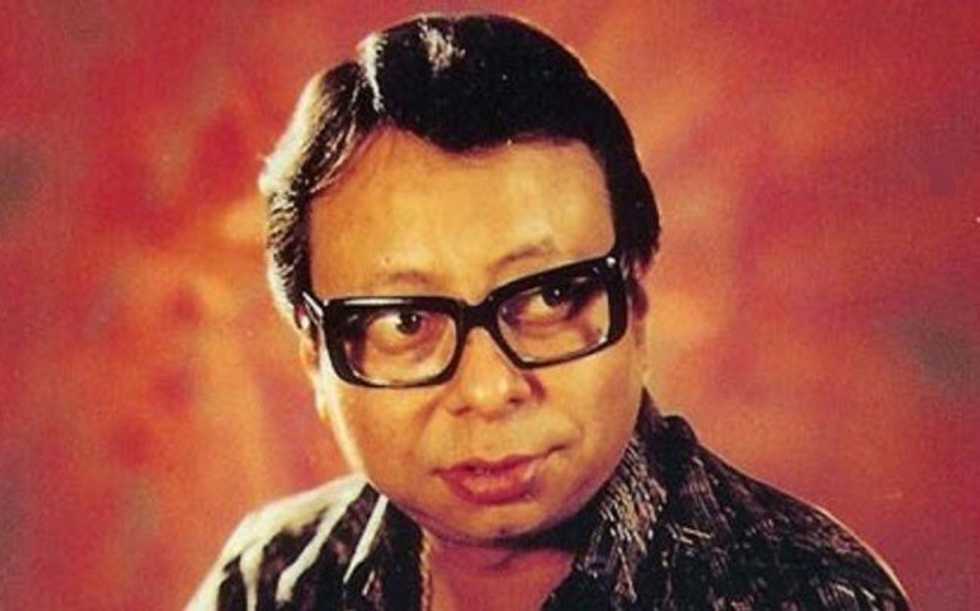
In the western world we often like to recognize popularity as something that's synonymous with success and talent, even though there are still many artists, producers and composers who have slipped through the cracks. Using this method of measuring success through popularity, we still fall short in our quest to hold up the best artists. If you were to travel to the other side of our planet, you would be hard-pressed to find a star bigger than the composer Raul Dev Burman. When it came to his composing, renown violinist David Harrington of the Kronos Quartet stated that he believes Burman belongs in the same sentence as Stravinsky or Debussy. You need not look past the sheer hundreds of films he worked on to understand the respect he commanded within his industry and his world.
R.D. Burman was India's most popular composer in the 1970s, during Bollywood's superstar era. He was the only son of Sachin Dev Burman, who himself was a singer and a famous Bollywood film composer. He was nicknamed Pancham, as Pa was the fifth note in the Indian scale system. It was said that as a baby he either babbled "pa" repeatedly or that he would cry in the fifth note “Pa” of the G scale. For westerners, this would be "sol" in the interval set spoken as Do Re Mi Fa Sol.
His work spanned decades, including 331 movies in his lifetime, the majority of which were in Hindi. At age nine, a composition he had written was first used by his father in the 1956 film “Funtoosh,” to his surprise. He also composed a large number of songs not used in films in Bangla, which are available on different albums. These were known as Pooja songs, or modern songs. Puja itself is the act of showing reverence to a god, a spirit, or another aspect of the divine through invocations, prayers, songs and rituals.
His first instrument was the harmonica and when he began to study music more seriously, he began with the Tabla and the Sarod. He had a very wide range of instruments he could play, something that was supported and encouraged by his father. He was a very efficient and creative composer. His inspiration for many pieces often came from what he heard in his dreams, leading him to attempt to recreate the ideas the next day. In one instance, he crafted an entire work around a melody he had heard a little girl humming while she was playing.
His music is noted for having influence from a wide range of genres , incorporating jazz, bossa nova, rock, swing and even mariachi music, among others. He would mix these different influences with the traditional Indian classical and folk genres, these styles being a stark departure from the western world's sounds. He was very adept when it came to keeping the Indian musical traditions pure. His music was often famous for a unique, grunting bass. This so-called “singing-style” commonly used the distortion effect synonymous with rock. This is the crunchy, radio-static sound that is used in nearly every rock & roll song, and nearly with every single hard-rock song.
One of the ways he kept up with pop and electronics in music was by using his own low-tech strategy by playing soda bottles as instruments. Burman would do things like use spoons on glasses or desks and would fill water bottles with different levels of water to control the tone when you hit them. In the song " Mehbooba Mehbooba," he played using a Listerine bottle. Keep in mind this was one of the most accomplished and popular composers ever using a measly mouthwash bottle for his songs. It's evidence that you don't have to necessarily possess the means to cutting-edge technology to be able to create beautiful music, if you have the inspiration and will to make it happen. His ability to blend styles was so unique for his time and culture that it's a shame many of us in the west won't ever know or understand just how influential Pancham was in not only the music of the east, but also the entire film industry itself.