


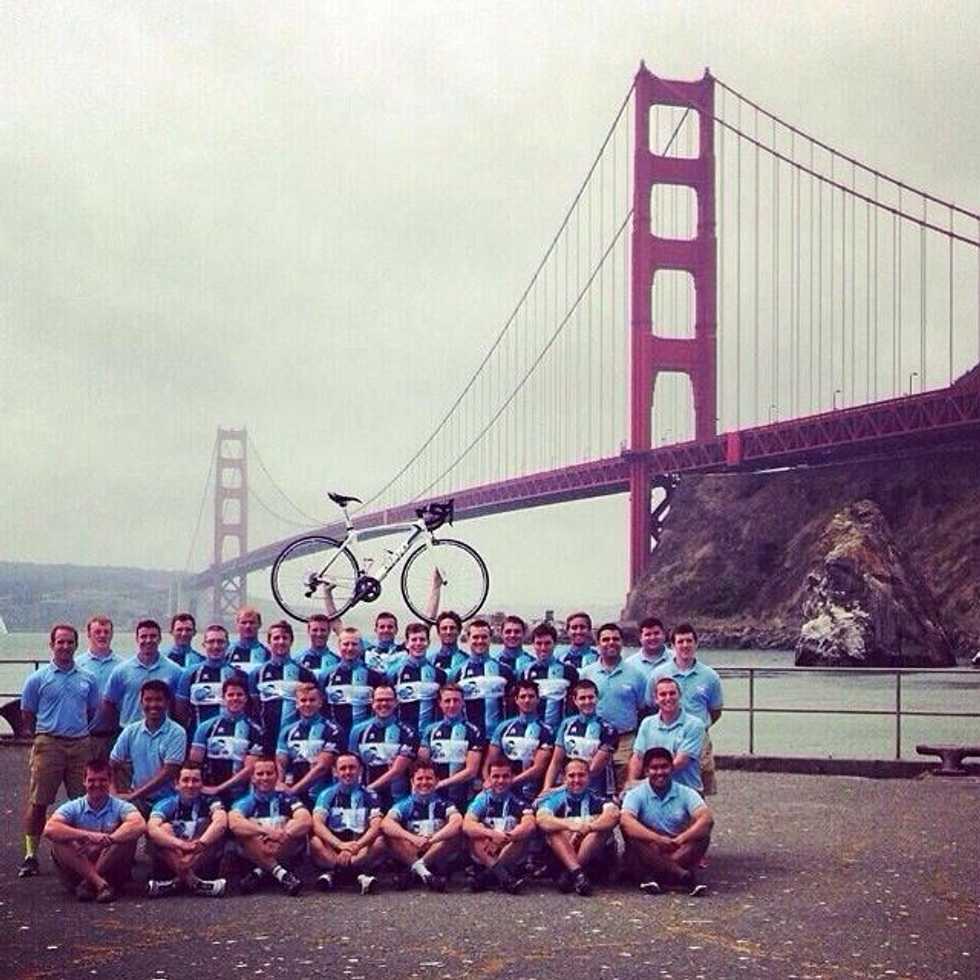
Imagine: for 62 days, getting up at 5 a.m., riding a bike for six hours and averaging 70 miles or more a day. Following this, you eat dinner and then spend time with people with disabilities, only to do it all over again tomorrow. This is Push America’s "Journey of Hope" that has been in existence for 27 years and an experience Josh Velasquez never could have imagined having.
Velasquez is a Michigan State University senior studying political science-pre-law, and a brother of the Alpha Theta chapter of Pi Kappa Phi.
“I like to claim that I’m an ordinary person doing something amazing,” Velasquez said. “I think that everybody can do that. There is a possibility for anybody to do anything as long as they stick to it.”
Push America is an organization founded by Velasquez’s fraternity that assists people who have disabilities by raising money and awareness for them. They aim to defeat stereotypes and words associated with disabilities, while the raised money funds programs that assist these people with the building of wheelchair ramps or the creation of disability-accessible computer centers.
“Our motto is: 'building leaders of tomorrow by serving people with disabilities today',” Velasquez said.
Push America’s "Journey of Hope" is an annual 3,629-mile cross-country bicycling event. The North route team of 24 cyclists will visit 52 cities between San Francisco and Washington, D.C.
“Our CEO of Push America was speaking and he said, ‘We ride across the country for the kids that wish they could ride their bikes across the street.’ I probably will never forget that in my entire life,” Velasquez said. “It’s just amazing what we can do and I just appreciate every bit of it.”
THE EIGHT-MONTH PREPARATION
Pi Kappa Phi brothers who aspire to join the "Journey of Hope" are required to raise $5,500 prior to the trip while also training for the lengthy bike ride.
Some members of the team bought t-shirts and sold those for money to donate, but he personally asked family members and friends to donate to the cause helping him exceed the goal by $600.
“I got a donation from a man that attended Cornell University, and he donated $250,” Velasquez said. “I have never met this man in my entire life and probably never will and his message was, ‘I’m a fellow Michigander. Nobody from my chapter did [the Journey] a few years ago, so I decided to pick you to donate the money to.’ Things like that are amazing and it’s kind of like a meant to be thing.”
Velasquez lifted weights for three-four months prior to getting on a bike in April. Velasquez said at the beginning of his training he thought riding 20 miles was a big deal. He slowly built up to 30, 40 and 50 miles.
“The best thing that helped me was aerobics class,” Velasquez said. “There would be about eight girls in a class, and I would be the only guy. It would be tough and it would be really hard. I’d be working out, and in my head I’d be like, ‘I’m not going to quit. There are a bunch of girls doing it. I’m going to look like a pansy. I’m going to continue to do this.’ So I had some motivation to finish that."
Velasquez cycled nearly 600 miles in the month of May by himself to prepare for the trip as best as he could.
“It’s a lot of mental preparation. Currently right now, there are 24 cyclists and I am one of four that has rode every mile so far,” Velasquez said. “I’m really happy with how everything is going. I feel so honored to be a part of the team and the support is amazing. I am having the time of my life and I could not be happier right now.”
AN ICE-COLD COKE TO FOLLOW
Velasquez said a typical riding day consists of the team waking up at 5 a.m. to pack their belongings and then they get on their bikes. Every 10 miles the team rides, they have a crew stop with Clif Bar & Company products and water available.
An average day in miles, if counted up and divided by the total 62-day ride, would be 70 miles. The most the team has rode in a single day however, has been 126 miles. The average pace the team rides is at about 14 miles per hour for six hours. Pace lines consist of three team members that travel together throughout the day.
“I bring a really military state of mind when I’m on the bike. I have my team of two guys and we call it, ‘Three out, three in,’” Velasquez said. “Three guys go out from my team, three are going to come in. We’re all going to be fine. Nobody is going to crash. Nobody is going to get a flat tire and not be able to finish the day.”
The team will ride for six hours, arrive at their next campsite and clean up. Following this, they will attend a “friendship visit” where they have dinner with people with disabilities, their caretakers and their family members.
The team tries to help out in any way they can. Whether they are throwing the football around with those who have diagnosed disabilities or talking to their caretakers and family members.
“What I take from [the friendship visits] personally is, I appreciate everything that I have now,” Velasquez said. “We’re sitting in Nevada in the desert for 400 miles and I’m like, ‘I love Michigan, I never want to leave.’”
Velasquez said the cyclists burn 5,000-10,000 calories a day while riding.
“The first thing I think about when I’m done is, where can I get the largest, ice-cold coke,” Velasquez said. “That’s all I want, ever.”
THE INSPIRATION
The ride itself brings together brothers of Pi Kappa Phi fraternity from several different schools and universities.
“The cool thing is, everybody’s from across the country. You've got guys from Ohio State, Long Beach, Virginia Tech, TCU,” Velasquez said. “It’s like a brand new chapter, and it’s cool because, at Michigan State, we have about 40 guys in my chapter and there is 35 of us on the trip, so it’s just like a brand new chapter for me. I’m just trying to get to know everybody.”
Velasquez's two closest friends on the journey are from the University of Cincinnati and Purdue University. He says the three of them have the best time laughing and joking around.
“One day we were just taking our time and being slow, just laughing and having the best time ever. We’re always safe on the bike and stuff, but sometimes we’ll press our luck a little bit,” Velasquez said. “We were just having a good time and one of our cycling coaches said, ‘If you don’t hurry up, something bad is going to happen to you and you’re not going to have time to finish the ride.’"
The group went about a mile or so further and one of the guys got a flat tire.
"We’re changing the flat, and [the Cincinnati cyclist] goes and bends over to remove his tire," Velasquez said. "The guy from Purdue bends over too, and the guy from Cincinnati brings up his tire real quickly, like pulls it up into the air, and hits the [Purdue cyclist] in the face. It was the funniest thing ever. It was just classic, Three Stooges, slapstick comedy.”
Recently, Velasquez was talking to some of his teammates about how they can all get closer together as a team. He proposed they have discussion nights every week to see how guys are enjoying the journey and what they think about when they ride.
“The two things I think about everyday while on the bike are Lacey Holsworth and the last relationship I had with my ex-girlfriend,” Velasquez said. “Things like that, I think, keep me going. They keep me going to motivate me to be a better man.”
“I think about Lacey Holsworth, an eight-year-old girl who smiles everyday no matter how hard an obstacle is," Velasquez said. "These people we go to visit with disabilities do the same thing and all I have to do is ride a bike for a day for 85 miles. That’s nothing compared to what these people go through and compared to what that little girl went through.”
Velasquez said when an opportunity presents itself, he tries to take the lead on it. He wants to lead the discussion groups to ultimately bring the cyclists closer together on this journey.
“I have the opportunity of a lifetime. There is no time for negativity and if people like an eight-year-old girl can inspire me and keep me going, I hope to repay that to somebody else,” Velasquez said. “Whether they are raising money for cancer research or doing a marathon, anybody can do anything if they put their mind to it and take it to the next level. If I can be that inspiration for somebody else, like Lacey is to me, I’d love that. And I’d hope they get the opportunity that they want.”
A $150 BIKE COMPARED TO A $250 BIKE SEAT
“I just think cycling is a 90 percent mental challenge and 10 percent physical,” Velasquez said.
Velasquez had three flat tires 1,500 miles into the journey and added that weather is one of the biggest obstacles. Both temperature and wind play a large factor in cycling.
“[Wind] can take your miles per hour from 16 to 12," Velasquez said. "You get so frustrated because it's just gust after gust pushing you back.”
Velasquez’s 1990's bike is the oldest out of the 24 cyclists' on the journey to Washington, D.C.
“It’s a steel-frame bike, so it weighs about 10-12 more pounds than most of the other riders’ bikes," Velasquez said. "Everybody always kind of gives me crap for it because it’s heavy.”
Newer bike models are made of carbon fiber and aluminum and Velasquez said he has to work harder because he does not have the best break technology or the lightest bike.
“That’s one of the things I have to work with and it’s its own kind of disability,” Velasquez said. “I have to do a little bit more, but when it really comes down to it, it’s no disability at all because as I have learned through this whole trip, two things: appreciation, and the only disability in life is a bad attitude.”
“I don’t care that I bought my bike for $150 and guys bought their bike seats for $250,” Velasquez said. “I’ll get through it just like everybody else.”
BECOMING A BETTER MAN
“The most satisfying thing is personal growth within myself and noticing when we leave visits that everybody, whether it’s a teammate, the people with disabilities or caretakers and families, everybody leaves happy, in a good mood and better as a person," Velasquez said.
After 30 days of riding, Velasquez feels like he is a better man and cannot wait to see what the rest of his journey has to offer.
“I’m just happy I’ve had this opportunity and I’d love for my guys from Michigan State to do this because they mean so much to me,” Velasquez said. “This is the best summer I’ve had, ever.”
“It’s just about growing up and realizing it’s not all about going out and chasing the girls and stuff like that, but having a real, meaningful purpose and enjoying every bit of it,” Velasquez said. “I’m in Fort Morgan, Colorado. I’m never going to be here again, but I’m just happy that I’ve got a sleeping bag and I’ll have somewhere to sleep and that we just had a meal. You just never really understand what you have until you see other people don’t have the same things you do.”
Catch Josh Velasquez and his teammates at East Lansing’s Patriarche Park on July 20, 2014, to celebrate their journey as they continue on to Washington, D.C. and follow the remainder of his journey on Facebook!














