
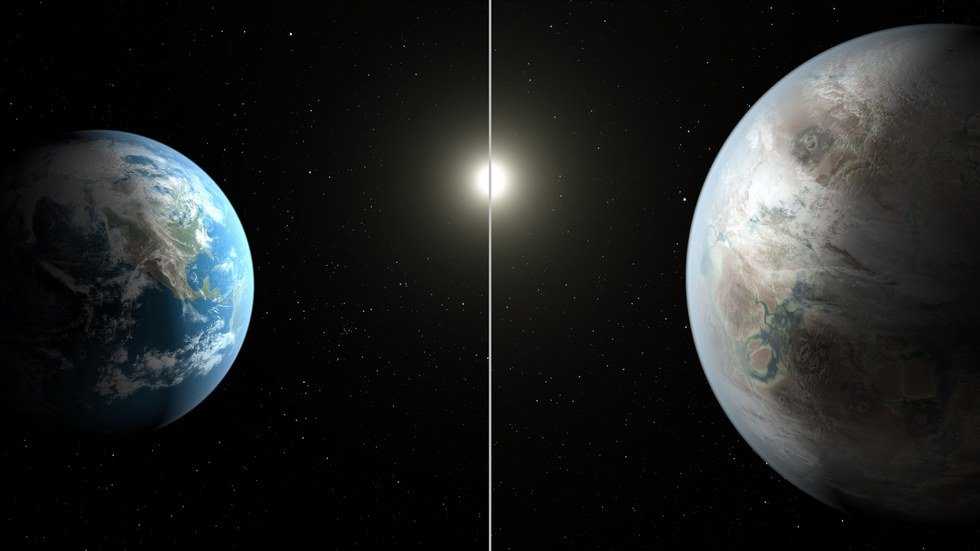
Scientists at NASA have been searching for planets that could be similar to Earth for many years, but on Thursday, they announced that they have found their closest match yet. There are so many amazing similarities between Earth and this newly discovered planet, Kepler 425b, that scientists and astrobiologists are kind of freaking out.
Here are some key points which show you why
Kepler 425b has a "sun" and an orbit a lot like ours.
Both the Earth and Kepler 425b are about 93 million miles away from the star that they orbit. So, while Kepler 425b is too far away from the Earth’s sun to receive our sunlight, it has its own "sun" almost the same distance away that is only slightly larger than ours, causing it to receive only an estimated 10% more sunlight. It even has an orbital year similar to ours, at 385 days compared to 365 here. In addition to this, the planet is also 60% larger than the Earth, meaning that the sunlight gets spread out to a larger area. This means global warming on Kepler 425b won't be an issue for an estimated 500 million years.
It's in a "Goldilocks Zone."
This means its proximity to the sun suggests that water possibly exists on Kepler 425b in a liquid state. So, there is a probability for aquatic features on the planet, such as, lakes and oceans, to exist. And where there is sunlight and water, there is more probability for life.
It could have similar geologic features.
Due to its size, is also suspected that the planet is rocky instead of gaseous, meaning geological features similar to Earth's, like volcanoes, are plausible. But, more importantly, there's likely to be solid ground, meaning that microorganisms would have, ya know, something to stand and exist on instead of just... floating around.
It's pretty similar in age.
Kepler 425b is estimated to have been around for an estimated 6 billion years, compared to the 3.8 billion birthdays our Earth has had. So, it's about 1.5 times older, meaning that it's like the Earth's older brother. Remember that older siblings usually get a lot taller and grow a lot more in general than their younger counterparts.
Put the age, access to appropriate amount of sunlight, and potential for water together and you get...
Some VERY exciting possibilities! While there is no confirmation of life on this planet yet, scientists plan to launch a new project called TESS in 2017 with the goal of providing "more detail on the size, mass and atmospheres of planets circling distant stars." Scientists seem to be cautiously excited. However, some suggest that there is more probability of finding water and life on Mars, or moons of Saturn and Jupiter, Enceladus and Europa, respectively. Still, the striking similarities between Kepler 425b and Earth give us a reason to celebrate and remain hopeful for the future of discovery.