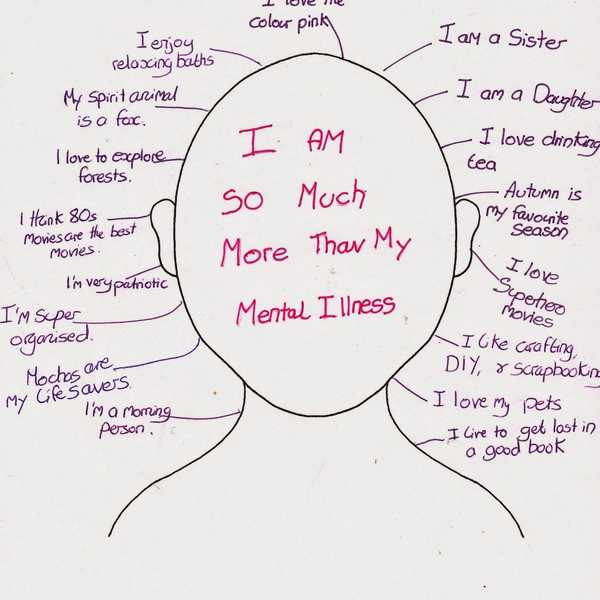

A thing that I like most about modern culture is that it's difficult to find a topic that someone isn't willing to talk about. However, there is a catch to this, and it's all about the way we talk about things. I'm not much for censorship, but I am up for a bit of respect. A bit of, say, treating each other like human beings, no matter what. I'm talking about things like these:
"She's so bipolar; she was fine one minute and then just got really upset for no reason."
"I'm tired of seeing all these anorexic models on runways. Like, go eat a burger or something."
"Yeah, you see, I'm super OCD; I cant stand that crooked painting on the wall."
"Dude, chill out, are you psychotic or something?"
"That's me, super ADHD; you're just like talking and I'm just like 'squirrel!'"
Thoughts like these, which I've found are buried deep within the brain of any given person in any given location, no matter who you are, contribute directly to the stigma of mental illness. There's no getting around that, and there's no excuse for giving these thoughts the power to be heard by uttering them into existence.
What I typically hear in response to my disgruntlement about using these serious mental health diagnoses as adjectives adds up to this: "But hey, we use 'crazy' or 'insane'� left and right, and nobody pitches a fit about that."
To answer that, let me tell you a story about a girl on a school bus. This girl was in my grade, and everyone was in agreement that she was a bit different. It was perhaps second grade, and the nicer people on the bus were simply wary of her, while the crueler ones were embracing early forms of bullying. This is done without really thinking about it: people weren't targeting her specifically. No, they were targeting her disabilities. I once watched her wash her hands until they were the color of raw hot dogs. It was things like that which, for whatever reason, made it easier for people to justify being rude. Anyways, I knew this girl rather well; she lived in my neighborhood and we had "play dates" a few times. She considered me a friend and I considered her a person to be nice to in the hallways. On the bus one day, she's sitting a few rows ahead of me and another girl gets on and starts looking for a seat. I'm just minding my own business, talking to another one of my classmates, when I hear it. Actually, the whole bus hears it, because this girl, among her differences, was louder than the rest of us, but only a few of us cared.
"You shouldn't wear that shirt."
I recognize this girl's voice, and so my head snaps up to the front of the bus. She's looking straight at the girl who's trying to look for a seat, and her fists are clenched. The girl's shirt reads "OCD: Obsessive Cookie Disorder." It features an image of the Cookie Monster from Sesame Street gleefully munching on cookies. It was white with green sleeves, and I remember this simply because I had same shirt at home.
The girl kind of turned up her nose and asked, "Why not?"
Then this poor girl from my neighborhood goes, "Because there are people out there that actually have OCD, and that shirt is offensive to their illness."
That was the end of the exchange for them, because the girl with the shirt kind of snickered and moved on, but I was not done turning this concept over in my head. I tried to justify the shirt. I tried to justify the humor in it. I tried really hard to picture myself wearing it again, because when you're seven or eight years old, you don't really decide on your wardrobe so much as your parents do. My mouth tasted like bile thinking about it, though. I didn't ever say anything to my neighbor about it, but what I did instead was go home, take that shirt out of my drawer, and throw it away. The distressed look on my neighbors face was burned into my brain for a very long time after that.
I think about this more than I care to admit.
But, you see, when there are slogans and statements going around talking about something being crazy, that's not the same as placing, say, talking about ADHD in a bad light. Anyone can have a mental health disorder and not consider themselves crazy, because having a mental health disorder does not at all strip you of your sanity. However, when people directly perpetuate thoughts that put specific mental disorders in a box marked with negative connotations, this is when thinking becomes destructive.
OCD is not just getting a little twitchy because there's an ink blotch on someone's shirt, or one of the pencils on your professor's desk is facing the wrong way. You are not OCD. I know this because Obsessive-Compulsive Disorder is not an adjective, it's a noun. It's an unwanted repetition of thoughts that can cause someone to carry out behaviors that they don't understand or desire to do.
ADHD is not seeing a squirrel and losing the conversation. It's not just "getting distracted" every once and a while. You don't just have "ADHD moments," which is a term I keep hearing. I see people laugh and say, "Oh, that must be my ADHD kicking in," like it's the cutest thing in the world to chronically not be able to focus or control your impulses. Sure. Except it really doesn't work like that.
Look, what you're really saying when you call a stick thin model "anorexic" is that you are interested in making assumptions about a very serious health condition, of which you know nothing about. An eating disorder does not have a "look" to it. In fact, all of these diagnoses are impossible to point out by simply looking at someone or a single behavior, which is why medical professionals are trained for years to diagnose them.
When you choose to use a mental health diagnosis to describe someone, or something they've done, you discredit the power the actual illness can have over someone, and the magnitude of the strength that it takes to overcome something so deeply embedded in you. It's not funny, and it certainly needs to stop.