The Metropolitan Museum of Art is a staple of art and culture in New York City, and really, in the world. With an array of carefully curated changing exhibits in addition to the unchanging staples, such as the Temple of Dendur room with a full wall of windows looking over Central Park, the Met never disappoints, and there always seems to be some new room or nook to explore.
As if that wasn't enough, the Met has a second location, The Cloisters at Fort Tyron Park in Upper Manhattan. This historic gem may be a bit out of the way, but expands dramatically on the medieval European works in the main museum.
This weekend, the Met revealed a new third location in Manhattan. Located in the building that was home to the Whitney Museum of American Art until 2014, the Met Breuer opened its doors on Friday morning revealing a series of exciting events and galleries. While the new museum maintained many aspects of the inner structure of the Whitney, it still managed to take on an entirely different tone than its previous inhabiter.
On Friday, a dance performance by David Dorfman Dance graced the garden level each hour, giving viewers within the museum and passersbys on the street a chance to watch the spectacle. Simultaneously, visitors played and created at the Drawing Space on the ground floor or perused the galleries in the three levels above that.
In the evening a group of artists, performers, curators, and other creative voices gave nine minute talks on the idea of "unfinished." These talks went beyond the Met Breuer and graced the main building of the Met on Fifth Avenue as well. A new group of artists began talks in the morning at the Breuer and then at the Cloisters location on Sunday morning.
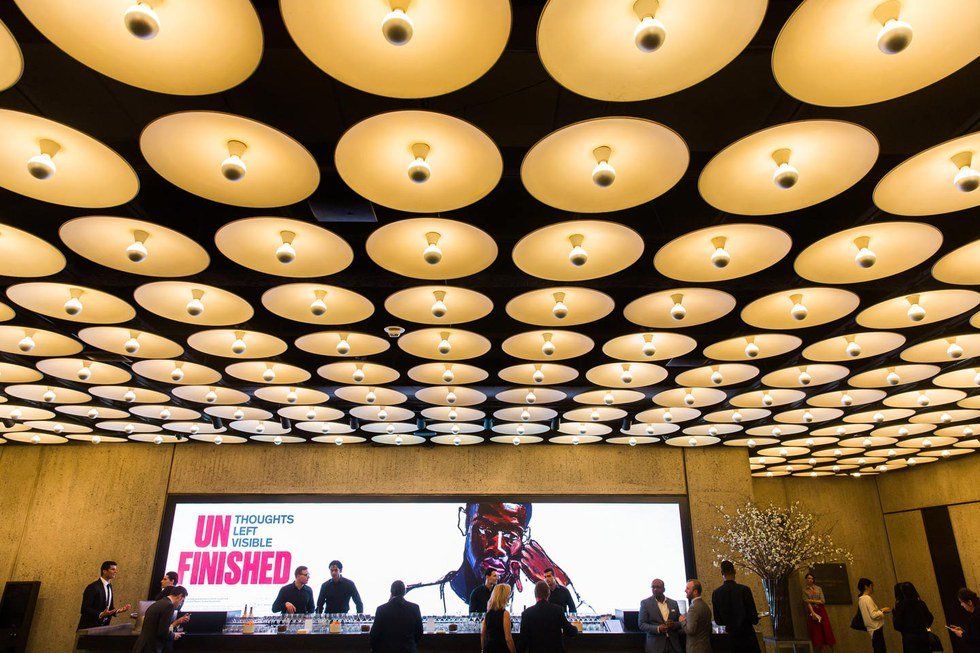
The idea of unfinished carried beyond the talks throughout the weekend with two floors of the building committed to an exhibit titled Unfinished: Thoughts Left Visible. This exhibit mixed 197 works, from famous, classic paintings to newer, stylistically more modern pieces through the theme of unfinished work and what "unfinished" means. By addressing the question of when a work of art is finished, the exhibit brought together generations and movements that may seem entirely unrelated.
A cafe and bookstore that felt like additional galleries in and of themselves filled the top floor of the museum. The cafe took over a large room, filled with comfy couches, with walls covered with framed works for sale. The fact that even the simple cafe felt like an experience worth having, more than a mere place to grab a bite to eat when the museum wears you down, speaks to the care and work put into curating every inch of this space.
While the current exhibits are subject to change in early September, I have no doubt that whatever comes next in this museum will be just as well-planned and intriguing as what I've seen so far and I look forward to seeing where this museum goes in the future.