
Recently I have seen negative comments about my hometown start to make their rounds on the social media networks I am a member of. Many of the complaints relate to the issue of our town not seeming to be friendly and lacking community events. One of the main reasons many people claim no change is happening is because some individuals who hold a good bit of the power to say what should or should not happen in our community see no need to have change in our area. Much to the dismay of the people who wish to stay sessile and unchanged, the people of the community who wish to seek change outnumber the folks who wish to remain stationary.
This quarrel reminded me of the issues my classmates from my community psychology class and I have been discussing. Dr. Jeanette Diaz, an associate professor in the psychology department at the University of West Georgia and my community psychology professor, hosted a talk in September titled "Community Psychology and Public Health: An Invitation to Dialogue," and this talk focused on the relationship between public health and the relationships and overall strengths of the Carrollton community in particular. Dr. Diaz's talk was very intriguing, and after listening to her talk and studying the field of community psychology on my own and in class, I realized so many people are clueless when it comes to knowing how important community is to one's mental and physical health. Since an outstanding number of people wish to spark changes in the community, they desperately need to know of how to properly go about successfully crafting a cohesive and successful community. Three key factors need to be understood before one can start creating change in a community, and hopefully, some folks from my hometown will heed these pieces of advice so we can spark an important change in our community:
1. Understand others by interpreting the systems they're involved in, not by their outward looks and actions.
Humans are judgmental creatures, but our automatic instinct to judge people is not an excuse to let ourselves have preconceived notions about others. This is especially important to remember when it comes to determining what to do to help others and how to go about having a personal opinion of someone. Our parents or caregivers always told us not to judge people by their "covers," but we seem to forget this important rule once we reach adulthood. Removing judgment and understanding others must happen before people can start to fix their communities. In her talk, Dr. Diaz refers to Dr. Urie Bronfrenbrenner's Ecological Systems Theory as a way to view other people. In this model, people are encouraged to look into a person and see how they interact with the world around them based on their personal perspectives and relationships rather than attributes people perceive.
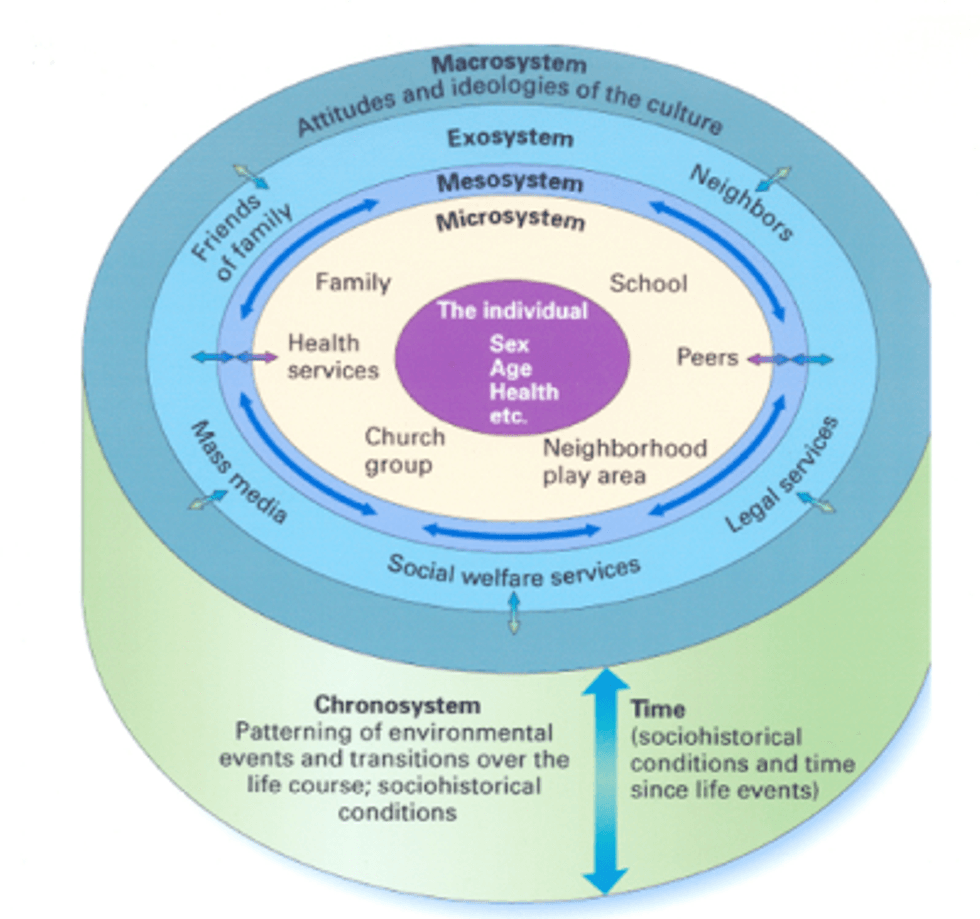
As boring as this diagram may seem, looking an an individual in this manner is mesmerizing, mainly because the new opinion one will form about a stranger will boil down to being a much more informed viewpoint of someone else that will lead to a greater understanding. An individual's sex, age and health will be the first "system" one will observe. Next, the microsystem, which is made up of family members, peers, educational facilities, neighborhoods, heath services and church groups, must be observed, and the experiences and relationships people have with their microsystems are not always ideal. The exosystem, which consists of family friends, mass media, social welfare services, legal services, and neighbors, is connected to the microsystem by the mesosystem. To show the relationship between these systems, places where crime is high and incomes are low typically have less access to sound and intact resources such as these. The exosystem then connects to the macrosystem that is made up of the attitudes and beliefs of the culture the individual is involved in. This can be problematic, Dr. Diaz explains, because the perceived practices and beliefs tend to differ from those that are seen from outsiders looking in to one’s culture. Finally, all these systems are encapsulated by the chronosystem, which consists of the patterns of changes that occur in one’s lifetime.
While looking at these systems sounds tedious, understanding someone rather than judging him will make one's ultimate goal of helping a community flow much easier. As we've learned from history, learning about one another is a far easier way to make change happen than trying to make changes based off the judgmental and preconceived biases people can have of one another.
2. Figure out why the problems in the community are happening and fix those issues before jumping to other conclusions.
Since humans are very judgmental beings, psychologists know how much people need to stress the importance and existence of the Fundamental Attribution Error. The fundamental attribution error is the fancy term for people judging others based on their outward appearances and expressions alone rather than looking into other people and seeing what issues people are having in their lives. We can apply the fundamental attribution error to communities by looking at how people incorrectly attribute things that happen in a community to outward factors rather than looking at what is happening internally in the community. Instead of saying a certain part of town is rough because of the people who live in it, think about how those people may be perceived as being rough because they have low-income jobs, the government is not focused on helping them repave their streets because their area is not as important as others and how the people who live in those areas likely do not have time to make their yards and homes look nice because they are incessantly worried about providing rather than living. Once one is able to have that perspective and understanding, he will be able to enter whatever community he is interested in helping and correctly assess the areas which need to be improved and figure out how to properly improve them.
3. Be more involved in helping to make your community a better place.
This seems to be a very basic and obvious tip to remember, but in a GoFundMe world, many people forget the "mobilizing" part of mobilizing and taking action for a cause. I am guilty of donating money to a cause instead of getting in the thick of whatever issue I was supporting and making a change myself. Not only do organizations whose goals are to cause change need more manpower because they have limited help, but placing oneself in an area that needs help shows initiative, compassion and care for a community. When people see others making a difference, it sparks a change in their hearts and encourages them to make a change, too. Next time, instead of donating $15 to a cause that is close to home or will help in your community, spend a few hours helping instead.
4. Band together and show authority figures your combined strength.
After understanding the necessity of the last three steps, it will be time to show the authority figures who are either oblivious to the area's struggles or against the improvement of the area why change must happen. To show the hard work and planning that has been put into improving an area, photovoice projects seem to be the most successful. A great way to have community involvement while also reaching a large number of people who might not even be in the original community is by creating a photovoice of the members of the community. Pictures and short narratives tend to be more moving than speeches and letters to Congress, and this method of outreach is very successful. In Dr. Diaz's talk, she presented a photovoice about the issue regarding the appearance and health of Carrollton, and it moved multiple people and caused changes in the community to occur. Presenting a photovoice project to authority figures with the people who contributed can be awe-inspiring and cause massive change, and once the previous steps are grasped and understood, making the change happen will be much easier to do with photographic evidence and a team of support.