


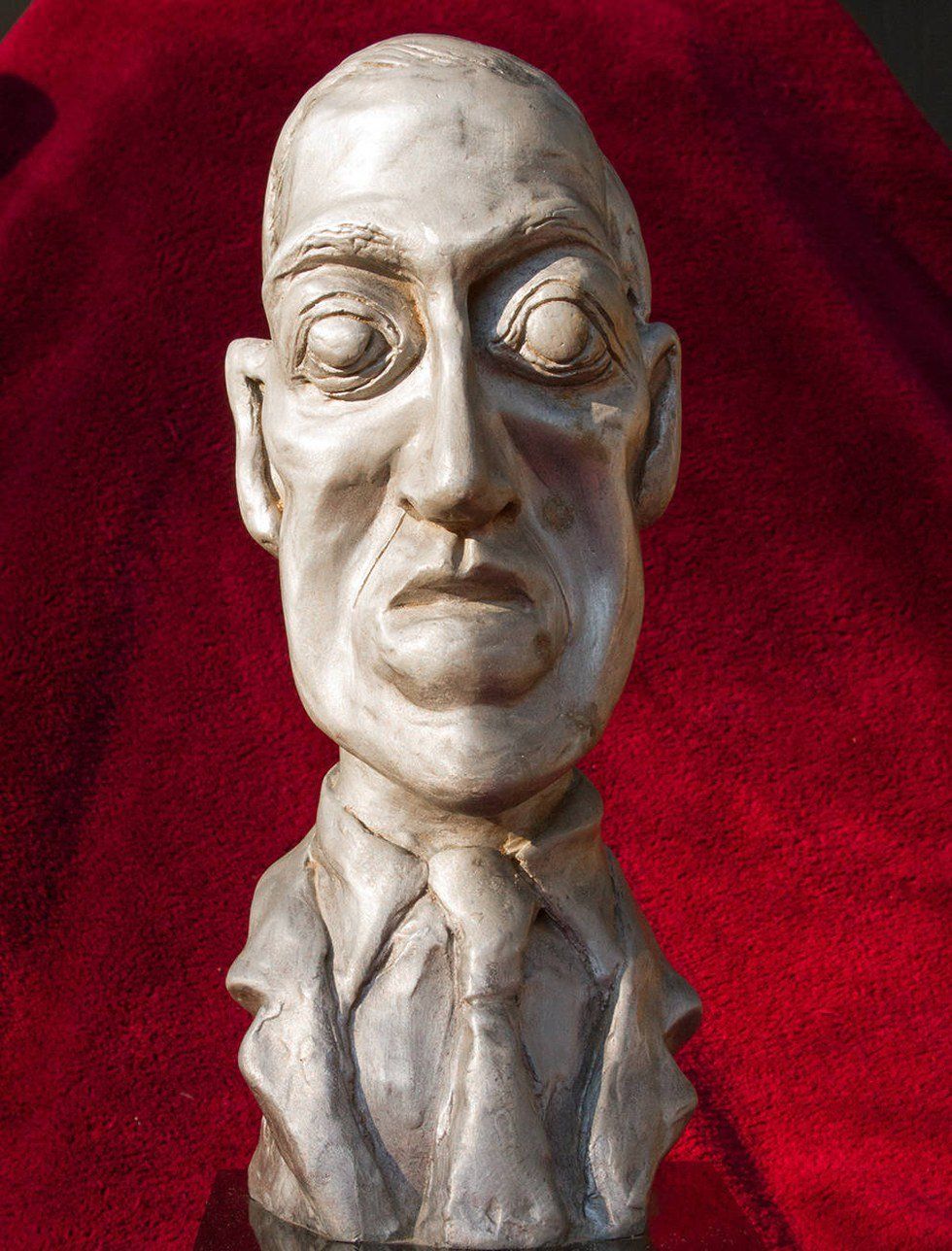
Perhaps one of the most influential American authors to have contributed to the development of the modern horror fiction genre is that of one Howard Phillips Lovecraft, whose contributions to fiction have been more influential than you might realize.
Among some of his greatest accomplishments include but are not limited to the establishment of the Cthulhu mythos, as well as the pioneering of the Lunatic Asylum as one of the foremost settings for supernatural terror in the American horror genre. In fact, the chosen name for both the asylum and the mythical Northeastern city in which it is based should be a familiar one to those following the Batman cannon.
In his short story entitled “The Thing on the Doorstep” Lovecraft coined the name Arkham, which would later lend its name to the formation of Arkham Asylum, the high profile maximum security prison and psychiatric treatment center housed on an island of the same name, which plays host to some of Gotham’s most iconic villains and psychopaths. The name would also live on after the author’s death in the form of Arkham House Pressings, the foremost authority on the archiving and publication of not only the works of Lovecraft, but also a number of other authors who both wrote within and were equally inspired by the otherworldly and sinister universe which was so often referenced within the late author’s work.
While it is clear that there is a lot which can be attributed to the author’s contribution to the literary world, a petition campaign raised by author Daniel José Older against the use of the author’s image for the World Fantasy Award and earmarks Lovecraft of being a racist. In his petition, which garnered 2,500 signatures, Older accuses Lovecraft of being “an avowed racist and a terrible wordsmith” as the result of the discovery of a poem entitled “On the Creation of Niggers” which was supposedly written around 1912 and was apparently not published until the time after his death when much of his unpublished memoirs and notes were sent to print.
This was when Lovecraft would have been 22 years old, decades before anything of notoriety would have been published and as evident through the themes explored in his later writing, long before the author’s ideas and opinions would begin to change towards that of a more tolerant and informed individual who would eventually speak out against what he felt were the horrors of colonization.
This has left many scholars racing to the man’s defense, citing that for many authors of the period what was written often served as a reflection of the political and social climate surrounding an author and not entirely the overall character of the individual holding the pen.
However, the current social climate and the individuals shaping it has become far too unforgiving of such views, past or present, and will likely take none of the situational or social factors which might have prompted such a composition into any consideration.
Rather, in an almost knee jerk reaction to having been confronted with such a mildly uncomfortable issue, very few can resist throwing around the word racist while completely disregarding everything else that Lovecraft may have done -- essentially,positively contributing to the development of American Literature as a whole.
Following the revelation of the racist poem, scores of writers of color began to look back on their awards with disdained and conflicted opinions regarding the choice of the World Fantasy Award and using a figure such as Lovecraft to represent an international and widely diverse group of authors.
Sofia Samatar, who won the award in 2014, spoke out during her acceptance speech stating that it was “awkward to accept the award as a writer of colour” which she further expounded upon in a blog post following her acceptance in which Samatar encouraged readers and authors to not remove the works of Lovecraft from their libraries, as she was and still is a dedicated scholar of the late author, but felt it problematic that such an individual should represent “an international award honoring the work of the imagination” when he clearly had such closed minded views.
Daniel Older, the organizer of the petition, had some rather scathing opinions about Lovecraft, whom he believed “used literature as a weapon against entire races” and who felt that the genre of fantasy was non-inclusive to minority authors on the basis that “writers of colour have always had to struggle with the question of how to love a genre that seems so intent on proving it doesn’t love us back.” In place of Lovecraft, Older instead suggested that Octavia E. Butler be the new model for the award as she is both a female and a person of color who left an equally powerful impression on the literary community. However, when reading some of the comments for the petition page one can’t help but question the overall motivation of some supporters, who openly admit to using the opportunity to phase out certain individuals in favor of those whom “we do not need to apologize for in the 21st century.” One user under the name Michael Liepert, goes so far as to suggest that any defense of the embattled author, as well as any objection to the award’s change in design, is simply the result of “people making excuses for bigots.” While having a bust of Lovecraft in their home might be awkward for most of its recipients, at the end of the day it’s clearly not uncomfortable enough for these individuals to consider returning their awards.
The ire of these individuals seems a little misplaced and one sided given that the use of Lovecraft’s image was meant to symbolize his contributions to the world of literature and was never meant to represent any form of personal opinion on the part of the author. The apparent lack of activism against such notably biased and bigoted authors such as Bram Stoker and John W. Campbell, Jr. is rather telling. It just seems rather petty and a tad pretentious how certain demographics are being allowed to pick and choose at their leisure, which individuals they feel deserve to be debased and demonized. In his blog post titled “More Crusades for the Crusaders” author S.T. Joshi calls out this apparent hypocrisy, which he believes exhibits on the part of the World Fantasy Awards, “a craven yielding to the worst sort of political correctness.” Joshi even goes as far to call Ellen Datrow, one of the officials credited as being responsible for the change to the award as being shamelessly “opportunistic” for her having built a career and profited on the publication of two separate Lovecraft anthologies only to turn around and denounce him in such a cowardly way.
Joshi goes on to note that the claims of individuals such as Daniel Older are no more racist than the sentiments and mindset he claims to denounce. A claim the author supports with the fact that Older along with several of his associates apparently feel as if they are qualified to speak for the entirety of authors of color and not just for themselves. As Joshi points out, for the better part of 40 years, he was one of the only minority scholars pursuing Lovecraft scholarship, and despite boasting a career total of 227 books published on the subject, he finds it laughably ironic that a ragtag group of emerging fantasy authors want to tell him that somehow they know more about the views and life of the author than himself. He proceeds by saying that such hit and run social crusaders harbor “a certain deficiency in brainpower by failing to grasp the immensely complex social, political, cultural and historical factors surrounding this entire issue.” Perhaps the most troubling implication of Joshi’s observations is that in the same breath in which his contemporaries impose a sense of self-appointed superiority in interpreting an author’s entire lifetime body of work, they also apparently drive home the idea that he is apparently not considered by his peers with any degree of seriousness as an author of color.
I just find it a little troubling as a fellow author that something which went unpublished for many years and perhaps was never intended to be published in the first place, would be the result of a long deceased author, who at this point lacks any and all ability to defend himself under such criticism, losing not only his credibility as an individual, but also one of the last real contemporary representations of his accomplishment and influence over modern American literature. Instead of being allowed to express and explore a personal opinion, which was most likely more indicative of the times in which he wrote rather than an actual reflection of self, through the medium in which he felt most comfortable, will be forever tarnished and left to ridicule under the blanket classification of being a racist. While I do not support such views, I do, however, support an individual’s right to have whatever opinion they may choose, no matter how ill-informed or outright wrong it may be. People as well as their opinions have the ability to change and given that most written works will inevitably outlive their authors, it is almost a certainty that every author will at some point be haunted by his or her own words. In the case of Lovecraft however, perhaps he will have the last laugh.
Prior to the authorities of the World Fantasy Award making the decision to drop the use of the author’s image, as an organization they still remain relatively obscure and in time will be for the most part forgotten. The fact that an organization which caters to the inclusion of a wide variety of authors from an increasingly diverse backgrounds in a genre which is dominated by an overwhelming 89 percent Caucasian demographic is important, but to entertain such individuals who try to spread the message of inclusiveness while spouting fervently venomous statements in their own blog posts which reduce Lovecraft to nothing more than a “talented racist” and encourage behaviors which are aimed at “punishing the little f**ker like the malevolent clown he was” while still lecturing on the author and turning a profit on the publication and criticism of his work seems at best…counterproductive.

















