


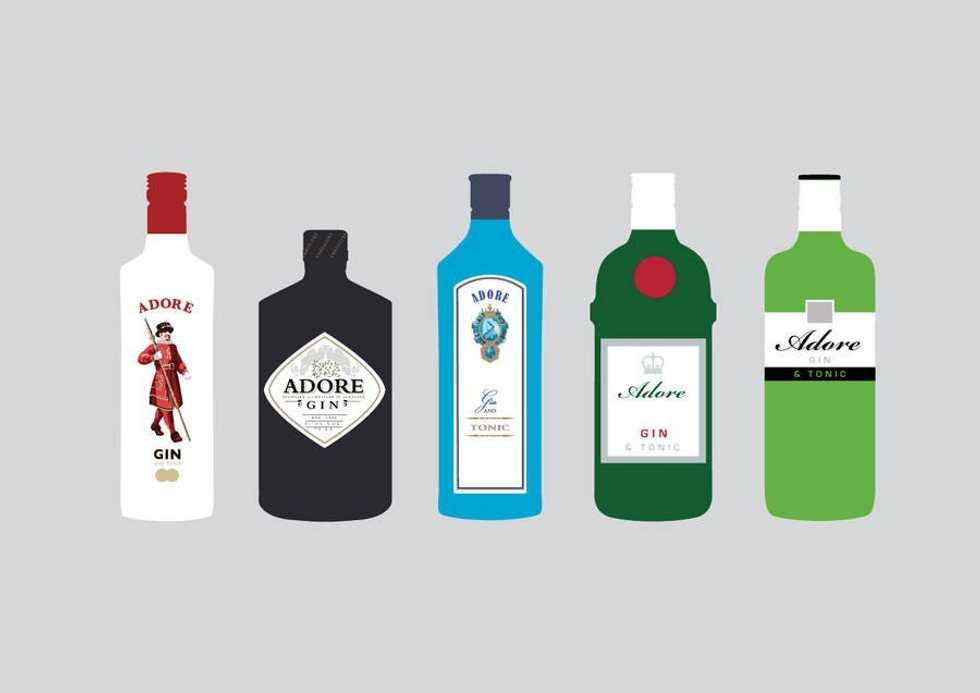
Love, like gin, comes in four distinct types and I am far fonder of gin than I am of love, ancient or modern. So let me explain ancient love to you through gin and why both are important to think about.
Types of Love: Storge, Eros, Philia, and Agape
Types of Gin: London dry, Old Tom, Plymouth, and Jenever
1. London Dry - Storge (Familial)
London Dry gin is the most common type of gin that you are going to encounter. Like it's name suggests this gin is dry, i.e. it isn't sweet, but that isn't necessarily a bad thing and blends quite naturally with some old fashion tonic. Some brands that you might have encountered that fall into the London dry category are Tanqueray, Bombay Sapphire, and Gordon's. Similarly to London dry storge is a common type of love, arguably the most common. Storge is familial love or love that arises due to familiarity with someone or something, like your family or your classmates. C.S. Lewis described it as a love of dependency where you have become so used to someone's presence, in psychology we call this the proximity effect; you may notice that you are far more fond of the people sitting near by in class at the end of the semester than at the beginning, even if you never spoke. While storge is prevalent and powerful, it lacks both breadth and depth much like London dry. If you ask for a gin cocktail, you will get London dry, and though there is nothing wrong with that, life isn't all gin and tonics (though I wish it were)
2. Old Tom - Philia (Friendship)
Old Tom is probably my favorite gin on this list. It was recommended to me by a former professor, and it makes quite possible the best martini I have ever had. Unfortunately, it is has been neglected and relegated memory of the past, or so it seems; so too with philia or friendship. Philia is not an ordinary friendship that comes from that person you sat next to in 'Intro to Psychology' and can have fun with at a party. In fact, I would argue that philia is not even the person you've know for a few years and would probably call a good friend. Philia is when you want to be more than friends with someone, which is a phrase that I am sad to say people are more likely to attribute to eros (discussed later on). I don't believe the step beyond being friends is, as John Green would say, "mutual face licking." The ancient Greeks, from whom this word comes, would more closely translate it to brotherhood. Too often I see people neglecting their friendships in favor of a romantic relationship, a phenomenon which confounds me. Cultivating our friendships is just as important, if not more so, than developing romance. People who live long and healthy lives are well connected with deep relationships that are not just within their family. So go forth a spend time with your the brothers and sisters you have chosen, bring a bottle of Old Tom Gin, and strengthen your love for each other.
3. Plymouth - Eros (Erotic)
Plymouth Gin comes from, you guessed it, Plymouth England and only one company remains that makes it, Plymouth. Plymouth reminds me of eros, also known as erotic or romantic love, due to the cultural implications. Plymouth is included in the types of gin not because it is so different from London dry, being only a little sweeter, but because we care told it what we are supposed to what... and it comes in Navy Strength (57% ABV). This reminds me of eros because we are told we should constantly be in search of a mate and that something is wrong with someone if no one is dating them. Not only this but Navy Strength has a somewhat stupefying effect of the drinker much like eros which comes from our base nature, and it is strong, but in my opinion, all too shallow. Neurochemical studies suggest that the neurotransmitters responsible for erotic love tend to peter out within four years; long enough for humans to mate, have a child, a rear it to an age where it isn't completely useless... I mean helpless... In any case what people often regard as "true love" is often infatuation a fact that become abundantly clear when they look at their lover. Eros like Plymouth gin has it's place but to assert that it is the be all end all is clinging to a false concept.
4. Jenever - Agape (Unconditional)
Jenever is the father of gin though it stretches the idea of a gin much in the same way agape stretches our understanding of love. Traditional Old jenever is made from at least 50% malt wine, and the rest of the alcohol is added through distilled spirits infused with aromatics, and then the liquor is aged in an oak barrel for at least a year. This doesn't sound like the gin most of us know and love, so too with agape. Though many of us would like to believe that our love is agape or unconditional, I think very few of us can attest to that. Agape is regarded as superordinate to the other loves which come naturally to us. Agape is often only attributed to the Christian god's love for humanity, and this stretches the human imagination. Though when your head begins to hurt with the boggling idea of truly unconditional love I suggest a jenever old fashion made with maple syrup.
Gin may not be entirely analogous to love, but that is because the truth resists simplicity. But, many of us think of gin as one monolithic spirit that only changes superficially from brand to brand. So too with love, we try to define love as one thing for all people that only changes superficially when in actuality neither gin nor love can be broken down so simply. So I encourage you to get your friends together, chill some gin and tonic, and discuss what love is and what it isn't and come to your own conclusions, or at the very least drink a fine cocktail.
The inspiration for this editorial came from an essay I wrote analyzing the short story, "What We Talk About When We Talk About Love," by Raymond Carver. I highly suggest giving it a read, especially if, like me, you think about the nature of love a lot.

















