MHE— to most people, those three letters look like the word “me” misspelled by someone who is just over-excitedly typing in caps. But to others, like myself, those three letters signify something that most people do not know exist that, well, essentially defines my life. Ever since I was born, I have always been “different” from your average person. Growing up, I had basically a perfectly normal childhood just like any other person born into a white, Catholic, middle class family living in modern day New York City suburbia. However, there was always one thing that set me apart from every other normal child (besides my devilish good looks, of course) that my parents would soon find out: I was born with a rare bone disease called Multiple Hereditary Exostoses. Even though I didn't know it as a child, this would change and shape the way I live my life forever.
I was born on November 19th, 1994 at Maimonides Hospital in Brooklyn, New York to two loving parents, Craig and Susan Eaton, and two older siblings, my brother Christopher (the oldest) and my sister Danielle (the monkey in the middle). I was born a perfectly healthy 7 pound 2 ounce baby or at least, so they thought. A few months after my parents took me home, they noticed what looked like a little bump on one of my left ribs so they took me to a doctor to have it checked out. A few tests, doctor appointments, and countless “second opinions” later, my parents were told that I had a rare bone disease called Multiple Hereditary Exostoses, aka MHE for short.
MHE is a bone disease that causes countless cartilage-capped bone tumors to grow throughout the body that affects about 1 in every 50,000 people. Think about it, that’s less than 150,000 people in the entire world affected by these tumors. These bone tumors could range in size from barely noticeable to bigger than a softball, and could cause pain, deformity and loss of motion that could even get as bad as immobility. Due to MHE, I have been going to doctors and seeing surgeons all my life. Ever since I was a little kid, I thought it was normal to make trips to the hospital once every couple months. I came to learn to enjoy it because as a kid, it was a free day off from school and a mini road trip to Philadelphia, where I have been treated at numerous hospitals throughout most of my life.
I’ve been treated at hospitals in Philadelphia for most of my life because simply put, the doctors I go to have been the best suited to deal with MHE and the complications that come along with it. In a large majority of people afflicted with MHE, the chance of these tumors becoming malignant is slim to none— barely even two 2%. Therefore, in nearly every case with MHE, the tumors remain benign and never pose a threat to life. But in the summer of 2010, I noticed a tumor that was growing on my shoulder much faster than usual. The size of it went from barely noticeable to the size of a baseball in the matter of about 5 weeks. It started causing me a lot of problems and on August 30th, 2010 I had a surgery to remove it, not even suspecting of what was to come. After the surgery, my doctor noticed that there was something “off” about the tumor. So, he sent it out to a pathologist to have some tests run.
About a little over a month later, the results came in. On the night of October 10th, 2010, my parents sat me down and said that we “need to talk.” My first thought was, “What, are we dating and you’re trying to break up with me or something?” But my juvenile attempt to make an uncomfortable situation bearable, failed. I was a naïve 15 year old that had no idea what was about to happen to me and how my life was about to change forever.
They sat me down and told me the three words that I had thought I would never hear: you have cancer. Cancer, at 15 years old. CANCER. The word “cancer” resonated and echoed in my head over and over as if I was in some sort of weird dream; a nightmare, to be correct. My heart sank and it was the worst feeling in the world. The rush of thoughts and emotions that overwhelmed me at that second were unbearable and I had no idea what to think or do except to just cry. That night, and the three nights leading up to the surgery, I barely slept. I stayed up all night thinking and when possible I would throw a lacrosse ball against a wall for hours on end to try and relax myself, but my attempts at peace failed. Beneath the calm exterior, I was a complete mess. I woke up the next day hoping that it was all just a hellish nightmare. But nope, the nightmare was reality. On October 13th, 2010 I had a twelve-hour surgery to remove the malignant tumors as well as the three ribs that the cancer had metastasized to. Thankfully, there have been no more major problems since.
So, as you can see, the implications this disease can have on someone’s life can be immense, both physically and mentally, and can take a toll on those that have to deal with it. Due to this unrelenting disease, I have had over 200 tumors, 30 surgeries, and cancer all by the age of 19 years old. The problems from MHE are nowhere near close to being done just yet. I have had to go through more problems and had to overcome more obstacles by the age of 19 than anyone should ever have to go through in their entire life.
Although to everyone I may seem like the happy, laid-back kid that never lets any of this get to me, I truthfully am the farthest from it at times. There are times where I just want to quit. There are nights where I cry and think of what the point of it all is and why I was born with this disease. Between the constant aches and problems caused by the tumors, the surgeries, the doctor appointment after appointment, the constant MRIs, x-rays and other testings, the trips to hospital after hospital after hospital, a lot gets taken out of you. It really does take a large toll and just puts a weight on your mind that is hard to shake. You start to just get fed up with having to deal with it at points. But, despite all these obstacles, I never give up and always find a new way to get through them because hey, things can always be worse.
One of my favorite quotes is, “Out of struggle, comes success.” When I am at my low points and I think of why I have MHE, the thing that keeps me going is the reason why, in my opinion, I was able to beat cancer and fare so well with this disease: I lived to help further the cause and do whatever is in my power to help rid the world of these pests that we call MHE and cancer. I lived to fight.
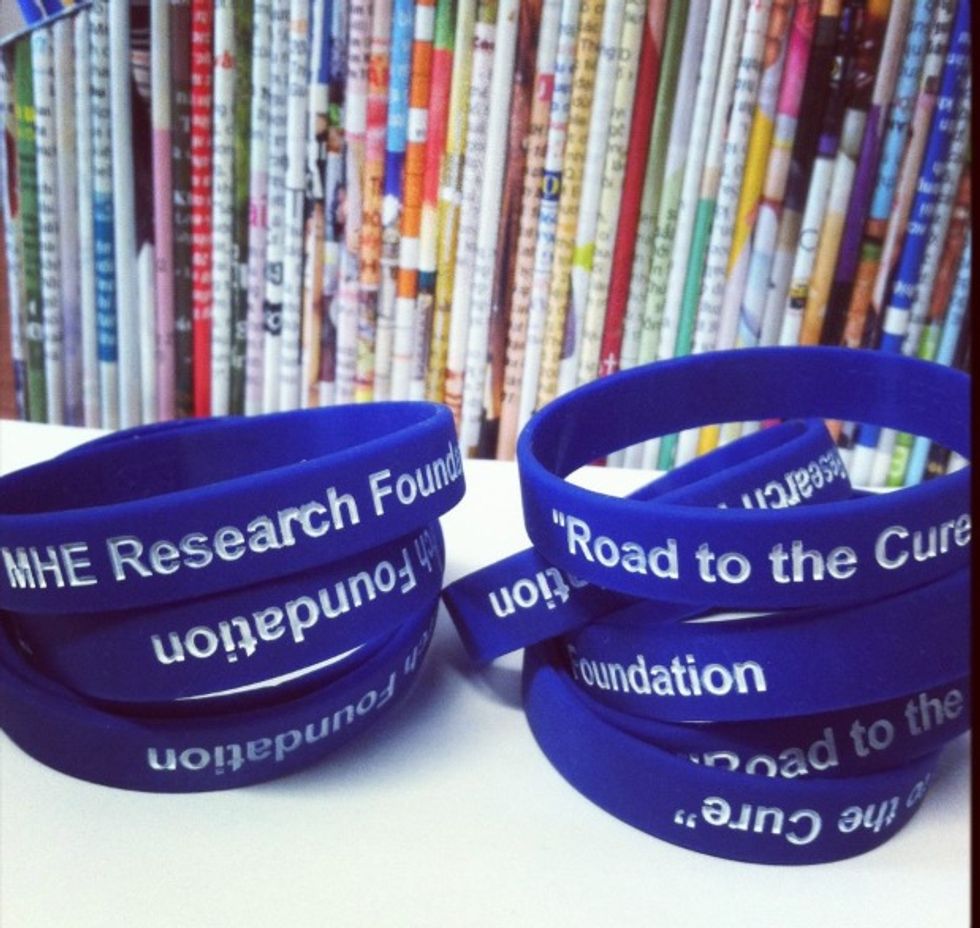
I am not writing this article in order to look for people’s pity or empathy; I am writing this to show and emphasize the effects this disease can have on someone’s life in order to hopefully spread awareness and to send a message that no matter the circumstances, there are always positives. You can take a devastating diagnosis, an illness, frustration and depression and turn it into a fight against the disease. Back in 2005, my family and I created the MHE Research Foundation which is dedicated to finding ways to raise money to fund researchers that are working for a cure. Since its inception, the MHERF has raised over $250,000 for research through fundraisers and selling “Road to the Cure” bracelets.
However, this limited funding can only go so far. For patients that are already afflicted with the disease, its too late; we will have it for life. But for future generations, for our children and grandchildren, there is a significant chance for researchers to find a way to prevent MHE for them. Personally, I was one of the rare cases where no one else in my family has MHE despite its hereditary aspect; I just happened to have the first mutation in my family line. Therefore, if I were to not have any biological children, that would be one less line of MHE patients. Although this is an unpleasant reality I have already came to terms with, a reality where a cure for MHE is found and I can have my own children is one that is much, much sweeter for myself and other patients in my position.
As you can see, MHE has taken a lot from me just as it does from other people afflicted with this disease. It has taken away any chance of me having had a “normal” childhood, taken away months upon months of my life due to surgeries, recovery, and trips to the hospital among other things, and above all, has taken away my peace of mind, constantly living with the thought in the back of my head that these problems will never go away. But, MHE has given me so much more; not only has it shown me how amazing my family and friends and the rest of my support base are, but also it has given me a strong will to fight against, an unmatched passion to advocate for, and an absolutely unparalleled determination to ultimately help rid the world of this disease.
If MHE had the same funding and support as well-known diseases like cancer and Alzheimer’s have, progress in research for treatment of and a cure for this disease would be exponentially farther than where we are right now. Rare diseases like MHE do not receive even one percent of the funding that well-known diseases like cancer and others have. I am in no way saying that other diseases are less important than MHE, but I believe that too little is done for such rare diseases. So, overall, this article is a plea to those reading it: we need your help. Whether it be through donating to the cause, sharing this to help spread awareness, or even just taking the time to read this and educate yourself about MHE, you can help and be a part of the Road to the Cure.
**If anyone would like more information on how to get more involved, please visit MHEResearchFoundation.org and please do not hesitate to get in contact with me via e-mail me at veaton@villanova.edu or through facebook if you have any questions. Please share this article and help spread awareness and become part of the Road to the Cure. Thank you!**