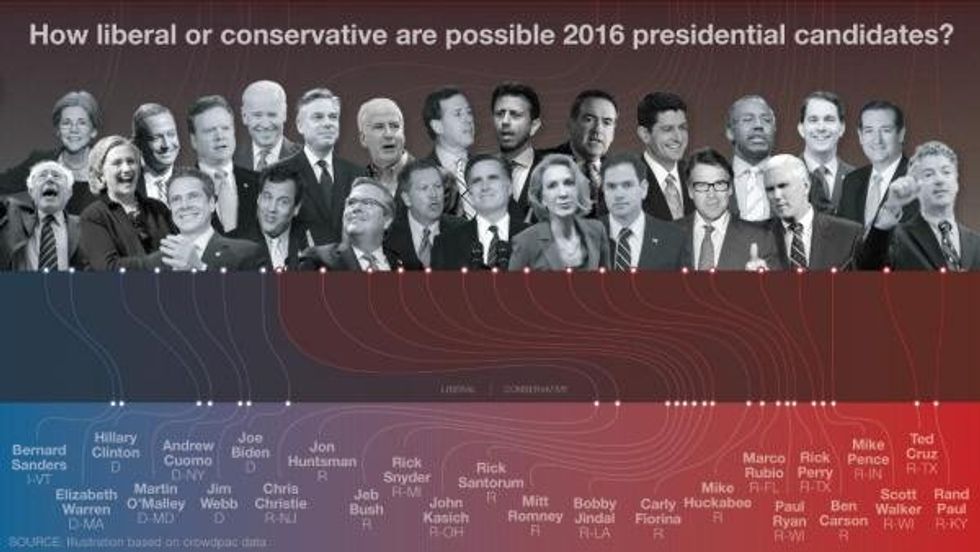
Take a look at the political spectrum. Generally speaking, there's far left wings, liberals, moderates, conservatives, and far right wings. We tend to call those who fall on the end of the spectrum, extremists. Liberal and conservative go hand in hand with the two primary political parties—Democrats and Republicans. I don't believe that one must agree with all issues associated with a certain party in order to identify with said party.
Sometimes we hear the phrase, “a liberal republican" or "a conservative democrat." Well, isn't that confusing? The word "liberal” is becoming a word thrown around way too frequently. We're living in a society in which such a word can be taken negatively or positively, depending on where you are. To some, many aren't "liberal enough" or rather, the opposite, "too liberal."
To clarify, there are several political groups and in that, many types of liberals. For the sake of argument, two liberals exist–liberals who aren’t liberal enough and liberals who are too liberal. In most cases, the moderate liberal fears both. But is there really such thing as being too liberal? On countless occasions, I have been told no. Sometimes, I disagree. Extremists on any side of the spectrum seem to degrade the opposing party and make quite the accusations.
In the same light, any extremist can have a tendency to come on too strong. There’s a different question of whether we fear the ones considered “too liberal,” if such people exist at all.
In the strictly democratic sense, there has been a leftward movement as seen with same-sex marriages, which has been nonetheless, beneficial. This is not to say this shift is steering the United States in the wrong direction. From a liberal point of view, it can be viewed with many positive attributes. Then we have those who are considered “not liberal enough.” The same people who claim Obamacare isn't liberal enough or tweet about Hilary Clinton not being progressive enough for democrats. Is there such thing as not liberal enough?
The phrase, "those who call themselves liberal," comes into play. In no sense is this to be politically correct or an accurate description of someone. In this case, it’s a slight jab at those who are believed to have no sense of liberalism.
For starters, liberals are at war with other liberals. Maybe this is my own personal opinion, but constantly people bicker about whether someone is a more “conservative liberal” or vice versa. Thus, some see the word ‘liberal’ as more of a title rather supporting such views.
The liberal self-identification factor has played a huge role in American politics. Many have some sort of self-recognition when associated with the term liberal. Maybe they believe that associating themselves with the word, liberal comes with a sense of pride or support for equality.
Many can argue the word ‘conservative’ can be taken in the same respect. We can overanalyze whether a person is “too conservative” or not “conservative enough.” Thus, the concern is not whether these types of people exist, the issue is why do we need to fall on the spectrum in the first place.