


I admittedly don’t get too worked up about much anymore. Life nowadays is very tiring, with the constant exposure to media, public outcry, and social issues--it’s hard to maintain any kind of feeling when some new disaster comes along.
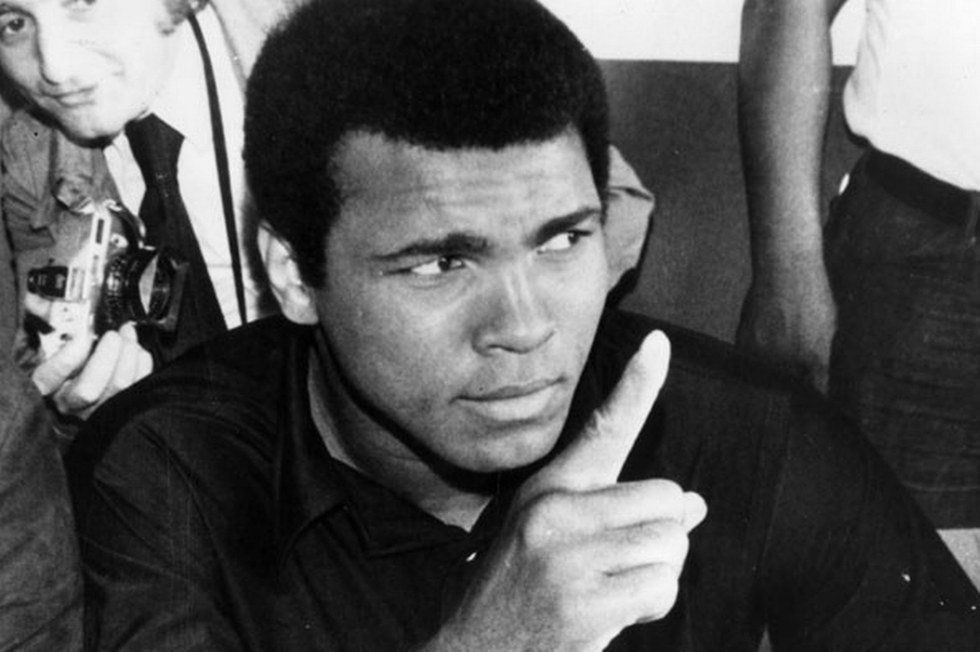
But when I heard Muhammad Ali had died at the age of 74, I felt a pain unlike anything I have felt in a long while. Muhammad Ali had been a name cemented in my life, and the lives of many, as a household staple of boxing. Even the least-sporty millennial (aka, myself) could name at least one boxer off the top of their head, and that boxer was Muhammad Ali.
In order to properly remember the man, one must remember the legend. Muhammad Ali set himself apart as an exceptional boxer and an exceptional human being. According to his first coach, Joe Martin, Ali (then known as Cassius Clay, his given name) set himself apart by being sassy, and by “outworking all the other boys.” His dedication to his craft was unparalleled, and his motivation was an inspiration. In 1956, Ali took part in the light-heavyweight class Golden Gloves tournament, and in 1959, Ali earned the Amateur Athletic Union’s national title in his division, and was christened Golden Gloves Champion.
This was only the beginning of Ali’s greater successes. At age eighteen, he was working his way toward the 1960 Olympic Games in Rome. Overcoming the odds (and his fear of airplanes), Ali won the Olympic Gold Medal in Light Heavyweight Boxing, beating Polish boxer Zigzy Pietrzykowski. In 1965, Muhammad Ali fought Sonny Liston in Lewiston, Maine, and TKO’d him in the first round in just two minutes and 12 seconds with his famous “Anchor Punch.”
During the Vietnam War, Ali’s boxing career came to a halt when he refused the draft. Losing his court battle, Muhammad Ali was stripped of his boxing license and his titles, and was sentenced to five years in prison. This did not deter him from his purpose: Ali actively spoke out against the Vietnam War, and used his time off the boxing circuit to give talks at schools and colleges.
However, as the war climate shifted, Ali was able to make a slow comeback into the boxing world, eventually facing off against Joe Frazier, an undefeated champion, at Madison Square Garden in 1971. Though Ali lost the fight against Frazier via decision after 15 long rounds, he did win his fight in the Supreme Court, and had all of his boxing titles and licenses reinstated.
Ali’s career only got hotter from there. In 1974, the famous “Rumble in the Jungle” against George Foreman took place in Zaire, Africa. All through the match, it seemed as though Foreman had Ali on the ropes—but that was Ali’s plan all along. The “Rope-A-Dope” tactic allowed Ali to maintain his stamina while draining Foreman of his, all while taking little damage. Ali’s tactic brought him to success, and he defeated Foreman in the eighth round.
In 1975, “Thrilla in Manilla,” also known as Ali-Frazier III, took place, and for 14 grueling rounds, both fighters stood up to each other. Ali, well-known for his trash-talk to faze his opponents, had merely riled Frazier up to the point of immense focus. Both fighters deviated from their normal fighting style, resulting in one of the most surreal and intense matches of Ali’s career. Ali finally TKO’d Frazier in the fourteenth round, and told his trainer afterward, “Man, this is the closest I’ve ever been to dying.”
With intense matches and title bouts, it seemed as if Ali could continue his legacy forever. Unfortunately, in 1984, Ali publicly announced his Parkinson’s diagnosis, which signaled the end of his boxing career.
I’m sure many people are acquainted with his boxing legacy—and while it is prolific and admirable, it must also go hand-in-hand with who Ali was as a man.
A generous man and a devoted humanitarian, Ali consistently tried to use his publicity and means to do good; “The more we help others, the more we help ourselves.” Ali was strong in his convictions and unwavering in his beliefs. Shortly after Ali won his 1964 title bout against Sonny Liston, Ali converted to Islam and officially changed his name to Muhammad Ali. Ali’s faith became his cornerstone. He believed wholeheartedly in the peace the Islamic faith provided him.
This peace was also one he tried his hardest to spread to others. Ali was a civil rights leader. He is cited as having “made goodwill missions to Afghanistan and North Korea; delivering sorely needed medical supplies to an embargoed Cuba; traveling to Iraq and securing the release of 15 United States hostages during the first Gulf War; and journeying to South Africa to meet Nelson Mandela upon his release from prison.” Ali created the Muhammad Ali Parkinson’s Center in Phoenix, Arizona, after his own Parkinson’s diagnosis, and continued to contribute to it until his death. Throughout the years, Ali has been recognized for his humanitarianism, being awarded such honors as the title of the United Nations’ Messenger of Peace, and earning the Presidential Medal of Freedom.
Ali was an inspiration to black Americans and black people all around the world. One anecdote from Ali’s biography says, “A reporter at one of Ali's last fights asked a bathroom attendant at Caesars Palace if he bet on the fight, and the man replied, ‘Yeah, Ali.’ When he was asked why, he said, ‘Why? Because he gave me my dignity. Because he's Muhammad Ali, that's why.’ For most people, that says it all.”
Some of Ali’s smaller, more personal victories are perhaps some of his greatest. Ali spoke kindly to anyone who approached him, and was always honest. A famous incident occurred in which Ali talked a suicidal man away from harm. Ali brought happiness to those closest to him, and some footage of him after his Parkinson’s diagnosis shows him still happy, still smiling, and still being “The Greatest.”
Muhammad Ali was dedicated to his fellow man in a way we may never see again. A great sportsman, poet, and civil rights activist, Muhammad Ali has shown all of us how much change just one person can make. He believed in unity wholeheartedly. He was wise beyond his years, and made his life grand from the very beginning right until the very end.
Mr. Ali, from the bottom of my heart, I want you to know that I—and many others—loved you, and continue to love you, very much. You have given the world so much hope, and no matter what, you were the very greatest. We will miss you with all of our hearts.
With love,
Everyone.
“Me. We.” – “World’s Shortest Poem” by Muhammad Ali
















