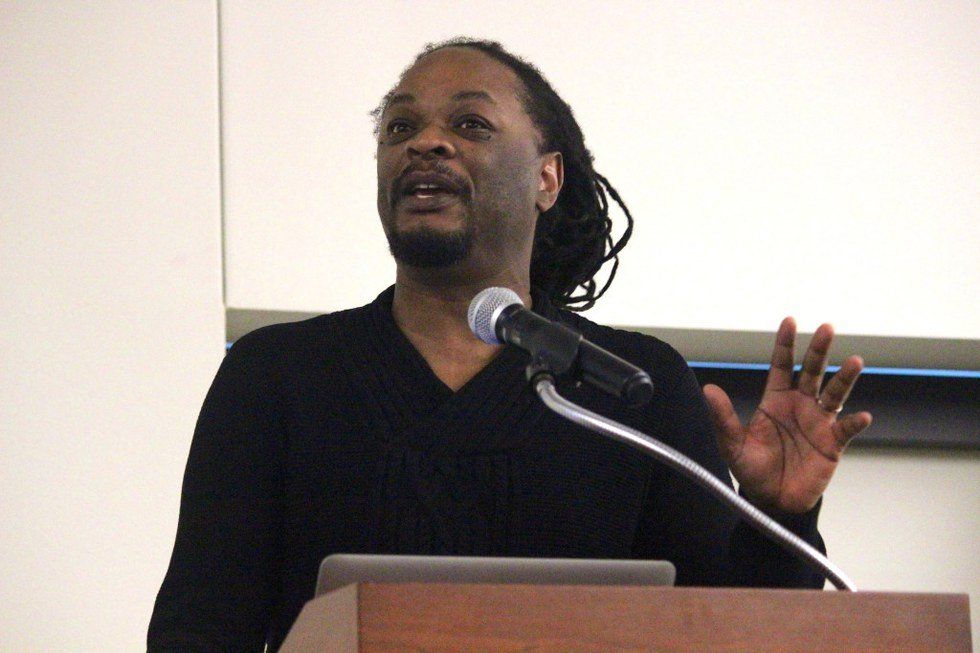
Last week, the dean of students at Stockton University, Gerald Martin, introduced well-known author Lawrence Ross to the campus center theater. Ross came to talk about his campaign, Know Better Do better: College, Racism, and You, for his latest book “Blackballed: The Black and White Politics of Race on America's Campuses”. “Blackballed” talks about a number of past and present racial, historical issues on hundreds of college campuses and how this ties into the Black Lives Matter campaign.
Many of you probably know of the latest episodes of racial hate that swept the US - the infamous “SAE Song” featuring two white college fraternity males on a bus who proceeded to sing a racial song about how blacks would never be allowed in their fraternity at Oklahoma University last March.The pressman for SAE then came out to say that they were only two guys out of the fraternity to do such acts and that this was an “isolated incident”. There was only one problem with this statement. This was not the first time this song was ever sung on a college campus.
Texas Tech and other universities had heard this exact same song on their campuses as well. This proved that this was not an isolated incident, and that other chapters in association with SAE had sung the song before. The song was actually taught to them on a cruise for a conference, yet the press still denied that their chapter had a racism problem and that it was only just about four chapters that were involved. They still considered this an “isolated incident”.
When we are looking at campus racism much like this one, it all starts about the same way. By association, we inherit white to be pure and good and the color black to be something sinister and evil. This can be seen in many experiments, such as the black doll and white doll experiment with young children. So, we can take a look back at this current situation and many ask the same question infantiling them. They never say that this choice was based on their own volition and judgment, to others, something else has to be at work here.
Ross said that his favorite theory that people like to use for why they did this was referred to as the “Wakka Flocka Flame Theory” propagated by none other than Joe Scarborough. Scarborough blamed the racist comments made by SAE on rap artist Wakka Flocka Flames lyrics. “The kids that are buying hip hop or gangster rap, it’s a white audience, and they hear this over and over again. So do they hear this at home? Well, chances are good, no, they heard a lot of this from guys like this who are now acting shocked.” To which Wakka responded later, “This isn’t about rap. This is about what happened on that bus. This isn’t about my rap music. I feel like they’re running away from what we’re talking about.”
Now, we can blame Wakka for a lot of things in this world, but hardcore suspended racism? I think not. But let’s humor this theory for a second. What about Tau Kappa Epsilon’s incident in 1963 at Cal State Long beach? They were suspended for singing something similar: “Bye bye black boy you better play it cool, or else we’ll bomb your Sunday school.” This song was derived from an incident of a bombing of a Birmingham Sunday school church in 1963, where four little girls were murdered after the bombing of the church. Can we still say that was an isolated incident? Can we still say that it’s all Wakka’s fault that these incidents occurred? Or is there something worse at work here?
Ross then proceeded to talk about this rather icky subject we call racism. It is icky because it’s a sensitive subject that many defuse, divert, or refuse to talk about it. Ross talked about racism very bluntly and candidly to his audience. He talked about the foundation of racism and how it is transported to today’s society of campus racism. He then talked about his theory of “three I’s equals a miss”. This theory was placed on how each case of racism is dealt with on a college campus according to his research.
First, they individualize the case saying that it was only that group or certain people within that fraternity or sorority, and that it doesn't make up the whole fraternity. The next thing they do is minimize the situation. They don't care what people saw, and they tell people that their chapter doesn't have a racism problem. This means that they are not digging deep enough to see that there were other problems within the chapter and not just that particular incident. The last thing they do will be to trivialize the situation. When all these things are done, you start diverting and dismissing the concern away from the situation.
So where do some of us fall on the line, educationally, with the theory and study of racism? Some of us come from educational backgrounds in knowing the racial theories and how racial ideas came into being, myself included. Some of us are in between, some think Martin Luther King Jr. was the one who freed the slaves in 1982 (a joke obviously, but you get the picture.). Whatever side of the spectrum we are on, Ross made us truly understand what racism actually was. Sociologically, race plays a part in our everyday lives, however race is a biological nothing. There are no differences between us biologically.
So what were one of the foundations of the United States? Was it freedom and democracy? Was it free market and capitalism? Or was it whom we all suspected? Beyoncé. Actually when we actually look at history, jokes aside, white supremacy is one of those foundations. White supremacy is a pseudo-science designed for Europeans to exploit non-Europeans and strip them of their humanity. Whites are considered to be normal while races other than white are referred to as the “outsiders” or the “other”. Ross was talking about the foundations of society. White supremacy bended certain rules to create a society in which to fit their own racial belief systems. Thomas Jefferson and Abraham Lincoln were among the famous Americans who believed that whites were intended to be above blacks and non-blacks. It created public policy. Slavery was public policy.
Once we get away from slavery, we enter segregation, again taking the rules and benefits to fit that of white Americans and bending benefits away from minorities. Minorities are working in a society of inequities, thus making it hard for them to work, find jobs or even be accepted into regular schools. What is interesting in what Ross says is that “society is always going to bend this way no matter what.”
Then we get into racism. Ross divided the category of racism into three parts. It claims differences in character and intelligence. Second, it asserts a superiority of race over another and others. Third, it seeks to maintain a dominance through complex beliefs, behaviors, use of language and policy.
Racism comes from the individual, but it’s at the institutional level that racism is never talked about. Ross referred to racism being a cancer and systemic racism is also a societal cancer. Ross says steps must be taken to make sure that racism is taken seriously, especially on college campuses. The first step is to realize “that you are sick”, meaning to address racial issues on campus to prevent them from occurring. It’s no surprise that African-American students decide to protest because these issues are not really looked in to. Many minorities before coming into college campuses sometimes come from underfunded schools. This forces them to be looked at as “people who don’t work hard enough,” when they don’t realize how hard it was for them to get to a university in the first place. Some also get in by sports, which shows how the athletic department is looked at in terms of revenue and the emphasis on students and color.
Jumping ahead to the end of the lecture, Ross brought up his favorite quote from Martin Luther King Jr.: "Nothing in all the world is more dangerous than sincere ignorance and conscientious stupidity." This made sense due to all the racial actions that students have done on their own volition and gave thought to their actions before doing these acts.
That being said, as people of a new generation, we need to fight against racism. We need to not make the same mistakes that many other college campuses have made in the past or present. We are supposed to be seen as the people who are able to fix what’s wrong in the world and to be better than that. We must all work together collectively to rid racism on our campus as well as be a leading example to other universities in the nation.