

Editorial Note: This article contains mentions of violence against women and sexual assault.
"Batman: The Killing Joke" is arguably the most culturally important and controversial piece of comic media not only for readers and fans of the DC universe and the “Caped Crusader,” but for popular culture as a whole. At its core, The Killing Joke is a rather simple one-off story of everyone’s favorite brooding billionaire Batman versus the comically cooky Joker. But "The Killing Joke" broke new ground for comics in two ways, first by giving Joker a humanizing backstory, and second by addressing and critiquing the overall principles and motivations of both characters.
"The Killing Joke" sees Joker attempting to drive police commissioner Jim Gordon “mad” through physical and psychological torture, all the while berating him for refusing to recognize that he and Batman, who the Gotham City Police are fairly chummy with, are both societal menaces who operate outside the law. The Joker is out to prove that he is no different than anyone else, that everyone needs “Just one bad day” to go crazy. Batman, in his own moral dilemma, is seen debating whether or not he ought to kill the Joker, as it has become apparent to him that their relationship will eventually lead to a death on either side. In the background of this story we also have flashbacks of the origin of the Joker, a regular guy whose “one bad day” causes him to become horribly disfigured and mentally unhinged. What we are left with is a nuanced portrayal of a Joker who sees the absolute ridiculousness of modern society, and wants to either make everyone else recognize the fact, or just die himself. The writing by legendary comic writer Alan Moore is tight and impactful, and artist Brian Bolland’s illustrations are so iconic with their dark, contrasting colors and sharp, disfigured faces that panels from "The Killing Joke" are immediately recognizable to anyone who has done so much as browsed the book. I’ll never forget the first time I saw the Joker’s big smile in his hat and Haiwain shirt as Barbara Gordon opens the door, or those horrible cherubs that Joker has parade a naked Jim Gordon around his circus of freaks.
All in all, many a comic fan were excited when it was announced that an animated movie version of "The Killing Joke" was being made with Bruce Timm (director of the incredible "Batman: The Animated Series") at the helm, with both Kevin Conroy and Mark Hamill returning as voices for Batman and Joker. Both Conroy’s Batman and Hamill’s Joker are what many consider the definitive voices of the character’s, Conroy’s low and commanding Batman being a perfect foil to Hamill’s manic and boisterous Joker. Hamill’s involvement was a big deal as well, considering he had previously said that he was done with the voice after "Batman: Arkham Asylum". In what was promised to be a page-for-page remake of "The Killing Joke" for the fans, we rejoiced when it was announced the "The Killing Joke" was given the R-rating that it deserved. My best friend and I bought tickets to a release night screening, and we sped to make it in time after my closing shift at my retail job, which is a lot like being Batman, since we both hide in the shadows and only assist when signaled, although I’ll probably end up getting fired. I arrived in a college name t-shirt and cargo pants, the official nerd uniform. As we took our seats surrounded by Bat-signal tees and Joker costumes, we smiled as Mark Hamill explained the process of becoming the Joker, and then fell into a hush as the opening scene faded in.
And then everything fell apart faster than a Taylor Swift apology.
First, let me tackle what was enjoyable about this movie. The second and third of this three-act special were loyal to the last panel of the original Killing Joke. Set pieces, facial expressions, and iconic panels were translated to animation in recognizable fashion, and major plot events were as shocking as my first read through. The best translation of still art to animation had to be Joker laughing coyly as he toasts Jim Gordon, his eyes obscured by a straw hat, giving extra focus to his horrifying grin. The voicework was, as expected, fantastic. Conroy’s Batman was its usual gruff and calculating monotone, but it was Hamill who rightly stood out. If "The Killing Joke" is the ultimate Joker story, then it’s only fitting that Hamill gave the best performance in his career as the “Clown Prince of Crime.” Hamill delivered Joker’s biting social commentary with an uncomfortable rage, and I thought his use of his normal speaking voice when Joker is seen before his horrible transformation in flashbacks was a nice touch. From that first laugh, he sold it. So where did it all go wrong?
The answer is one word: Batgirl.
Before I get into this, we have to understand the role of Batgirl (aka Barbara Gordon) in "The Killing Joke". "The Killing Joke" is known, among other things, for its brutal violence and imagery, much of which surrounds Barbara. In one of the most fucked-up scenes ever committed to comic, Joker shoots Barbara Gordon in the spine as she opens her apartment door, paralyzing her and leaving her on the floor in a bloody mess, but not before he strips her naked and photographs her in order to psychological break her father, Jim Gordon, later in the comic. This is where "The Killing Joke" is at its most controversial, as many have pointed to evidence that Barbara was also sexually assaulted, a debate that has gone on since the comic’s debut. And while Moore has chosen to distance himself from what he now admits was a problematic and inappropriate story line, this does little to address the recurring trope of violence against women in comics as a plot device, where said women are left powerless and only serve to highlight the violence or depravity of a character. In "The Killing Joke", we see Barbara shot, and then we see her again for one scene at the hospital, where she tells Batman in wide-eyed horror that her father has been taken and that she is worried, never mind the fact that she may never walk again. As someone who likes The Killing Joke for its take on the philosophies behind Batman and the Joker, this plot point has always bothered me, because that’s all it is. Barbara is unable to enact her revenge on the Joker, or discuss the ramifications of her injury: It’s just something that happens, and is not touched on again in the story. It is a legitimate critique of the story, and it was something that the creative team behind "The Killing Joke" movie set to resolve, only to fail at in an explosion of misogyny.
In attempting to make the less than 100 paged Killing Joke into a full-length feature movie (or 90 minutes), Bruce Timm and the writers chose to give exposition to Barbara Gordon/Batgirl, hoping to amend her problematic storyline in "The Killing Joke". When I first read about their plan, it seemed like a good idea. Tying the audience to her character and making her more three dimensional, rather than a set piece ready to be disposed of, would be a step in the right direction of lessening the problematic discourse of the original Killing Joke, and perhaps demonstrating her role as Oracle, Batman’s logistics and information expert, after her paralysis. I had faith.
But lord, was I wrong.
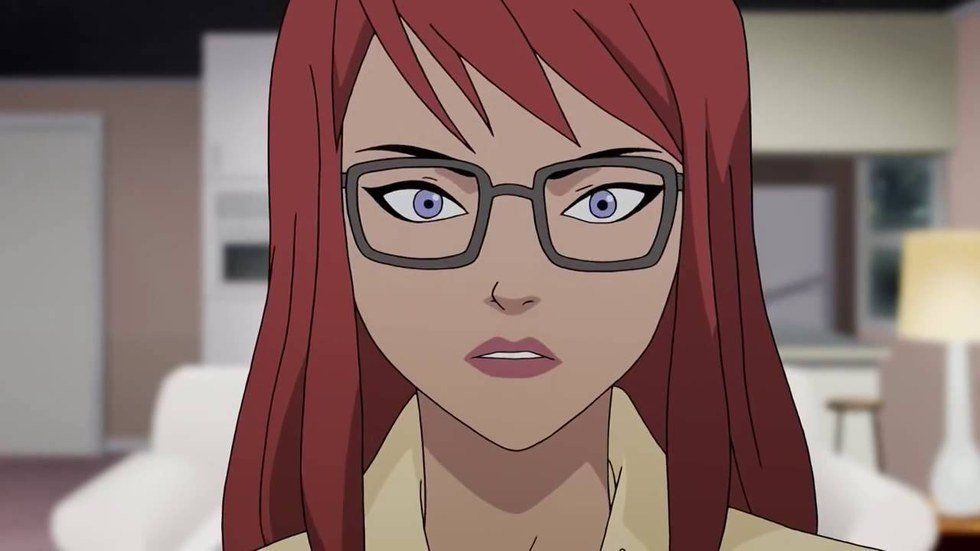
What we are instead treated to in the first 30 minutes of The Killing Joke animated feature is an objectified, stereotyped Batgirl that betrays her portrayal in comics and lessens the film as a whole. Batgirl, who has been working with Batman for the last 2 years, finds herself up against the “sociopathic” nephew of a crime boss who is enamored with her, toying her with come-ons and invitations to come and find him. Batman, concerned with her uncontrolled emotional state, does not trust her involvement in this case, and tells her to stay away. Here we have our first major plot complication: Batgirl is attracted to Batman, yet resents him for refusing to treat her as an equal. She seeks advice from her stereotypically gay best friend, goes off to fight the mobster again, and then has rooftop sex with Batman after he confronts her about not taking crime fighting seriously, like he obviously does. This creates awkward tension between the two, until she finally call Batman, who has coincidentally been injured fighting the mobster. Batgirl comes to the rescue, and almost beats the mobster to death, after he asks her during the fight if she’s upset because it’s “her time of the month.” She realizes that she was wrong to almost kill this murdering psychopath, and begins to understand Batman’s previous statement about having to come “close to the abyss” to be a crime fighter. End act 1.
Let’s break this clusterfuck down.
First, Batgirl displays the classic trope of the woman who can’t control her emotions. She yells in the library describing her relationship with her “yoga instructor” with her best friend. She flips a guy into a bush when he tells his girlfriend he wants space. She kisses Batman after she lashes out at him, then has “amazing” rooftop sex. She beats the antagonist silly when he makes a period comment. The writers make it clear that she is not in control of herself, unlike all the other strong and collected men in the story. There’s also the whole thing about her not being a very good Batgirl. She’s constantly losing fights and getting in situations where she needs Batman to save her, who she simultaneously resents for doing so. Typical woman. Finally, the first act ends with her recognizing that she’s not cut out for the tough work of being a Bat family member, turning in all her gadgets to tall, brooding, and handsome. At the start of the original action on The Killing Joke, she is no longer Batgirl, and is still guilty about banging ol’ Bats under a gargoyle.
To me this is a problem because this character is not what Batgirl is about at all. Batman is a father figure to Batgirl, with a significant age difference to show in the comics. She is an adapt fighter and tactician, often besting Robin in their adventures. She works side-by-side with Batman, a trusted confident and rational thinker. She is not some confused woman in a rom-com attracted to her boss, and the sex, to me, felt kind of incestuous. It betrays the powerful and confident woman portrayed in Batman: The Animated Series, something that the team behind The Killing Joke should know well. Batgirl becomes a self-fulfilling prophecy. In the words of Noah Berlatsky, “What kind of superhero would just let herself be shot? An overly emotional, unprepared, semi-incompetent hero, the cartoon creators chorus.”
This, along with the more-often-then-not lazy animation (anything that moves more than walking speed in CGI rendered), makes The Killing Joke a subpar translation of an equal parts controversial and groundbreaking comic. Rather than admitting and addressing real concerns of fans and critiques alike, the project digs itself deeper into the hole, presenting its audience with what felt like a rushed remake that adds little to the source material. While Joker and the man who also a bat sure did duke it out mentally, the film lacked the nuance and style of the original comic, something that the film version of The Dark Knight Returns was able to execute with little complication. But perhaps the time for The Killing Joke has past, as many fans and critics of comic culture have distance themselves from the graphic novel in more recent years, admitting that maybe, just maybe, it was trying a little to hard to be edgy and dark. My only hope is that DC animated movies returns to films like Mask of the Phantasm for inspiration, and maybe put out a Long Halloween movie soon. When it comes to the last laugh, this critic certainly isn’t giving it.

















