The high speed bullet train zooms down the track as a girl with long flowing blond hair, a pale face and bright blue eyes awkwardly shrugs her shoulders and stands up on her tipee toes to keep from being claustrophobic.
The train is so crowded that everyone’s shoulders touch. The girl tries to hold her breath to keep from breathing in the stinky stench of sweat that has now perspired like a cloud above her head.
Ding! Ding! The doors open and the girl is free from the train as she walks into a crowd of Japanese people. Some people stare at the girl, looking her up and down. Then a young child with black hair and brown eyes waddles over to the girl and asks to touch her golden locks.
“People in Japan aren’t use to seeing people with blond hair, so I get asked a lot if they can touch my hair,” said sophomore Bethany Hettinger.
Bethany grew up in Japan because her parents are Christian Missionaries and teach English. Her dad is also a wedding pastor.
“Weddings are popular in Japan,” said Bethany.
There are three religions that the Japanese pass through in their lifetime.
“First, they are born into the Shinto religion, which is the ancestral religion of Japan. Basically, this is because they are born into their family. Next, they marry Christian because it appeals to the youth, as many of them like the western way of doing things like wearing the beautiful dresses. And then they die Buddhist and have a Buddhist funeral,” Bethany said.
Bethany was born in Chiba, Japan, which is a prefecture to Tokyo. The most recent place she has lived is Osaka, Japan.
“[Osaka] is compromised of approximately 2.6 million people, it’s the third largest city in Japan and is known for its stand-up comedy entertainment, so it’s a very crowded, but fun city,” said Bethany.
Bethany lived in Japan for 18 years until she decided to come to America to attend Colorado State University last year.
“I decided to attend C.S.U. because I wanted an American education and some relatives live here, so there was a level of comfort. Also, my brother attends C.S.U. and really enjoys it,” Bethany said.
In Japan, Bethany grew up learning English and Japanese.
“I like to say that my first language was actually two languages because I remember learning them around the same time,” said Bethany.
In Japan Bethany’s family only spoke English at home and Bethany spoke Japanese when talking to other people.
“We weren’t allowed to speak anything else besides English at home because my parents wanted me to be able to go to an American university someday. Also, a lot of my friends from Japan who learned English later on speak bad English,” said Bethany.
Even though Bethany is fluent in Japanese, she wants to keep her skills sharp as she attends C.S.U. She is taking a level 400 Japanese class, which helps with translation and interpretation.
She has a double major in English with a concentration in language and international studies with a concentration in Asian cities. She also has a minor in Japanese.
“I initially wanted to choose just one, but I wanted to do more. So far it’s been really fun and has been worth it,” said Bethany.
Bethany is also a Resident Assistant for Parmalee Hall.
“I signed up to be an R.A. because initially I wanted to help guide residents in their transition into college and help them to grow, succeed and graduate. I also found this to be a good way for me to connect with the international students,” said Bethany.
Bethany has helped people embrace the Japanese culture as she shares it with her friends and hall mates.
“Bethany is always having international students over in her room and they always make sushi and other cultural foods that they share with everyone. It’s so inspiring that even though she is in America she still holds on to the Japanese culture,” said sophomore friend, Emily Reeder.
Living in the United States has been very different than living in Japan.
“One thing that stands out is how people communicate with others. In the U.S., people are more direct and loud while in Japan people are more indirect, polite and quiet. Plus people in the U.S. shake hands when they meet, while people in Japan bow,” said Bethany.
“Also, everything here is bigger, which scares me sometimes. In Japan, the shoes, houses, cars, roads and the portions of food are all smaller.”
The Japanese eat three meals a day with dinner usually eaten later in the evening.
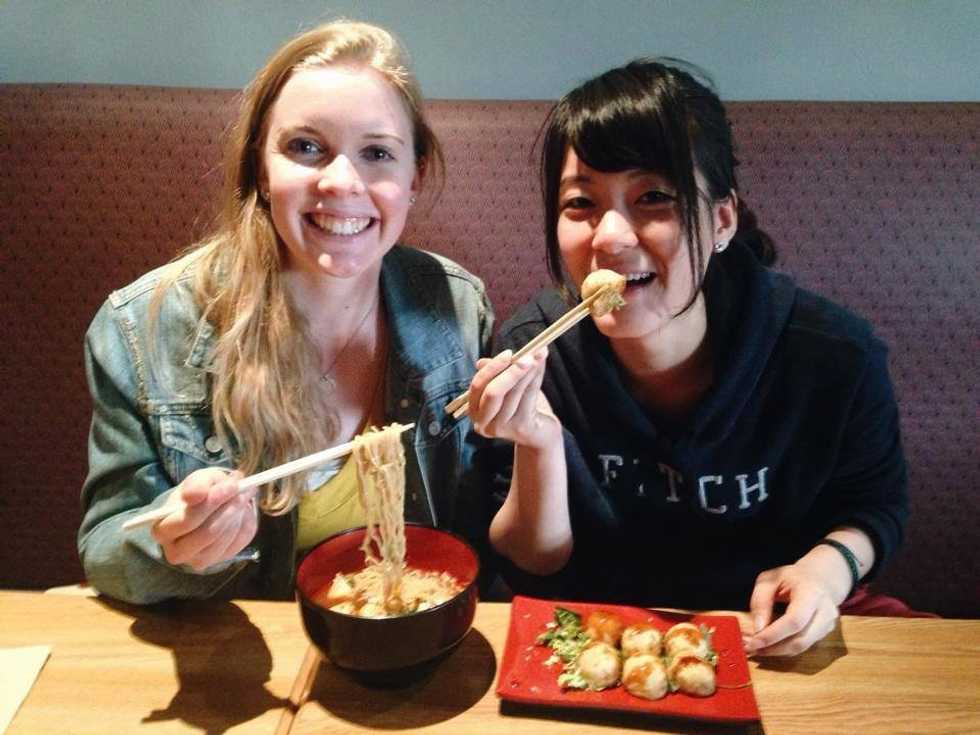
“The staple food is rice and we eat extremely balanced meals with smaller portions compared to the states. We eat a little bit of everything at a meal, which can be compromised of a little bit of salad, soup, meat, rice and another side dish. We also eat a lot of noodles,” Bethany said.
Another thing that’s different from the United States is the Japanese fashion.
“The fashion in Japan is more formal and unique,” said Bethany.
“Another difference is that the United States is the only country to not use the metric system. I feel that that’s inconvenient and sad. Also, people in Japan sleep on the floor, which I don’t mind at all and wouldn’t trade for anything.”
Since Bethany attends school in the States, she goes home for winter break and over the summer to visit her family and Japanese friends.
“I can’t wait until the summer because I really miss everyone,” said Bethany.
Through American culture and Japanese culture, Bethany has learned to adapt and lives by a very popular Japanese saying.
“My favorite Japanese saying is ‘mizuni nagasu’, which literally means forgive and forget,” Bethany said.