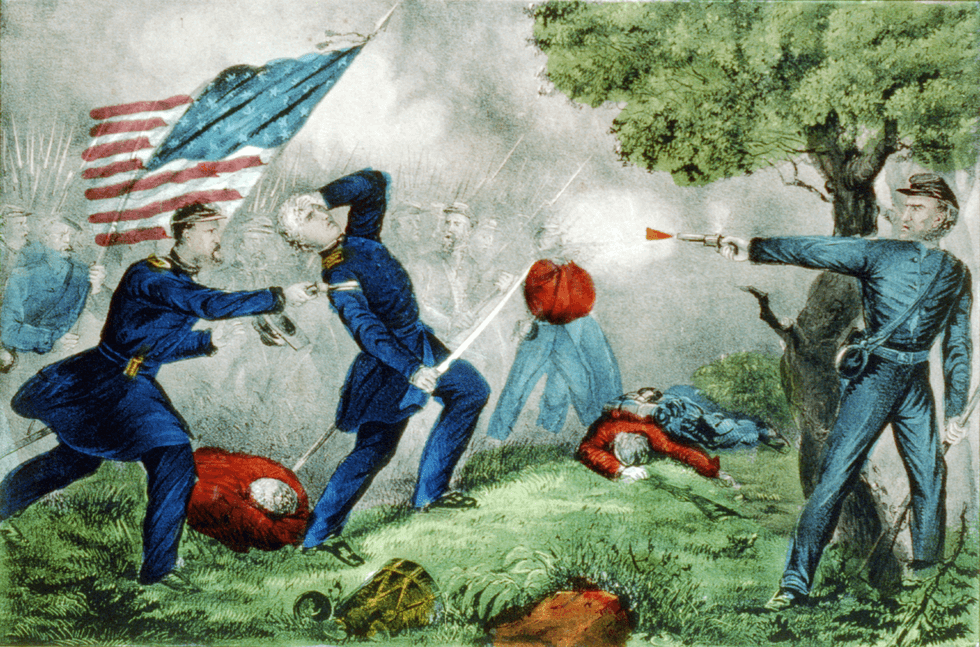
On Oct. 21, 1861, a small battle took place near Leesburg, Virginia. Compared to the much larger, well known battles that would occur later in the war, this battle was a mere skirmish. Each side engaged roughly 1,700 men as opposed to the 90,000 Union and 70,000 Confederate troops engaged at Gettysburg. For the Confederates, the battle was "a splendid success," and was the third of a string of victories in 1861. For the Union, the battle would be remembered for, and named after, the forbidding cliff at the center of their defeat; "that cursed Ball's Bluff."
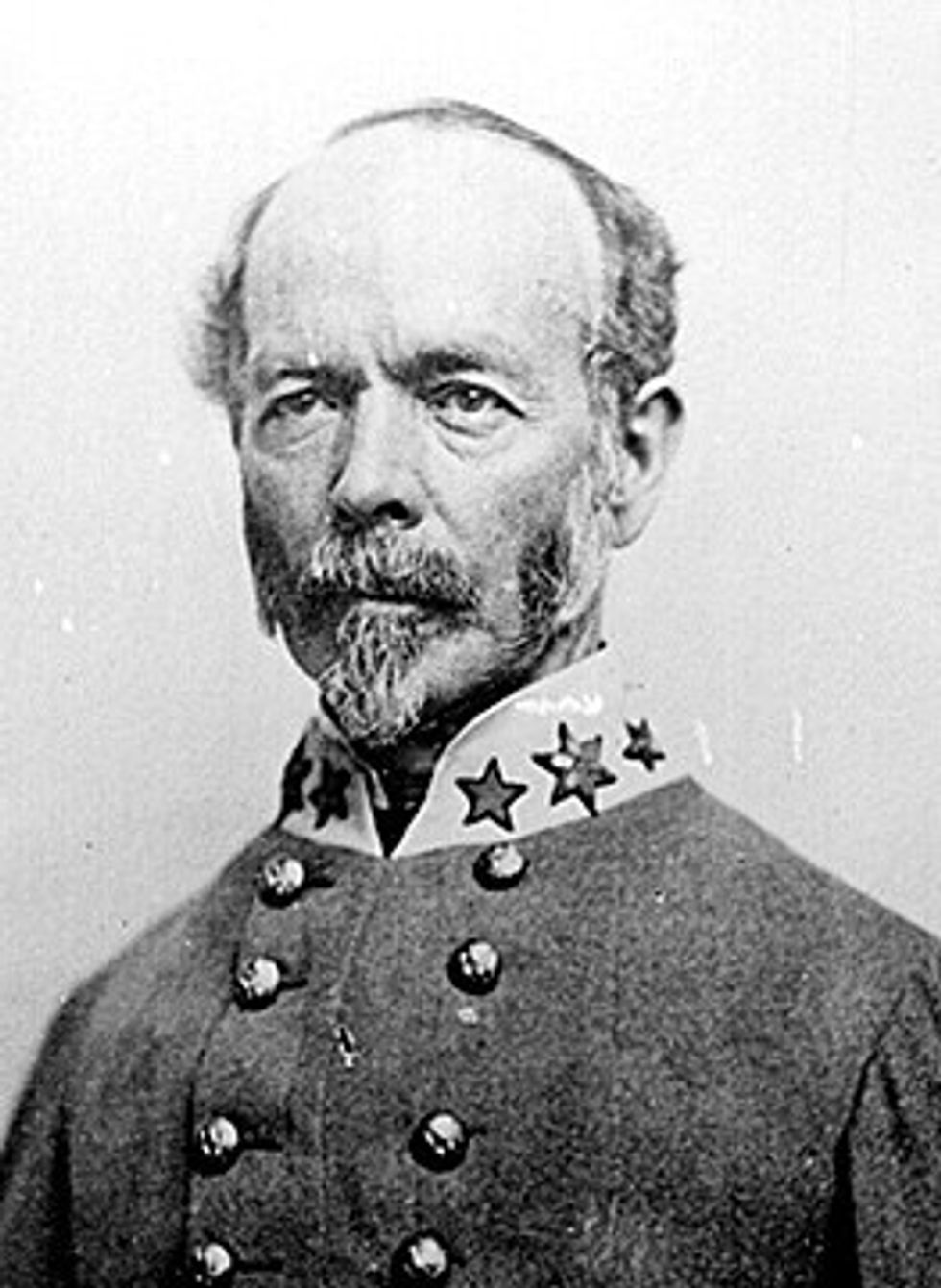
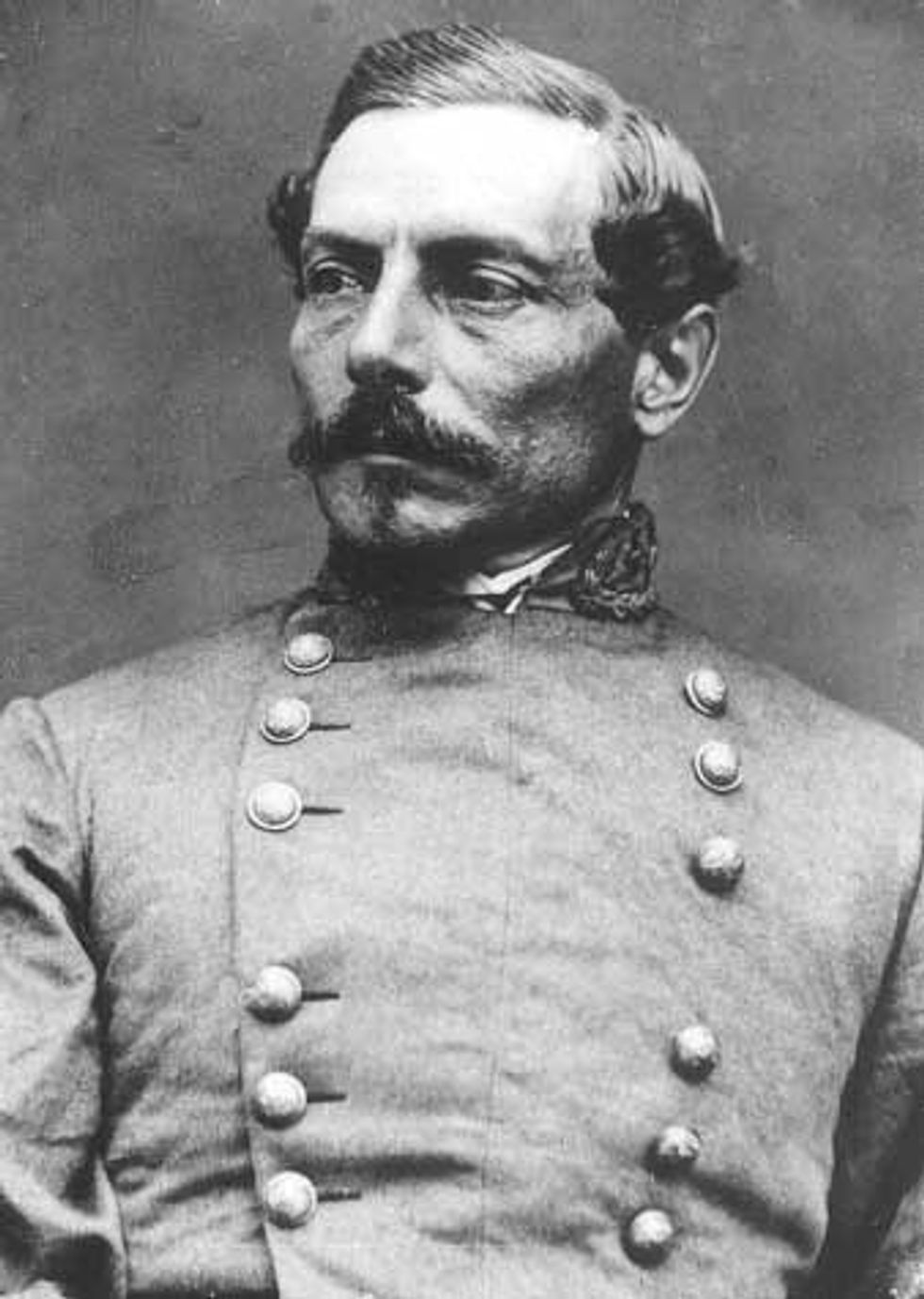
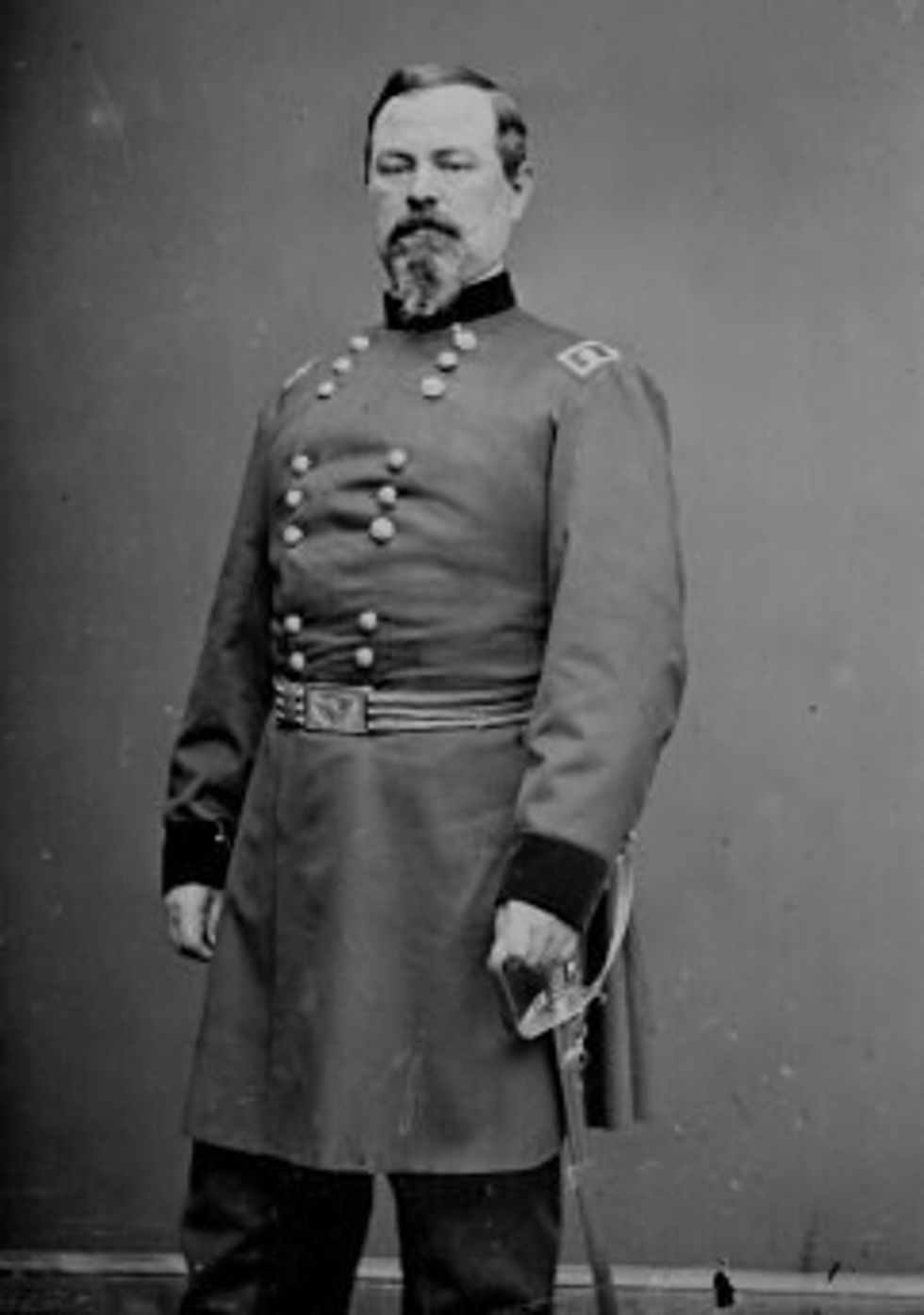
The atmosphere of the war in the fall of 1861 was, "all quiet along the Potomac." Both sides were recovering from the first major land battle that occurred in Manassas, Virginia on July 21. The Confederate armies of the Potomac and the Shenandoah under Joseph Johnston and P.G.T. Beauregard were able to drive the Union Army of Northeastern Virginia under Irvin McDowell back to Washington. Although the battle was a Confederate victory, neither side really knew what hit them. The Battle of First Manassas was supposed to be a quick victory to end the war, but instead it showed that the war was going to be long and bloody.
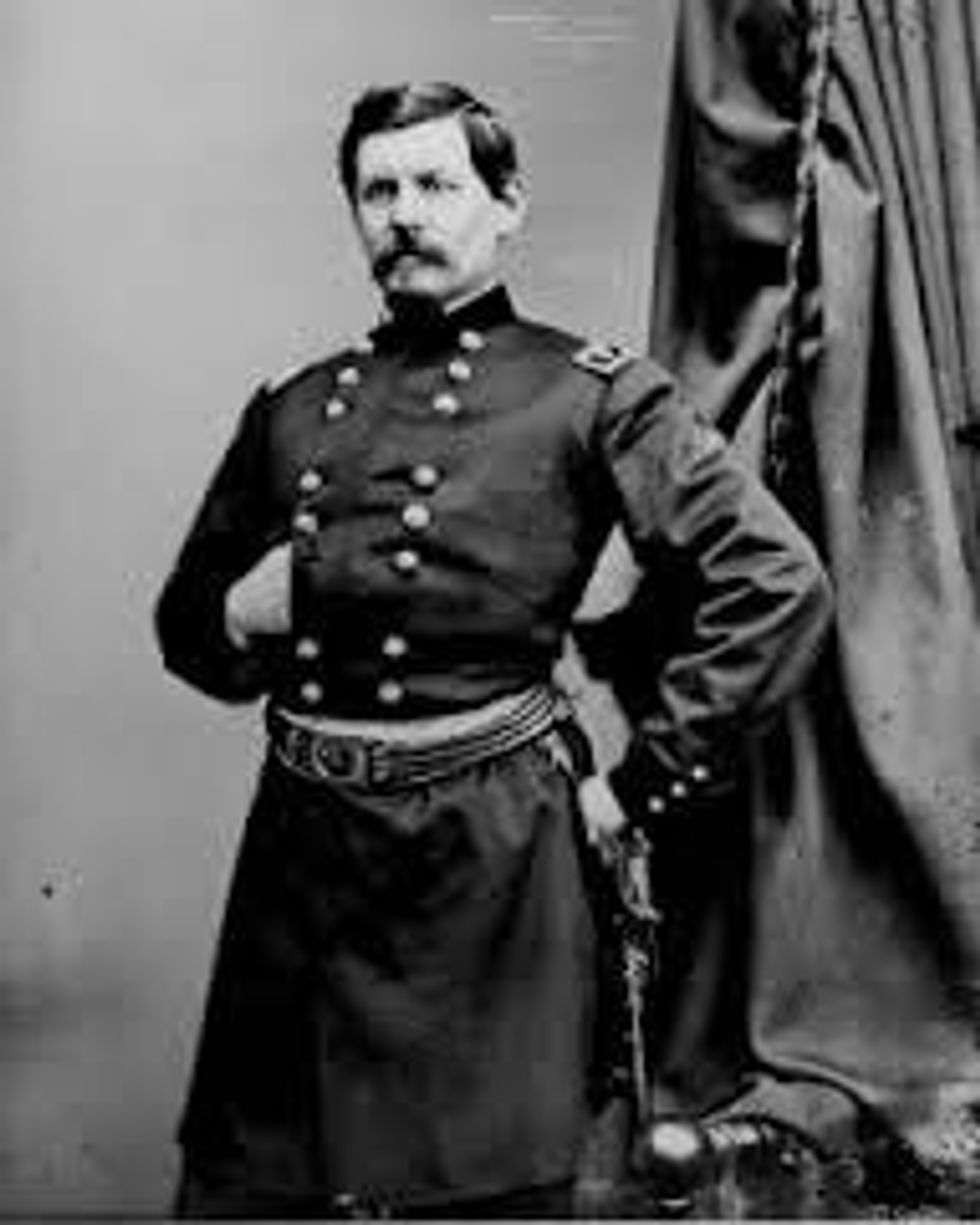
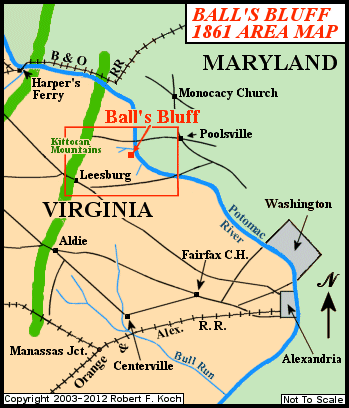
In response to the Union disaster at First Manassas, Abraham Lincoln replaced McDowell with George B. McClellan, who experienced success in western Virginia. McClellan quickly trained and organized the defeated army, renaming it the Army of the Potomac (both the Union and the Confederate armies would have this name until 1862). Both sides were prepared to watch each other from their respective sides of the Potomac River. Johnston and Beauregard and McClellan posted garrisons all along the river in order to prevent a potential crossing. By Oct. of 1861, Johnston pulled all of his garrisons, except the one at Leesburg, back to the main force near Manassas. Opposing Leesburg was the Corps of Observation under Charles Stone camped in Poolesville, Maryland.
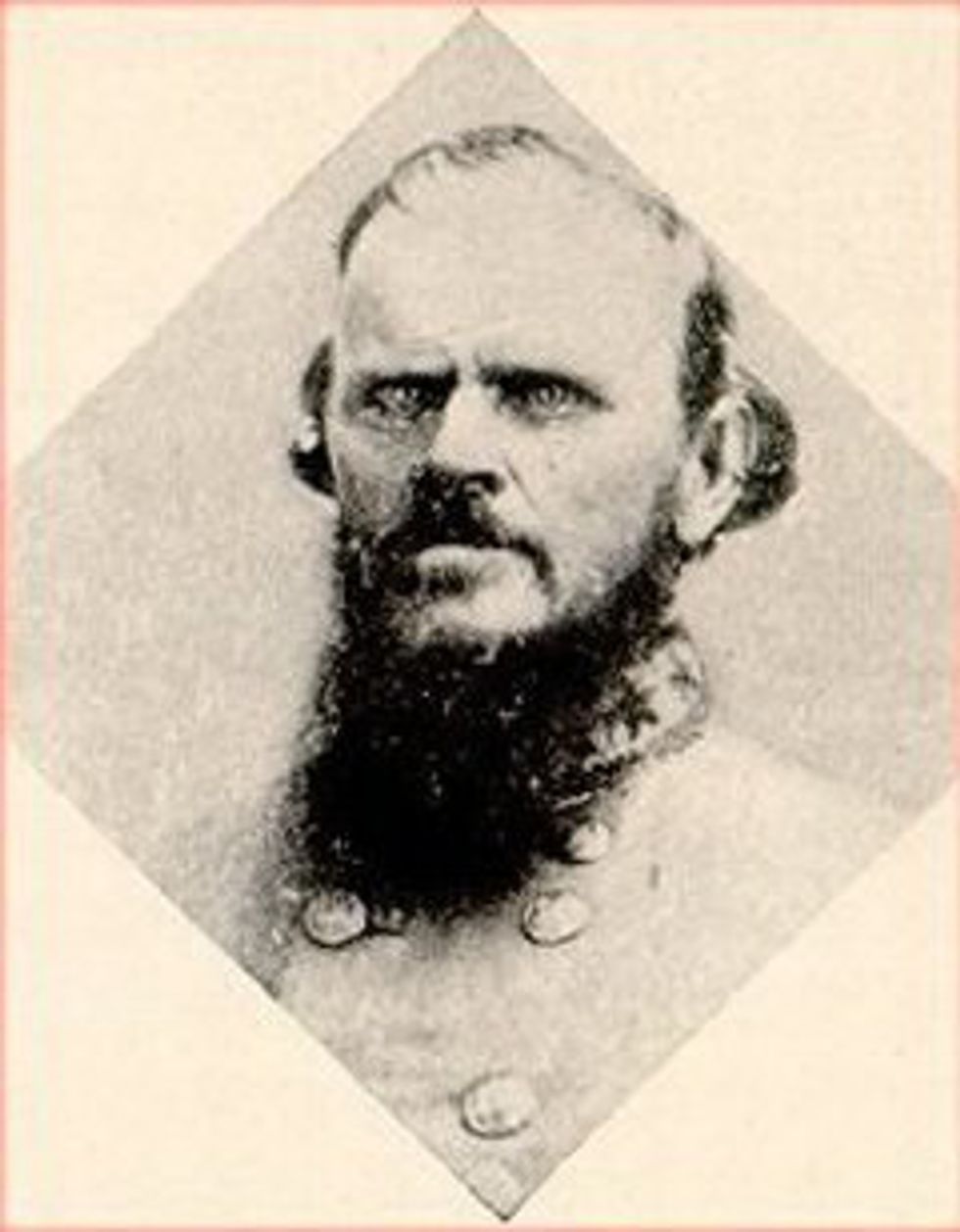
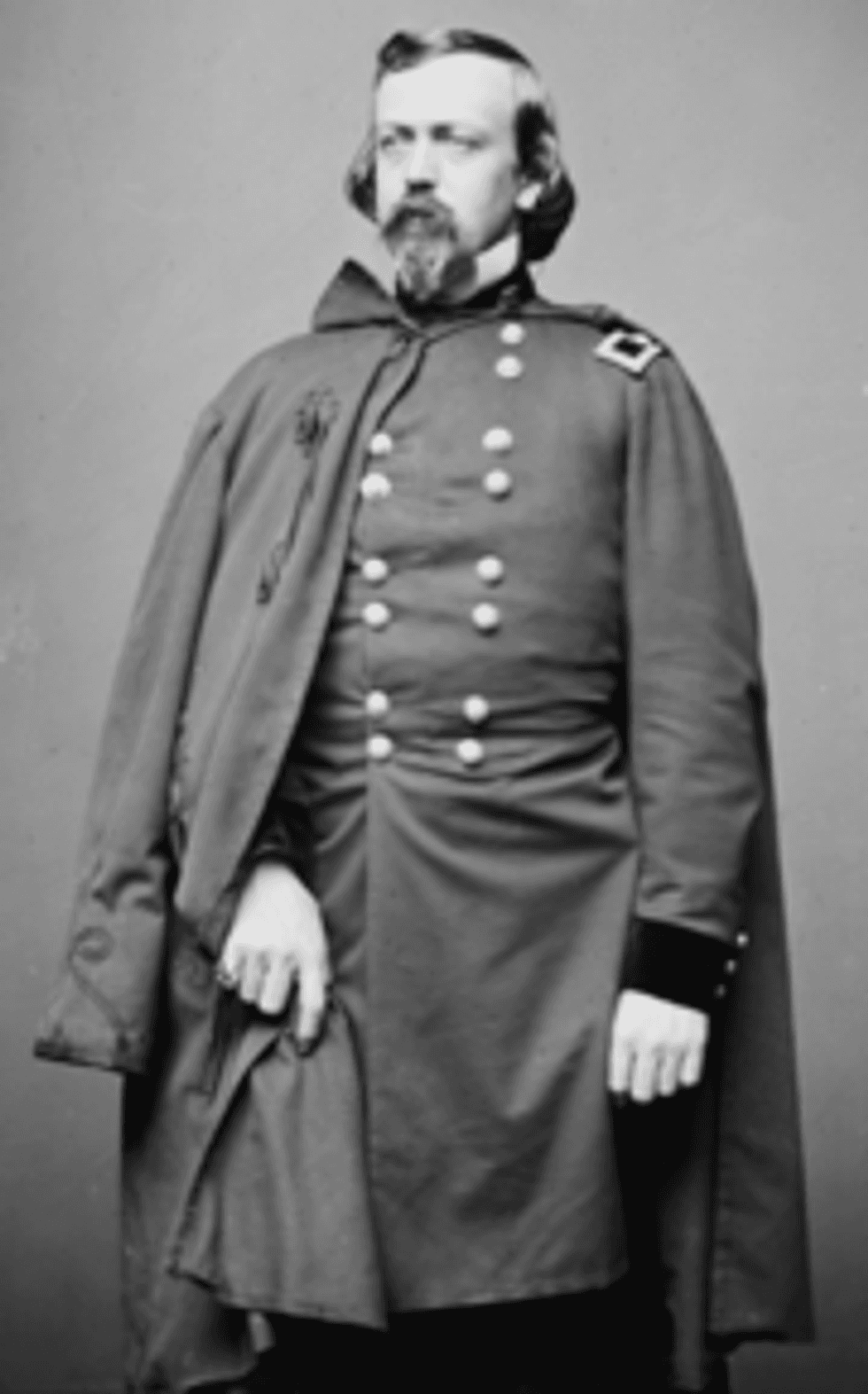
Leesburg was an important town for the Confederacy. It was at the cross roads of two major roads and was near numerous river crossing points including Conrad's Ferry (today's White's Ferry), White's Ford, Ball's Bluff, and Edward's Ferry. If either army was to cross the river, there was a good chance it would be near Leesburg. Nathan "Shanks" Evans commanded the 2,800 men in Leesburg opposite the 10,000 men in Stone's Corps of Observation. Evans was aware that the odds were against him and to make matters worse, McClellan ordered 12,000 men under George McCall to Langley, Virginia (at the site of today's CIA headquarters) and eventually as far as Dranesville (12 miles from Leesburg). On Oct.16, Evans moved his command south of Leesburg, fearing that he was be trapped in Leesburg. His superior, General Beauregard, was not pleased with his decision and ordered him to return to Leesburg on Oct.19.
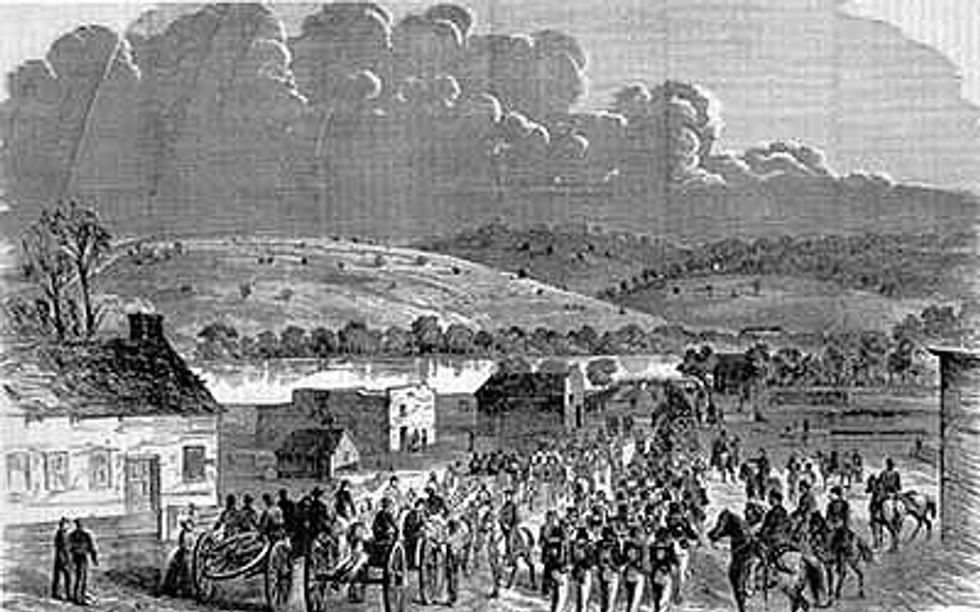
Stone and McClellan noticed the departure and return of Evans' forces and McClellan ordered Stone to make a "slight demonstration" on his part to see what the Confederates would do. The "slight demonstration" consisted of feint river crossings to give the Confederates the impression that the Union troops were crossing. To discover what effect his demonstration had on the Confederates, Stone ordered a scouting party of 30 men to cross the river on the night of Oct. 20. Unbeknownst to Stone, McClellan, fearing a trap, ordered McCall's division to return to Langley. McCall would begin his march in the opposite direction of Leesburg on the morning of Oct. 21, just as the Battle of Ball's Bluff was getting underway.
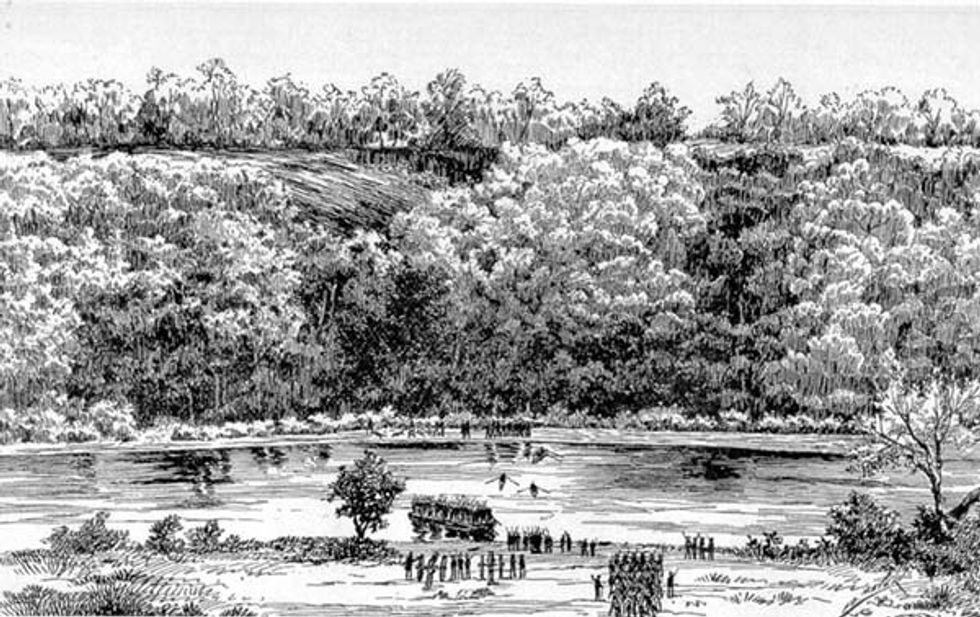
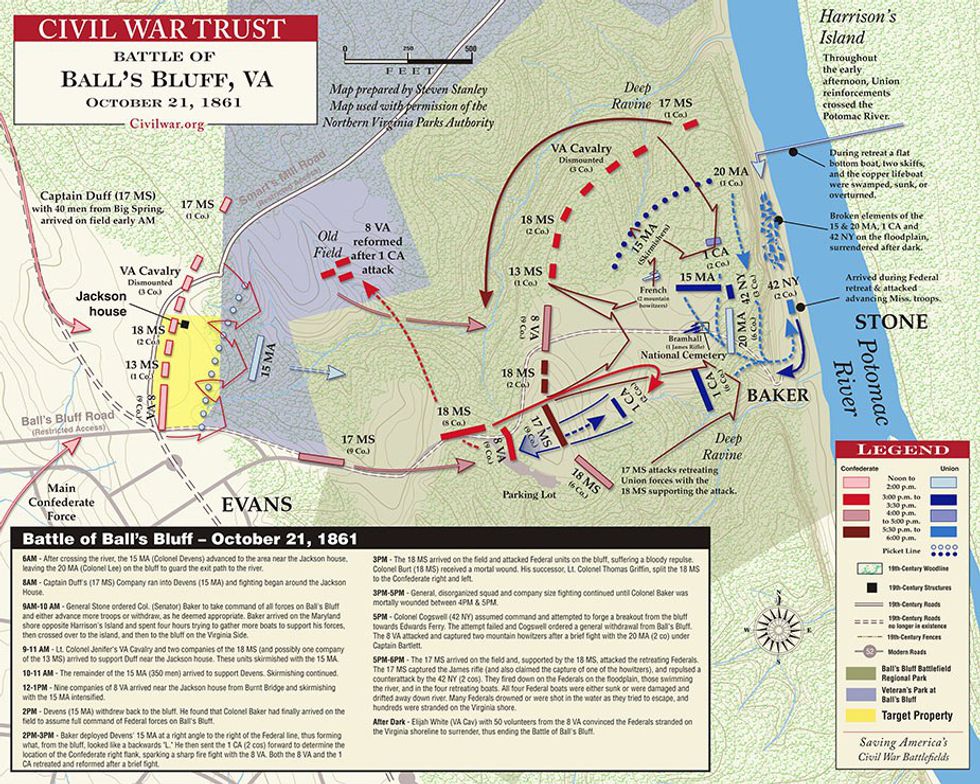
The 30 man scouting party consisted of men from the 15th Massachusetts under the command of Captain Chase Philbrick. Philbrick was an inexperienced officer, but he was relatively familiar with the area. The scouting party crossed the river towards Ball's Bluff late on October 20. The crossing point near Ball's Bluff was bisected by Harrison's Island. This made crossing a slow process for 30 men, let alone 1,700. Once they arrived at Ball's Bluff they moved up the bluff and towards Leesburg. Philbrick and his men came across what they believed to be an unguarded Confederate camp behind a row of trees. Instead of investigating further, Philbrick decided to return to the Maryland side with this information. Stone was informed of the Confederate camp and decided to send a raiding party to capture it. The raiding party consisted of 300 men from the 15th Massachusetts under the command of Colonel Charles Devens. Devens and his raiding party would cross the river with three small boats and begin their raid in the early morning hours of the Oct. 21. The disaster at Ball's Bluff was about to unfold.
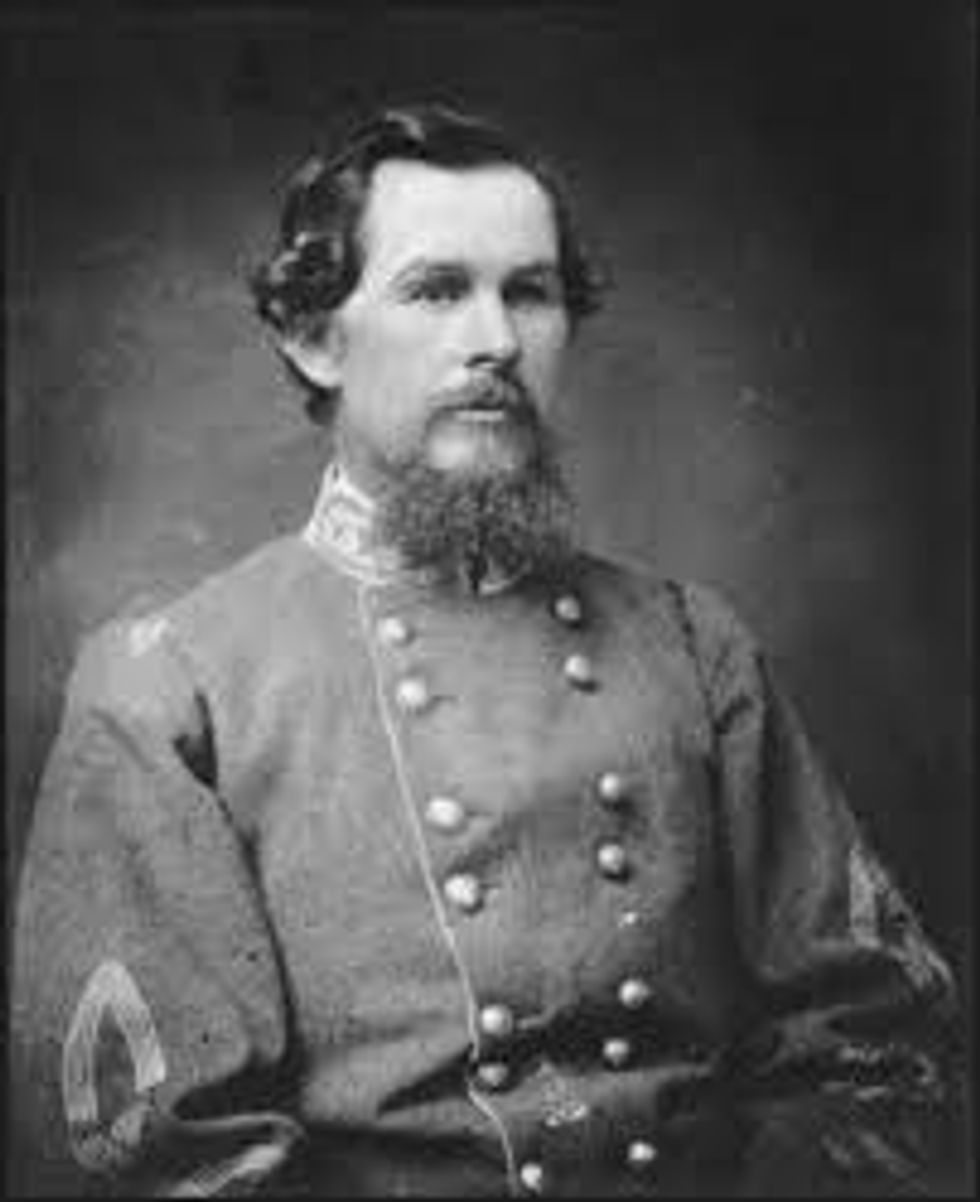
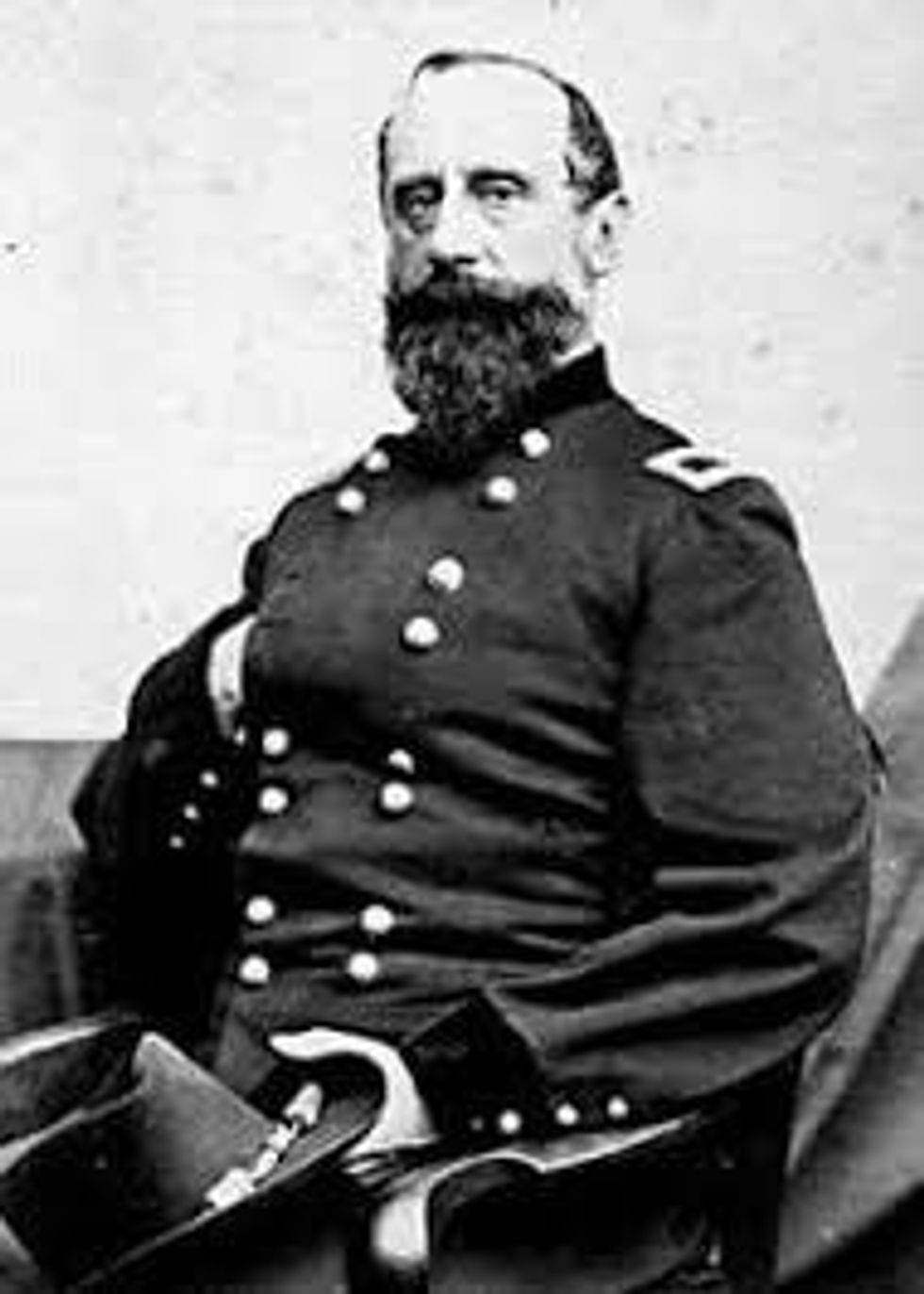
Devens would move along the same path as Philbrick (Philbrick was with the raiding party) and they arrived at the row of trees. To their surprise, there was not a Confederate camp. The moon light that shined through the row of trees the night before gave the impression of a Confederate camp. Instead of returning to Maryland, Devens decided to stay and await further orders. Whilst informing Stone of the non-existant Confederate camp, Devens began to engage portions of the 17th Mississippi under Major William Duff. Duff would be reinforced by dismounted cavalry under Walter Jenifer and the 8th Virginia under Eppa Hunton. Stone was informed of both the missing Confederate camp and Devens' skirmishing and ordered Colonal Edward Baker, commander of the 1st California, to take command of the situation. Instead of immediately crossing the river and assessing the situation, Baker sought out more boats for the crossing. The Union would be limited to four, creating quite the bottleneck at the river crossing. Baker himself would not cross until 2 p.m., four hours after taking command of the situation..
When Baker crossed, he was met by Devens, who had retreated back to the bluff. Baker ordered his men into an "L" or chevron formation, with their backs to the bluff and the river. Baker's subordinates believed that this formation was vulnerable and that they should move up to higher ground. However, while scouting the high ground, portions of the 1st California engaged Eppa Hunton and his 8th Virginians. Although the Virginians became disorganized and temporarily retreated, Baker decided to stay in his vulnerable position. This was a mistake. The 18th Mississippi under Erasmus Burt followed up on the 8th Virginia. Burt decided to attack the Union forces head on. Burt and his troops marched into what Elijah White considered, "the best directed & most destructive single volley I saw during the war," which inflicted heavy casualties including Burt. Burt's replacement Thomas Griffin split the 18th Mississippi into two battalions and attacked the two Union flanks. The Union's left flank was occupied by the 1st California and was the most vulnerable part of the Union line. The 18th Mississippi used the cover of the trees to attack the Union line. The fighting on the Union left consisted of a series of charges between the two sides. Colonel Baker with his men on the left flank. At around 4:30, a volley from the 18th Mississippi struck Baker in the head and the heart, killing him instantly (there are 44 accounts of his death). Baker's death created panic in the Union line.
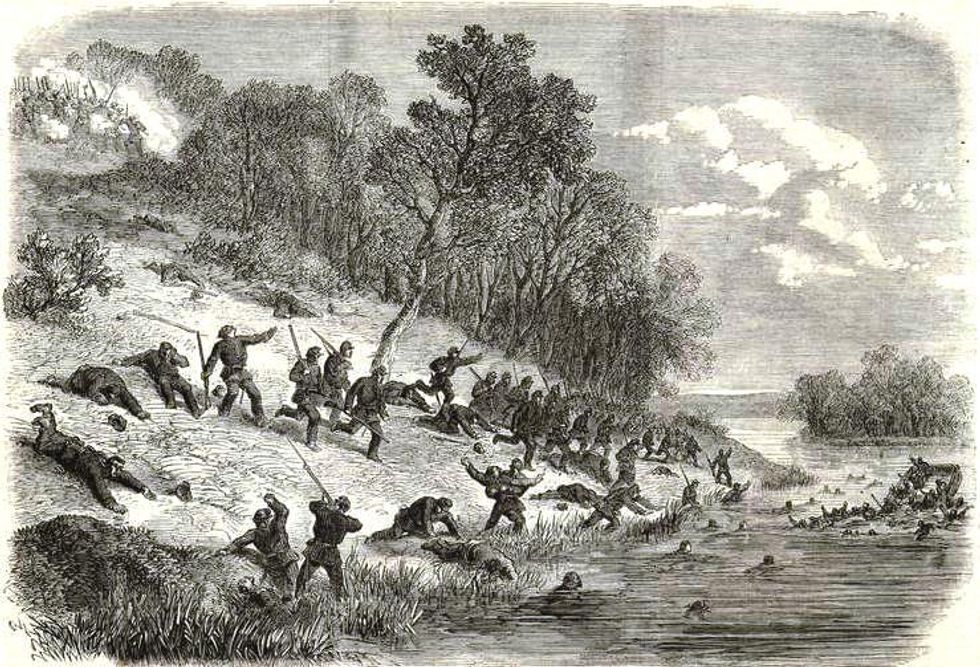
Baker's replacement, Milton Cogswell, attempted to rally the troops, but it was too late. Fresh Confederate troops from the 17th Mississippi under Winfield Featherston arrived on the field to drive the Union troops back into the river. The four boats were destroyed and the Union troops were forced to swim or be captured. Many of the Union troops drowned while attempting to escape. The Battle of Ball's Bluff was one of the most lopsided battles of the entire war. The Union suffered 1,002 total casualties, while the Confederates suffered 155.
Although Ball's Bluff was small in comparison to other Civil War battles, the political repercussions were large. The Joint Committee on the Conduct of the War, formed by Congress following the defeat, was eager to place blame on someone. The battle was not only the third defeat the Union had suffered, it was also a personal loss. Edward Baker was a senator from Oregon (the only senator killed in battle), and one of Abraham Lincoln's best friends (Lincoln's second son was named Edward Baker Lincoln after his friend). The defeat should have been placed on Baker, who made most of the tactical errors, or McClellan, who failed to inform Stone of vital information. Stone later stated that he would not have ordered a crossing had he been told of McCall's return to Langley by McClellan. The Committee was not about to blame a colleague and personal friend of the president, or McClellan (Lincoln still trusted McClellan to save the Union). The Committee was comprised of Radical Republicans, who were greatly influenced by Senator Charles Sumner, a known rival of Stone. Thus Charles Stone became the Committee's first scapegoat. Stone would be placed in prison for six months, never to be formally charged with anything. Due to his career being tainted by the results of Ball's Bluff, Stone would resign from the army in 1864. The Committee would continue to preside over the conduct of the war, ensuring that is was fought their way. The actions of the Committee would cause all Union generals to think twice about their decisions.
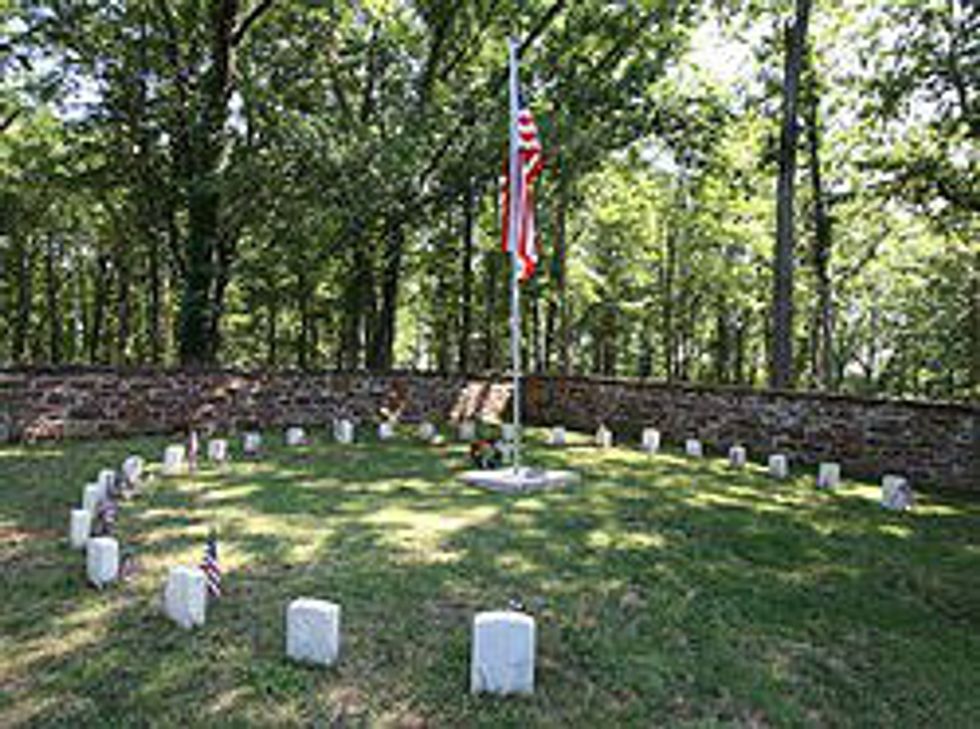
Stone described the size of Ball's Bluff as, "about equal to an unnoticed morning skirmish on the lines before Petersburg at a later period of the war," but he of all people knew its results were much more significant. The Battle of Ball's Bluff was a little known Civil War battle that greatly influenced how the war would be fought.
I would like to thank Jim Morgan, author of "A Little Short of Boats." His book is the premiere book on Ball's Bluff and his tours at the battlefield greatly influenced this article.