“Hey man, you want to get some sushi?”
“Hell no, that shit’s disgusting.”
And suddenly there I sit, deeply offended on behalf of Food. What my friend has displayed is the closed-mindedness which I have often seen in those around me. Otherwise rational people will recoil at the mention of a concept so foreign that they cannot relate it to anything familiar and safe. No one says sushi tastes like chicken. Except if it’s chicken tempura. More to the point, it is not cold or slimy, it is not frightening; sushi’s only crime is being un-American. Being Japanese, this is an understandable label.
My love for the Japanese delicacy of sushi began in high school, where an Asian friend insisted we go out for dinner to a place he loved. I and my friends still being uninitiated at the time felt some reticence. The menu often seems incomprehensible to the unexperienced, so our friend had to take care of us. It is always preferable to have a guide in these situations.
The dishes come before the order, a small plate and a smaller dish. Three condiments are served: wasabi, pickled ginger, and soy sauce. The soy sauce goes into the dish; the others are taken in small amounts and set to the side. Wasabi is put on a piece in small amounts (any more than a pea-sized piece and you may die) as it is essentially condensed horseradish and will burn your sinuses out of your head. The ginger is a palate cleanser between rolls.
That first day I asked a waiter for a fork. He laughed hysterically and walked away; I never saw that fork. His laughter still haunts me sometimes at night, but I’m slowly coming to grips with it. When our order arrived, I rolled up my sleeves and ate with my hands. My Midwestern hands, incapable of navigating chopsticks, would not stop me from new culinary experiences. It took one bite to begin my infatuation.
For those put off by my experience of a less than helpful waiter, be assured that eating with your hands is also acceptable. In fact, I have done so at every sushi meal since. Though I cannot possibly count it, I estimate that I have spent hundreds if not thousands of dollars on sushi in the past years. As my love has grown I have tried to share it with the world, a missionary of food to those around me.
My closest friend was with me that first meal, the first time either of us tried sushi. He loved it as much or more than I, and the majority of my sushi meals since have been shared with him. Years later we are both in college, studying at different universities, living in different cities. To this day, if we are both in the same city at the same time, we drop everything to make a trip to our favorite Japanese restaurants.
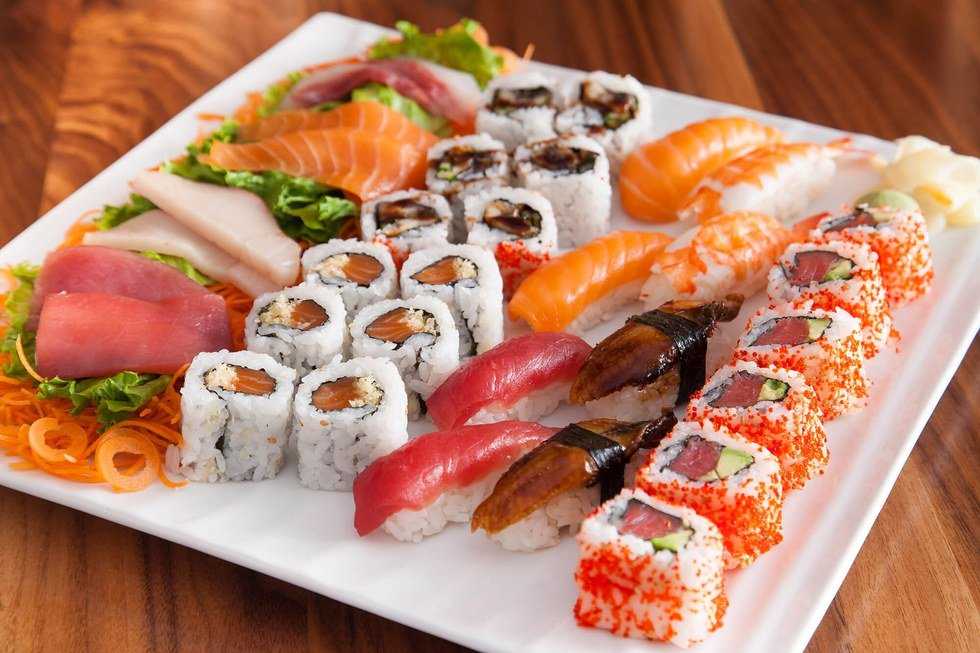
My brother was concerned that there would be nothing for him to eat, as he is allergic to shellfish. I showed him smoked salmon, fatty tuna, red snapper, and fresh-water eel. I laid out a rainbow of nigiri—each a single slice of fish over rice—and showed him how to slow down, to experience a single flavor and truly appreciate it.
My father thought sushi was intrinsically gross, he likened it to eating something still alive. I told him that sushi doesn’t even mean raw, the only constant is rice. For him I chose the flashiest maki (rolled) sushi I could find. A dozen different ingredients and textures wrapped in rice and seaweed, some deep fried. Forty years of smoking had dulled his sense of taste, but he did admit he enjoyed it eventually.
My fascination with this style of cuisine is deep as well as enduring. Every roll is crafted by a chef to perfectly blend taste and texture. I have yet to visit or hear of another restaurant where a meal is arranged into a work of art every time, even at the cheapest level of preparation.
Being high school students when we began our eating adventures, we made rounds at the cheapest places we could find. A half-step above something you find pre-packaged in a supermarket, these places were all you can eat. Yet despite the obvious truth that these establishments were the bottom of their culinary barrel, every dish shone with the precision of an expert and the passion of an artist.
For years during school and even still now, my friend and I will meet at our favorite place and gorge until we can hardly stand. A meal will often threaten disaster, as you cannot leave left-overs. To do so would be an insult to the chef. You also cannot let the food sit on the table too long, for letting it go stale would similarly impugn the chef’s effort.
Factoring in over-ambitious appetites and the knowledge that rice expands in your stomach, we have found many a time that though you may feel full upon leaving, by the time you drive home you feel fuller than anyone has ever felt, and maybe if you lay very still you won’t be sick. When the illness passes after having destroyed our bodies, we find that we are sated enough for one day. We go our separate ways, each of us back to our universities, our jobs.
The next time we are in town at the same time we will all do it again, having forgotten the lesson. But some lessons are worth relearning. I remain grateful for new experiences, tastes of new cultures. And when your food is served fresh, you pause for a moment to bow your head and put your hands together. It means to give thanks; literally ‘I humbly receive:' Itadakimasu.
~~~~~
Bad Poem of the Week:
A Triolet on the Damn Cicadas Outside my Window
Summer is screaming
Through a soup of night.
In this heat there is no sleep, no dreaming.
Summer is screaming;
The voices of the trees, teeming
With fervent life enduring the season’s slow bite.
Summer is screaming,
Through a soup of night.