Islam, a religion of peace and mercy, is not synonymous with terrorism. Islam does not represent violence, just as terrorist groups such as Al-Qaeda or "ISIS" do not represent Islam.
Due to decades of global terrorism, the growth of Islamic-claimed terrorist groups, and media coverage filled with Islamist-fueled violence, a widespread belief has become sustained in the United States that Islam is a destructive religion that urges its followers to violence. However, although global terrorism today is disproportionately due to extremists acting in the name of Islam, equating Islam/Muslims to violence and terrorism is invalid and incorrect.
Global terrorism today is prominently credited to extremists acting in the name of Islam. Although this is the case, attributing terrorism to the religion of Islam is not validated. Omar Alnatour, humanitarian working for Helping Hand for Relief and Development, and United Muslim Relief made great points in his Huffington Post article: According to the FBI, 94 percent of terrorist attacks in the United States from 1980 to 2005 have been by non-Muslims. The same report states that there were more Jewish acts of terrorism in the United States than Islamic.
But, as Alnatour stated, "just as we cannot blame the entire religion of Judaism or Christianity for the violent actions of those carrying out crimes under the names of these religions, we have absolutely no justifiable grounds to blame Muslims for terrorism."
Furthermore, since 1970, there have been 140,000 terror attacks committed globally. Alnatour points out that even if Muslims were credited for all of these attacks, those terrorists would represent less than 0.00009 percent of the global population of Muslims, which, in 2010, totaled approximately 1.6 billion adherents, or 23 percent of the global population.
Beginning in the 1970s, terrorist groups, such as Al-Qaeda, Boko Haram, Hamas, "ISIS" and Taliban have emerged waging violence in the name of Islam. The goals of these extremist groups encompass global political dominance, rejection of democracy and rejection of human rights values and are executed through terrorist attacks involving bombings, beheadings, suicide attacks, vehicle-based attacks, aircraft attacks and hijacking, and more. Within these attacks, soldiers, innocent lives, along with innocent Muslims, are killed. In fact, Muslims suffered between 82 and 97 percent of terrorism-related fatalities over the past five years, and Muslim majority countries bore the greatest number of attacks involving 10 or more deaths.
Although these extremist groups exploit the religion of Islam, their actions and goals are entirely antitheses to the Islamic faith. In Islam, suicide is haram, or forbidden. The Qur'an, the central religious text of Islam, is clear that innocent civilians must be protected. Islam does not recognize "collateral damage," civilian casualties, as legitimate even during war.
"Muslims throughout their history never allowed the killing of civilians, even in the midst of wars such as the Crusades. There is no respected Islamic scholar here in Saudi Arabia or anywhere else in the Muslim world who would support such a fatwa." (The Guardian - Khashoggi)
Furthermore, Islamic teachings forbid Muslims to force others to convert. "Let there be no compulsion in religion...." (Al-Islam - Al-Baqarah: 256).
These are just a few examples of the conflicting attributions between terrorism and Islam. As USA Today stated, "Islam does not support terrorism under any circumstances. Terrorism goes against every principle in Islam. If a Muslim engages in terrorism, he is not following Islam. He may be wrongly using the name of Islam for political or financial gain."
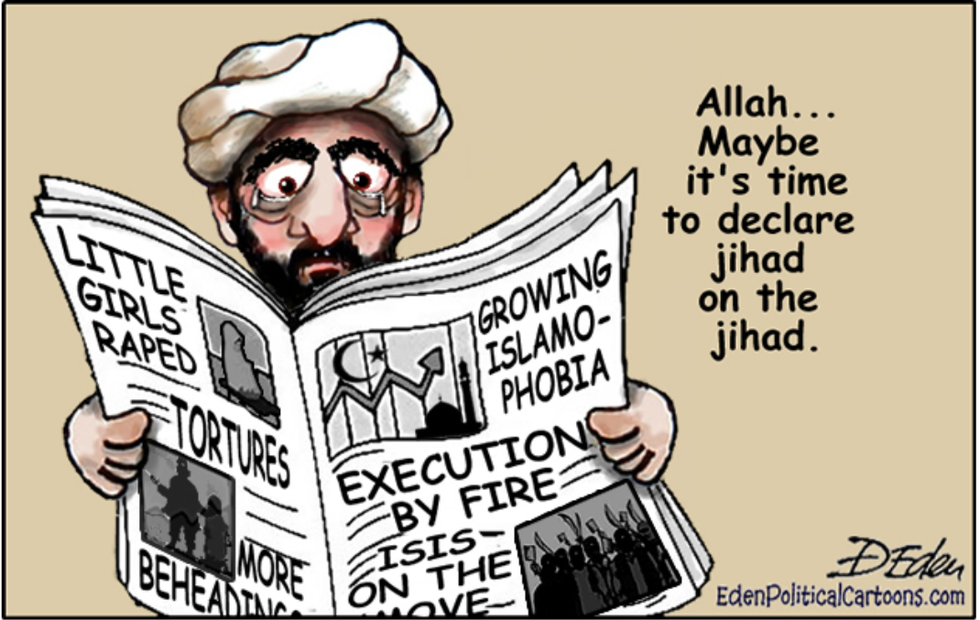
Through the global terrorist crisis, Western media coverage of the phenomena has fueled, if not ignited the fire of Islamophobia, the fear of Islam and Muslims, and the unbreakable tie between Islam and terrorism. Since the 9/11 bombing of the World Trade Center in New York, Islamophobia has intensified greatly due to the consistent portrayal by global media of the Islamic faith as a violent religion that is in direct opposition to the West. Constantly using terms like "Islamic Terrorism" or "Muslim terrorists," the media gives the religion an automatic negative connotation. Ultimately, using terms like these is oxymoronic, as Islam is not an attribute of terrorism, nor is terrorism a representation of the Islamic faith.
An example of a misconstrued term used by the media that, in turn, exploits Islam is the widespread usage of the word "Islamist." In academia, the term Islamist means a Muslim who seeks a formal role in a political system. In mass media, though, the term is used to denote a wide spectrum of characters, often time without distinction, from non-violent groups and individuals who believe their government should be based on Islamic principles, to Islamic political parties, to terrorist or vigilante groups. In this, the media gives a false, negative association to Muslims and Islamic political parties, and adds to the epidemic that is Islamophobia. The word “Islamism” is not a synonym for “terrorism,” nor is it a synonym for the religion of Islam itself.
Muslims Against Terrorism, an Islamic anti-terrorism organization, asks that media not use connotative terminology that furthers negative association such as "Islamic Fundamentalists" or "Muslim Terrorists" regarding terrorist attacks "because such things do not exist. Islam is the religion of peace, love and mutual respect. Islam is the religion of moderation. Islam is the religion of human value and dignity."