
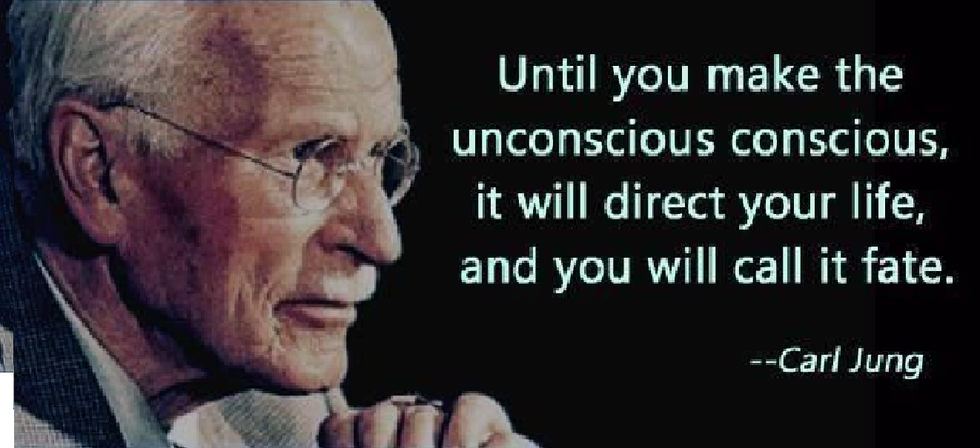
Carl Jung was a psychologist in the late 1800’s and early 1900’s. He was actually a friend of Freud’s for a time before the two began arguing extensively about some of Freud’s ideas. Jung’s theories aren’t as well-known as Freud’s, but you might be surprised how many concepts were pioneered by him. He was the first to use terms like “extroverted” and “introverted”, among others. (Check out his other theories at http://www.simplypsychology.org/carl-jung.html)
Jung developed a system for sorting personalities that used four letters—T, F, S, and N.
T for Thinking, the way someone deals with and processes information.
F for Feeling, the way someone deals with and processes the emotions of others and themselves.
S for Sensing, the way someone perceives reality using physical data.
N for iNtuition, the way someone perceives reality using connections, assumptions, and reading between the lines.
Each of the four letters then have a subcategory, introverted or extroverted as denoted by a lower case e or i. For example, Extroverted Sensing would be denoted with “Se”.
In order to use Jung’s system, the participant reads the descriptions of Jung’s eight cognitive functions and decides which describe his or her personality.
Here is where it gets complicated.
Cognitive functions work off a hierarchy. Every person uses all eight functions, but the order in which they are most likely to use them is important. That is called the cognitive function stack, and every personality has a different stack. The top four cognitive functions are the most important. And to make things more complicated, the functions work in pairs of opposites. The opposite of S is N, the opposite of T is F, and the opposite of "i" is "e". For example, if you use Extroverted Sensing, you would also use Introverted iNtuition. Confused yet? No? Let’s give it a try. (If you really are lost and would like to figure it out, try reading articles on https://mbtifiction.com/the-book-addicts-guide-to-mbti/)
Okay. Here goes. We’re going to go step by step to develop your cognitive function stack. Pick which one of these is the most accurate description of you:
Te- You understand how things happen. You can easily make decisions based on what you see because you apply your reasoning to the outside world.
Ti-You take the world in and process it. You categorize ideas, sorting them into a system that makes sense. You can easily find logical solutions or draw conclusions.
Fe-Aimed at others. You know their needs, you know why and how society operates the way it does. When someone acts or speaks, you think “how does this affect others?”
Fi-Aimed at yourself. You know your own values and emotional needs more than you understand those of others. When someone acts or speaks, you think “how does this affect me?”
Then take the opposite. If you chose Fe, take Ti as well. Now you have two of your functions for your cognitive function stack. Now repeat the process with these:
Se-Present senses. You focus on what is happening right now. You can remember things in good detail.
Si- Past senses. You have a habit of resorting to past experiences and reviewing them instead of paying attention to the world around you.
Ne- It’s all about patterns. Patterns of behavior, using old patterns to predict what comes next. You’ve figured out how things relate to each other. You wonder what would happen if something disturbs the pattern. You like new information because you can then connect it to your networks of ideas.
Ni-You can read between the lines. You can understand the meaning behind things. You know what a symbol stands for and you are interested in things that are unknown.
Good. Now you have four Cognitive Functions. Let’s build the actual stack by determining the order your functions go in.
The first function is the one you use most often, called Dominant. The second is Auxiliary, the third is Tertiary, and the fourth is Inferior. We're not using the last four of the eight functions, so we don't need to get into their names.
Take a look at all four of your functions and rank them based on how often you use them. Do you think a lot? Thinking is your Dominant function. Rank them as best you can. Then take a look at the result. Jung’s system allows us to understand why we resort to different modes of understanding. Do you have trouble understanding why your best friend keeps getting upset, but know exactly why you’ve been feeling depressed lately? Ever wonder why something that seems obvious to you isn’t obvious to someone else? All these things can be better explained when we understand why our minds work the way they do.
I hope you’ve stuck with me this long, because now it all connects. The 16 personality types in the MBTI (Myers-Briggs Type Indicator) relate to Jungian Cognitive Function Stacks. For example, the subcategory of your Dominant function determines whether you are Introverted or Extroverted in the MBTI. The other connections are harder to spot. Check it out:
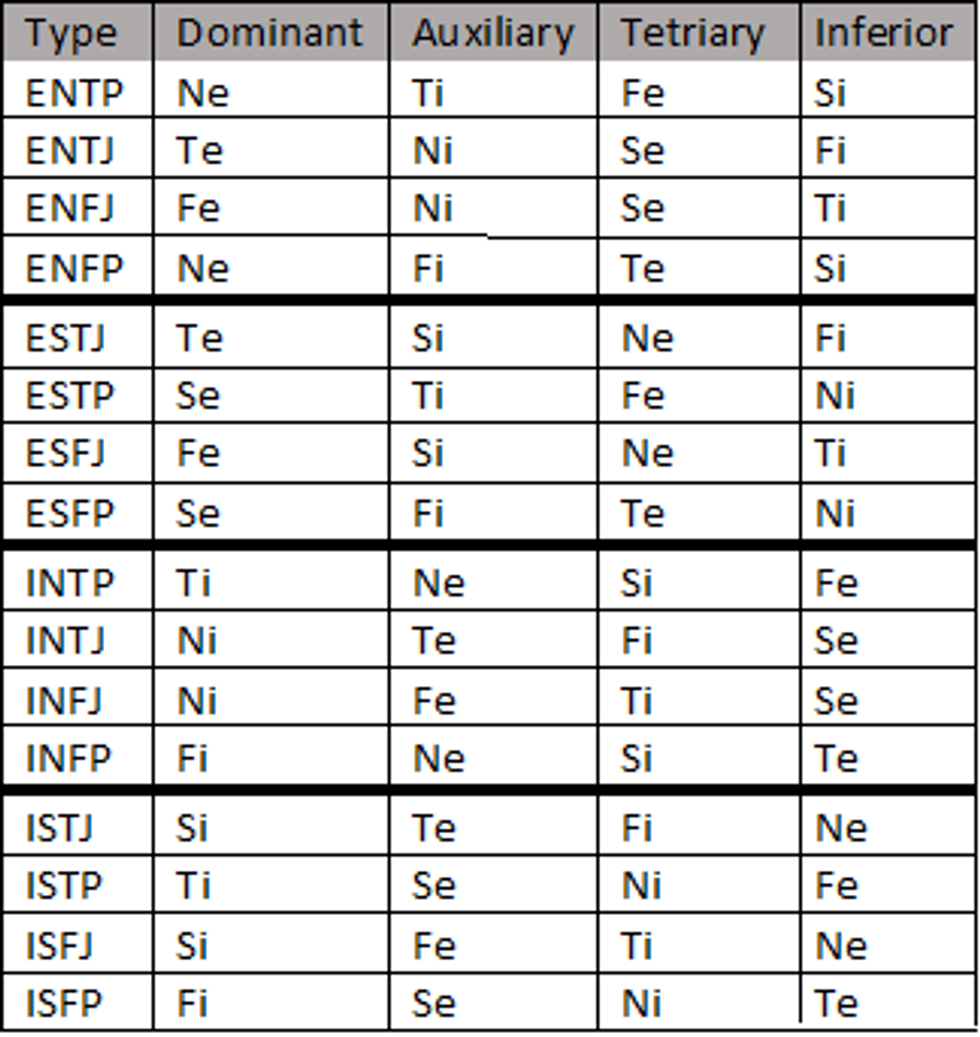 Stacks courtesy of mbtifiction.com
Personality type is a useful tool in understanding the people around us. Try reading up on all of the types, not just your own. You'll understand why your introverted friends need their time alone and to not take their absences personally. You'll understand why your extroverted friends feel upset when they haven't gotten out in public for a while. Your "Feeler" friends could use some more emotional support and your "Thinker" friends need some time to process something that happened to them. We're all made differently, and whether or not you believe in the merit of personality theories, you would do yourself some good by looking into them.