
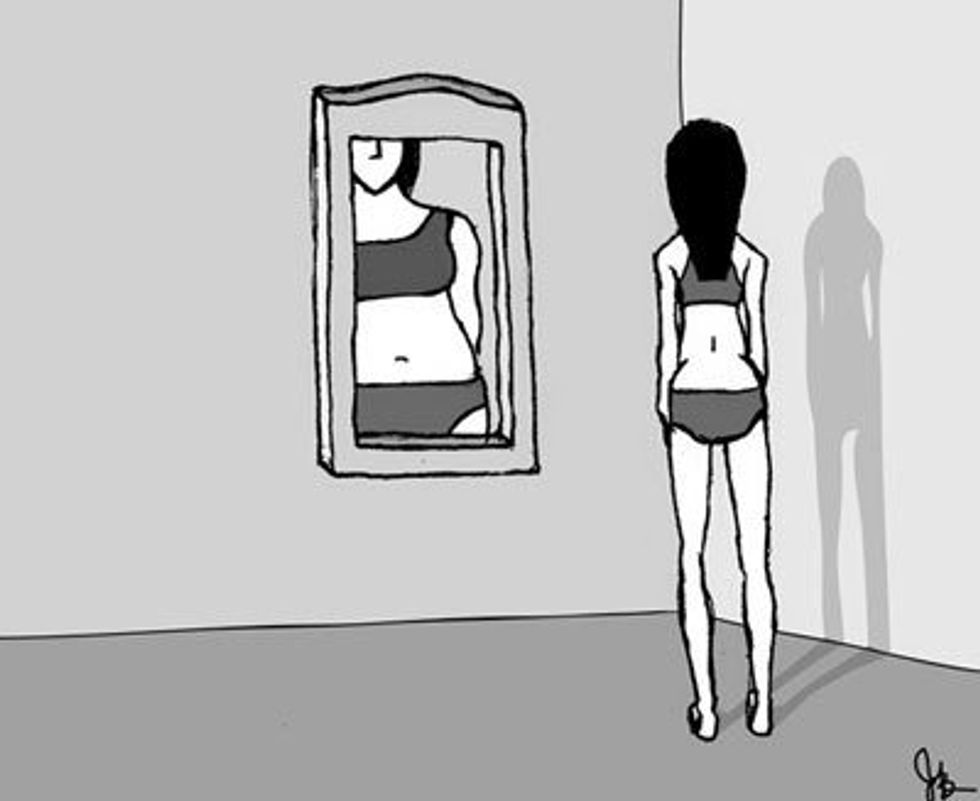
My history with eating disorders began my sophomore year of high school when I began starving myself. Now, there are dozens of reasons why I decided to do this, the most obvious being I thought I was too fat.
I have never been a skinny girl and growing up with a sister with whom everyone commented was "skinny enough to be a model," my weight haunted me even as a young child.
I remember instances where my so-called "best friends" would talk about my weight, whether it be in my face, or in "secret" to people in my life. My parents and family members would make comments about how I would look "so pretty if [I] just lost a few pounds."
Don't get me wrong, I love my family, but growing up being constantly scrutinized for what I looked like did awful things to my self-confidence. As in, I had none.
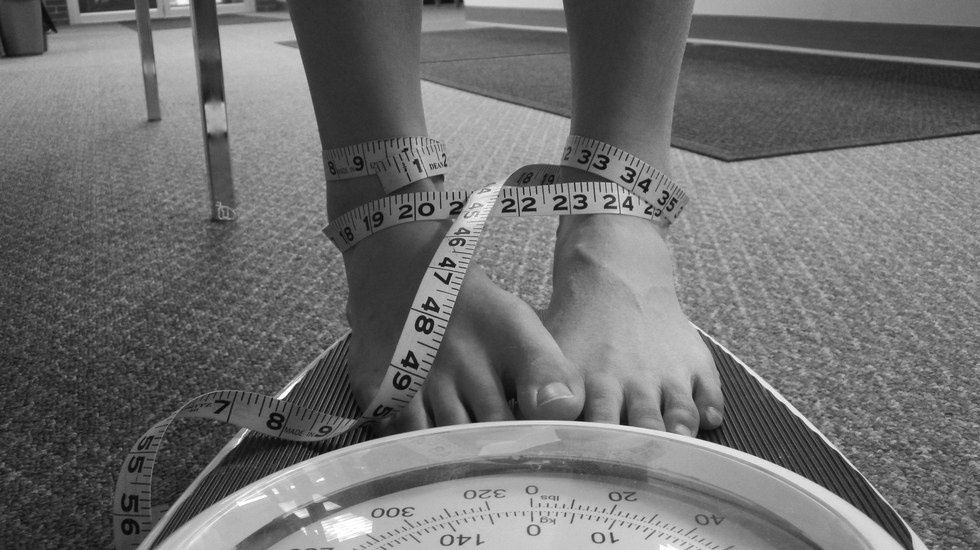
My sophomore year I decided to take matter into my own hands. I began to skip meals. It was slow at first, with me occasionally skipping lunch at school, telling my friends that I had to "finish last night's homework assignment" or that I simply "couldn't put down this amazing book" I had been reading and spending my lunch period in the library.
I already didn't eat breakfast, as sleep had always been my priority. With breakfast and lunch out of the way, dinner became my only meal most days.
During this time, my parents both worked a lot and were unable to cook family dinners every night. They would leave my sister and me to fend for ourselves.
At some point, dinner became an afterthought, as did food in general.
I began to do research on eating disorders, because I wasn't even sure that what was happening to me could be considered one. I would go to anonymous blog sites for anorexics and read the comments people left for each other about how they were "so proud" of the person who had only had two saltines that day. While I never posted on any of these sites, I found comfort in them and often spent hours reading them. But I still was not convinced that I had an eating disorder, no matter how much I starved myself.
Through my obsession with eating disorders, I discovered that the phrase "anorexia" is actually not the accurate title for what we see as anorexia. Anorexia is when a person is not hungry for whatever reason. Anorexia nervosa is the correct phrase for what we see as anorexia in society today: an eating disorder that causes people to believe they need to lose weight, so much so that they restrict the amount of food intake.

And do not misunderstand, I was hungry. I was constantly hungry, but after a certain point, I found that even if I was hungry, the pangs no longer caused me to actually want food. I became consumed with pride over how little I ate. I was obsessed with saltines and gum. I relished in the compliments I got from family members about how I looked once the weight started coming off.
But it wasn't enough.
Soon, it seemed to me that my father began to notice. He would buy or cook my favorite foods and sit the family down for dinner. I couldn't escape, and I began to panic.
That's when my real problem began.
After dinner every night, I would find myself in the bathroom, staring at myself in anger about the calories I had just consumed. I didn't know what to do, until I realized there was an easy solution.
So every night, I would turn the bathroom fan, sink, shower, and music on, before lowering myself in front of the toilet, two fingers in front of me.
Bulimia became my addiction.
My eating disorders not only affected my physical body, but my emotional health. Because I was always hungry, I was always in a bad mood. I hated everyone, and I didn't want to talk to people ever. One little thing would make me snap and break off friendships I had had for years. I wasn't happy unless I was throwing up.
I would cry every time I did it, but I would feel immense pride in myself. I thought I was being strong and respected myself more than I had ever before.

That is the problem with eating disorders. They are disorders. There is obviously something very wrong with having pride in vomiting everything you have just eaten, but many people (whether it be boys, girls, teens, adults, etc.) can't see it as a problem.
It is still very difficult for me to talk about my struggle with eating disorders, and while there have been times where I have spoken to people about them, it has always ended in a relapse. This is why I often do not like to speak about them, and probably why many people find them hard to bring up.
But we cannot pretend like they don't exist.
Nowadays, mental illness has become something of which more people are aware. However, it has come to my attention that eating disorders are often only talked about during National Eating Disorders Awareness Week.
It is important for people struggling with eating disorders to realize that they are not alone, and that even though their mindset is normal to them, it is not normal in that people should never feel like they have to do anything they can to change who they are and what they look like.
For more information about eating disorders, please visit these sites: