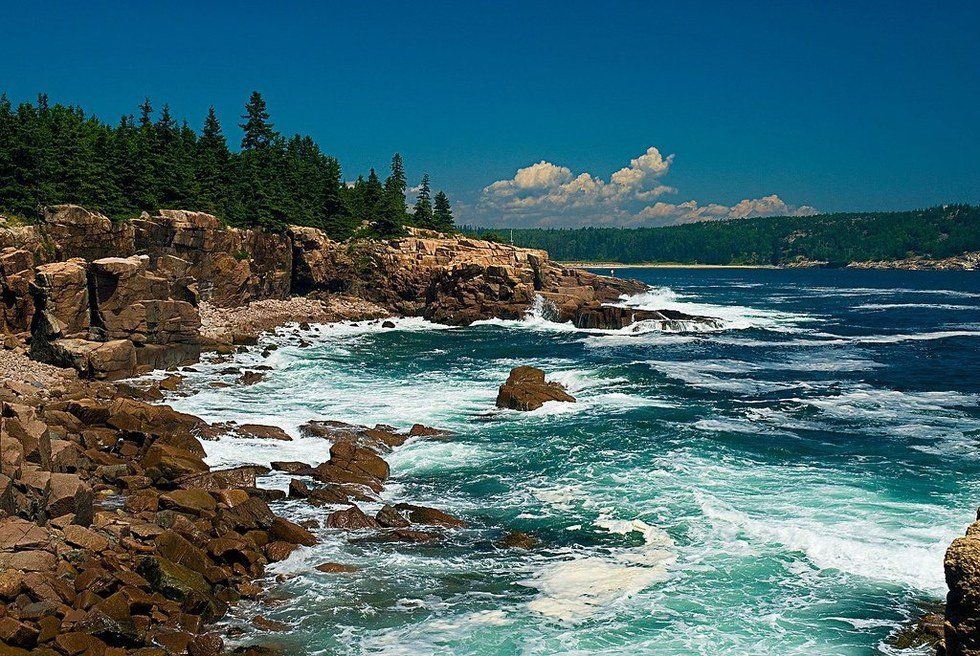
My gaze lingers on the whitecaps of the ocean waves, crashing against one another in a disorderly fashion. Fluorescent ripples of gold reflect against the blackened, tempestuous water. Bar Harbor’s city lights are beckoning weary fisherman and swimmers inland for the evening. With each draw of the tide, sand and stone crumbles away from the shoreline and Casper’s breaths become audibly tighter. His exhalations are visible in the late October air, forming a wisp of a cloud that blankets the turbulent sea before us.
“You don’t have to do this,” I tell him. His brows are drawn together in a downward slope and the skin of his fingers feels clammy against my own.
“Actually, I do.”
We haven’t really discussed the accident that occurred little over a year ago. My chest tightens when I recall the blankness of the coursing ocean, the brief disappearance of Casper’s body. When I fall into deep, restless bouts of unconsciousness at night, the sheets of my bed tangle around my limbs, resembling those crippling, chilly waves that seemed to freeze my very bones. I remember how lifeless Casper’s body felt by the time I reached him, how absolutely hollow he seemed as I practically dragged the both of us back to the rocky beach. The ride to the hospital had been agonizingly slow, and the smell of antiseptic combined with Casper’s grey complexion had been enough to cause bile to rise in my throat. “You’re going to be okay. You’re going to be okay,” I had repeated over and over like a religious mantra, though I couldn’t tell if I was being confident or just trying to convince myself that I wasn’t about to lose my best friend.
I pull my jacket tighter around my shoulders, seeking what little warmth the flimsy piece of fabric can provide. Casting another glance towards the flickering flames of light upon the ocean’s surface, it seems as if those jostling streams of brightness are mocking us, branding us as cowards for our inability to set foot on the beach until this particular evening. Casper and I had spent many an afternoon driving home from his weekly sessions of trauma therapy at the local gymnasium, contemplating the idea of tentatively breaking down the barricade that now existed between the Atlantic Ocean and our monotonous, daily routines. However, whenever the exit for the public access lot appeared, Casper would clear his throat or yawn fervently, claiming to be too exhausted or preoccupied with his studies.
“You don’t even do your homework.”
“I stare at it. I absorb it.”
I wasn’t about to push him, though. I knew that—eventually—Casper would work through his own fragmented outline of recovery and make his way back to the sea, not matter how sluggishly he maneuvered through salvaging his aquatic motor skills. Even now, sitting next to him upon the jagged rocks above the hungry waves, I attempt to keep myself silent, not wanting to pressure him.
“Stop making that face. You look constipated.”
My head snaps to the left, eyeing his measured expression. “Excuse me?”
“You heard me. Emma, you’re terrible when it comes to keeping your mouth shut. I can tell that you want to say something. Don’t let me stop you.” When I don’t respond immediately, he exhales heavily before running a hand through his thick, dark hair. Before the accident, he had kept it trimmed as close to his skull as possible so that the majority of it could be concealed beneath his cap when he swam during collegiate competitions. Now, though, his bangs fall across his forehead and he is constantly forcing them out of his line of vision. “If you’re thinking about what happened,” he begins, “you should stop. How long has it been? A year? Dwelling on it isn’t going to change the fact that it happened.”
It. He’s never said the actual word aloud, as if giving the occurrence a name would solidify his tentative grasp of perilous reality. The non-descript nurse had been rather upfront about the situation, explaining to Casper that his lungs had filled with water as he nearly drowned. I can recall his expression of disgust, a silent rejection of weakness. They had questioned him, wanting to know if the damage had been intentional. His brilliant, blue eyes had filled with hatred as he responded in the negative, and he had glared at his own hands, looking as though he blamed them for his fragility.
“You could have died, you know,” I say, not knowing what he could possibly want to hear. I hate to admit that I’m slightly agitated; after all, it isn’t my problem, not really. Casper had been the almost-victim, not me, yet I can’t shake the feeling that if he had died, then some part of me would have gone with him. Probably sensing the tension in my already coiled muscles, the lanky male wraps an arm around my shoulders and pulls me against his side. It feels familiar, perhaps too comfortable, like the faux reassurance from my father’s reluctant embraces during our last swim practices more than three years ago. His fingers had twitched on my shoulder, clearly eager to be elsewhere, while Casper had busied himself with our time sheets. After patting my wet hair like I was an obedient dog, my father would spout excuses and shuffle through the double doors, only to return hours later, smelling sweeter than usual.
“Chill. I’m not going anywhere,” Casper says. We sit in silence for a few moments before he begins to shift his weight on either thigh, clearly wanting to get moving. He bites his left thumb nail—a habit he’s had since we were young—before standing, signaling for me to join him. “If we’re going to do this, we need to set some ground rules,” he says.
“Obviously.”
“Keep our expectations low. Like, ‘lower than the sagging ceiling of your basement’ low.”
“Of course.”
“No more talking once we start. We need to eliminate all distractions.”
“Got it.”
“No admiring me without my shirt.”
“I swear to God—”
“And,” he says with a laugh, interrupting my outburst, “you have to stay right here.” He drags his tennis shoe through the sand, forming a thin line. “Assistance on your part is prohibited.” His lips form a hard line and his expression is void of the humor that had just been present.
“You can’t be serious!” I practically shout. “What if you freak out? What if you start drowning again? What if—”
“I won’t. You know, I’d feel a lot more confident about this if you’d stop questioning my ability to function as a coherent human being.”
Crossing my arms over my chest like a child enduring a scolding from a parent, I peer around Casper’s lithe frame and watch the undulating sea. I can only imagine those same, strong drags of the tide pulling him outwards, but recalling his previous statement, I work to erase the thoughts from my mind. His eyes burn with determination, much like they used to before his swim meets, and I nod slowly. “You’re right. You’ve got to do this on your own,” I tell him.
Not wanting to waste what little light has lingered on the horizon, Casper hurriedly removes his shoes, socks, and black sweatshirt. He doesn’t chance a glance in my direction as he moves to where the rocks and sand meet the foaming water, and I’m grateful. My wide, worried eyes would have only served to further his point about my not having believed in him.
During Casper’s first session of therapy after the accident, the trainer had thought it would be a brilliant idea to immediately put him directly into the deep end of the pool, no questions asked. I suppose that Casper had explained his former swimming experience on the information sheet that he had filled out beforehand, and the trainer—Stan, I think—had escorted his new student to the indoor pool of the community gym before proudly explaining that their session that day would be focused around the diving board.
“Tragedies can only be overcome through immediate confrontation,” Stan had said. Wanting to move through his trauma therapy as quickly as possible, Casper had mounted the board and plummeted head first towards the chlorinated water. However, the moment his skin hit the chill of the still, bleach-smelling fluid, his body resembled that of a plank and he sank almost instantly. As he moves towards the edge of the first breakers, my pulse quickens as I think about the possibility of that very event repeating itself, of Casper’s entire body ceasing to move of its own accord and flopping lifelessly into the waves.
One foot is in the water. Then, the other follows. He wades into the waves at the speed of a five-year-old that is entering the water for the first time, but at least he’s moving. With a few more measured steps, he reaches the first breaker, wherein the waves crash against his dark sweat pants and leave salty, splash evidence along the outlines of his knees. When he suddenly stops for a moment, perhaps to gather his composure, my breath halts in my throat and I prepare to race towards his figure. Endlessly aware of my neurosis, his right hand raises and he flashes a thumbs-up, telling me that he’s alright.
Due to our remarkably competitive nature during our elementary years, we had been children of very few words. Our mothers and fathers would alternate carpooling in their classic, office-green SUVs that practically screamed, “Sports parents!” I remember with absolute clarity an afternoon spent in the swimming section of the local Dick’s Sporting Goods, two seven-year-olds paddling through the endless racks of spongy clothing while our mothers continued to chat about our final times at the most recent junior swim meet. At certain points, it appeared as if they were more invested in the sport than we were.
Desperate to end the shopping trip in an efficient manner, Casper and I chose an array of suits and began hurriedly trying them on without our parents’ knowledge. Eventually, our mothers discovered that their children had vanished and proceeded to search the entirety of the swimming section before noticing two pairs of tiny feet beneath two, side-by-side dressing rooms. Casper’s mother, Lydia, practically shouted, “Come out when you’re done! We want to see!”
The doors opened simultaneously, revealing the male and female equivalents of matching black, Nike swim suits. I’m sure our mothers felt a streak of panic as they watched their argumentative kids eye one another in a suspicious manner, but before either one of them could utter a complimentary word, Casper’s round, blue eyes softened slightly and he raised his right hand, giving me a thumbs-up. From that point on, we became more than just competitors that were produced by parents that happened to be best friends. We became a team.
I’ve never stood on the sidelines before; I’ve always been out in the water with him, trying to best him in every possible way. My toes are wiggling against the tips of my boots, and as Casper nears the second breaker, I roll onto the balls of my feet. The adrenaline coursing through my veins as his body drifts further away from me is akin to that of preparing to launch myself from the starting platform at the beginning of a race. I can’t think about anything another than moving forward, one stroke at a time. Victory is the only thing on my mind.
I suppose Casper is thinking about victory, too. Now waist deep in salt water, his hands are skimming the tops of the waves and, for the first time in months, he actually looks happy. His dark hair is plastered to his forehead due to the spray from the oncoming waves, but he doesn’t appear to mind. His shoulder level shifts slightly and his back arches forward as if preparing to dive. I want to tell him that he’s an idiot, that moving too quickly will surely result in repeated injury, but I force myself to keep quiet, honoring the rules that we established little more than ten minutes ago, although it feels more like a decade.
He disappears. I wait.
When his head reaches the surface once more, his outstretched arms are raised in happiness, and he shouts to the stars above him. I release the breath that I didn’t know I was holding and laugh like a madwoman. For the first time since Casper entered the water, he turns around and smiles, clearly pleased with himself. I’m thankful that he doesn’t feel the need to push himself any further than going under the waves, for he slowly begins his trek back to shore.
During our senior year of high school, Casper and I had attended the state swim tournament. I had been up in the stands—waiting for the girls’ freestyle heats to start—when Casper had stepped onto the platform for his lane. He exchanged a few friendly nods with competitors before lowering his goggles and gripping the front of the platform with his hands.
The race was over in less than two minutes. When the flat of his right hand slammed into the wall for the final time, he jolted from the water to look at the score board that was positioned to the left of the pool. After months upon months of late nights, bad protein shakes, and exhausted muscles, he had finally earned the top spot in the free-style, two-hundred-meter category. I had cheered louder than ever that day, and when his eyes found mine, we exchanged our now signature thumbs-up.
When he finally made his way back towards our section of the stands, he grasped my upper arms and asked, “You ready to kick some ass?”
“Always.”
“Glad to hear it. I want to see you beat my time, you got that?”
“I can do that with my eyes closed.”
I didn’t see my father before stepping onto the platform. I tried to remember what he had told me during our countless drills, but my memory fell short. I regained control of my breathing, and gripped the edge of the platform with shaking fingers. At the sound of the flare gun, I jumped away from the platform and dove directly into the water, fighting like hell to keep my mind on the race. In the end, I placed second.
“You beat your personal best, though,” Casper told me on our way to the locker rooms. “So, it’s still technically a win.”
“Don’t patronize me.”
My mother was waiting for me with a navy blue towel in her hands, and her eyes looked bloodshot. She sniffled loudly and looked as if she had been crying for a solid hour. “Where’s dad?” I asked, looking around her body. “Is everything okay?”
She had always been incredibly strong, but in that moment, my mother clutched me to her chest and wailed like an angry toddler. It didn’t take me long to notice the tan line that was now visible around her left ring finger. Not wanting her to know that I had noticed, I extrapolated myself from her arms and told her I was going to the locker rooms to change. Casper, clearly not bothered by the feminine sign on the door, followed me inside. We walked to the very back row of lockers before sitting down on an old, wooden bench that creaked under our weight.
Without saying a word, Casper wrapped his arms around me and pressed his lips to my forehead. I did this awkward fusion of scream-crying long enough for my mouth to start tasting like blood, and Casper sighed against my skin. “He’s an ass.”
I didn’t say anything. I felt like an idiot, not having noticed the unraveling of my own family.
“But you’re going to be okay,” Casper continued. “You’re too strong to let something like this ruin you. And I’ll be right here, every step of the way.”
Vision still blurry, I turned my face upwards to look at him, and he flashed a half-hearted smile and a thumbs-up. “You’ll be okay,” he repeated.
When Casper finally exits the ocean, he sprints forward, albeit in an uncoordinated fashion. Not even bothering to put his shoes or shirt back on, he picks me up and spins the two of us around before we both practically collapse on the sand. We laugh together, probably too loudly, but neither of us particularly cares. With a large gust of wind, though, Casper is made aware of his lack of clothing and quickly reaches for his sweatshirt.
An hour later, we’re setting up a haphazard tent near the tall grass behind the beach. I hadn’t intended to spend the night there, but apparently my male counterpart has other ideas. As we lay an overlarge sleeping bag in the tent, Casper turns his head to me and says, “Thank you.”
“For what? That was all you.”
He rolls his eyes and sits on the sleeping bag, gesturing for me to do the same. I follow his instruction and sit with my knees beneath me, staring outwards towards the now calm ocean. “You didn’t have to come with me to therapy every day, and you definitely didn’t have to deal with my moody, annoying ass whenever I complained about not being able to swim anymore.”
I think about his statements for a moment. While what he’s saying is technically true—I was never forced to do any of those things he mentioned—a part of me feels as if I would have always aided his recuperation process, no matter how he felt about the idea. He had spent countless nights at my place, listening to me rant about my father and his new girlfriend, and he had never once backed out of the situation. How could I possibly abandon him when he needed me?
“I wanted to,” I say, realizing that it’s completely true. “I wanted to make sure you were okay.”
He smiles. “And that’s why we’re such a great team.”
My mind doesn’t stop racing as we climb into the sleeping bag and I place my head against his warm chest. I think about the sleepless nights we would spend at the school pool perfecting our dives, the absolute anguish in my chest that had threatened to crush me in the locker room, and the cold, empty shell of Casper’s body as I had watched him in his hospital bed, never once leaving his side. Despite the fact that his skin is now dry, he still reeks of salt water, but instead of rolling away, I loop my arms around his torso and pull him closer. He chuckles in his state of almost unconsciousness. “I’m not going anywhere. We’ve stuck it out this far; I think we can handle whatever else happens.” He places a quick kiss on my forehead before softly saying, “We’re going to be okay.”