2016 is shaping up to be quite a year for superhero movies. Deadpool captured the spirit and behavior of its lead protagonist in a way few superhero movies before it have done. Batman v. Superman: Dawn of Justice was a jumbled mess, but it did have its moments, particularly where Wonder Woman and the Batman corner of the DC Universe were concerned. And then there’s Captain America: Civil War, which actually proved to be a better version of Civil War than the original Civil War storyline--and if you’ve read that series, you know exactly why. With X-Men: Apocalypse about to hit theaters, Suicide Squad coming up at the end of the summer, Doctor Strange set to release in November, and all the films to be excited for in 2017 and beyond, the natural thing to do is look ahead. But right now, I’d like to look back in time for a moment. Let’s take a trip to 1995, a time when we weren’t conditioned to sit through all the credits of one movie in order to get a tasty tidbit of the next one. Let’s go back to the world of cinema superheroes before the Marvel Cinematic Universe, before Christopher Nolan got his hands on the Caped Crusader. Ladies and gentlemen...let’s talk about Batman Forever.
When it comes to the Burton/Schumacher era of Batman films, Batman Forever is kind of the forgotten middle child, primarily as a result of the movies around it. Forever was, in many ways, a response to the feeling that its predecessor, Batman Returns, had gotten too grim and gritty for its own good. It traded Michael Keaton for Val Kilmer, Victorian goth for cybergoth, and creepy for cartoony. The result was a movie that, after the first Batman film had gone out of its way to kick the character’s campy reputation out, decided that maybe camp wasn’t so bad and decided to let it back in. But compared to the sheer God-awful mess that was Batman & Robin, the movie that made the Nolan trilogy necessary in the first place, Batman Forever looks like it should have swept the '96 Academy Awards. Sure, Forever was as much a calculated corporate move by Warner Bros. to keep the merch moving as anything else, but at least they made the movie first, then the merch. Batman & Robin went the other way around, and as a result, we got quite possibly one of the worst movies of all time.
So that leaves Batman Forever in this weird, awkward, transitional spot. On one hand, you can see everything that’s about to go wrong in Batman & Robin, but it’s all kept in check, so we don’t get the same kind of trainwreck. At the very least, it takes its core plot elements seriously. On the other hand, this movie looks and feels vastly different from Batman and Batman Returns, and it definitely isn’t as good as either of those movies were. So for the most part, people forget about it, and when they do remember this movie, they tend to focus on the negative aspects, the ones that would come to dominate its sequel and kill Batman as a film franchise for eight years.
Let me get this out of the way: yes, there is a lot wrong with Batman Forever. Chris O’Donnell was 24 when filming on this movie started, but he’s supposed to be playing a teenager, and he doesn’t feel very believable in that role. The fact that his character does the “ninja laundry” scene makes things worse--in fact, if the franchise had ended here, I’m sure the whole movie’s reputation would be based on that scene and how much it sucked. The infamous Bat-nipples from Batman & Robin make their debut in this movie, as does the technique of extreme close-ups on Batman’s gear and body for no reason--but thankfully, this movie doesn’t abuse this technique nearly as much as its sequel. The hostage from the opening scene is incredibly grating and makes you kind of hope Batman doesn’t successfully save him, even though you know in your heart that if that happened, Batman would spend the whole movie mourning the poor schmuck. Tommy Lee Jones’s take on Two-Face tends to feel more like he’s playing Jack Nicholson’s Joker dressed as Two-Face than the actual Two-Face, and that’s before you consider that he’s replacing Billy Dee Williams as Harvey Dent. Chase Meridian isn’t a terrible romantic lead, but she’s pretty forgettable when compared to the complexities of Catwoman or the screaming hysterics of Vicki Vale. And if you don’t like Jim Carrey, then this movie won’t change your mind about him.
Make no mistake, Batman Forever is a big, loud, stupid movie. But it’s a fun big, loud, stupid movie, and it’s definitely a better movie than people give it credit for.
For one thing, unlike its predecessor films, Batman Forever is actually self-aware with regard to how silly it is. Let’s not forget that Batman Returns, for all its edginess, has a scene where the Penguin receives a funeral from six actual penguins, who come out from hiding after his death and carry him to a watery grave. This sounds like something you’d see in a parody, but the movie plays it for drama, complete with somber background music. The Burton Batman films may have been groundbreakingly dark and serious for their time, but make no mistake, they had their campy moments, and now that we have the even darker and more serious trilogy of Christopher Nolan’s Batman movies, the campy moments stick out like sore thumbs and clash horribly with the atmosphere the movies are trying to establish. But where scenes like Penguin’s funeral or Batman conveniently flying his plane in front of the moon so it makes his logo felt out of place in those movies, moments like that actually fit the tone in Forever. The cheesy one-liners--most infamously, ”It’s the car, right? Chicks love the car”--suit the cartoonish vibes of the film. Yes, they’re still bad, but at least you feel like the actors delivering them are in on the joke. You can go with the fact that the Riddler’s dastardly invention, the Box, looks like a blender no matter how many features he adds to it because the movie doesn’t attempt to pass it off as stylish and the rest of what’s going on doesn’t make very much sense anyway.
What’s more, if you look past all the rave lighting and exaggerated CGI cityscapes, you’ll actually find some continuity with the previous Batman movies. Gotham City looks too vast and too filled with skyscrapers and statues to be real, but you can still feel how crowded and depressing it would be if it was real in some of the establishing shots. Furthermore, the gangs of cannon fodder in this movie, both Two-Face’s personal goons with the neon guns and the ravers Robin saves a girl from, aren’t all that different in substance from the Red Triangle Gang that the Penguin employed back in Batman Returns. They’re all campy swarms of thugs who suit the aesthetic of the movies they’re in and exist so Batman can punch them in the face.
Speaking of Batman, despite all the silliness going on around him, he’s actually pretty much the same character here as he was when it was Michael Keaton underneath the mask. He shows the occasional flash of deadpan wit, but for the most part, he’s the same no-nonsense guy who still hasn’t worked through his childhood trauma from the Burton films. In fact, the movie actually makes an admirable attempt to explore the psychology behind Batman with its themes of duality and revenge, as well as through a subplot where Bruce Wayne tries to work through repressed memories of his parents’ deaths. Granted, the parts where Batman is directly trying to work through these issues are somewhat botched, since key parts of them were cut for time, but nonetheless, it shows that the writers actually put some thought into this and tried to get at what makes the character tick, rather than just having him punch things for two hours and calling it a day.
In fact, Val Kilmer’s incarnation of Batman is, in some key ways, more true to the source material than Michael Keaton’s Batman ever was. In particular, his take on Bruce Wayne is more accurate in terms of personality, showing him as the publicly-active socialite and CEO he tends to be in the comics, rather than Keaton’s socially awkward, introverted version--which, don't get me wrong, it was good, but it was clearly an area where Warner Bros. was taking liberties with the character. But the part that sticks out the most is the fact that Batman stops going out of his way to kill people in this movie. Remember when Batman made all those explosions and inadvertently killed those LexCorp goons in Dawn of Justice and people complained about it on the Internet? Yeah, well, when Tim Burton was at the helm of this franchise, Batman killed people on purpose. Like, a lot. He’d set people on fire with the Batmobile, strap dynamite to their chest and then walk away smiling, try to shoot the Joker with the machine guns on the Batplane...it all felt weird and wrong, especially when the even grimmer Christian Bale version of the character adhered so strictly to the "no killing" rule. Fortunately, Forever shows that he’s started following that rule. Not only is he not gleefully blowing up random minions anymore, he also spends a significant amount of time persuading Robin not to kill Two-Face, and the way he describes things implies that, between Returns and Forever, he realized all the killing he was doing made him no better than the criminals he fought. Of course, that doesn’t explain why Batman tricked Two-Face into falling to his death by throwing all those coins in the air, but it’s far easier to justify than the murderous rampages he went on in the previous two movies. Oh, and let's not forget--when this movie flashes back to the deaths of Batman's parents, this movie doesn't keep up the first movie's crap about the Joker being the one to kill them. (Joe Chill did it, and Tim Burton knows damn well!)
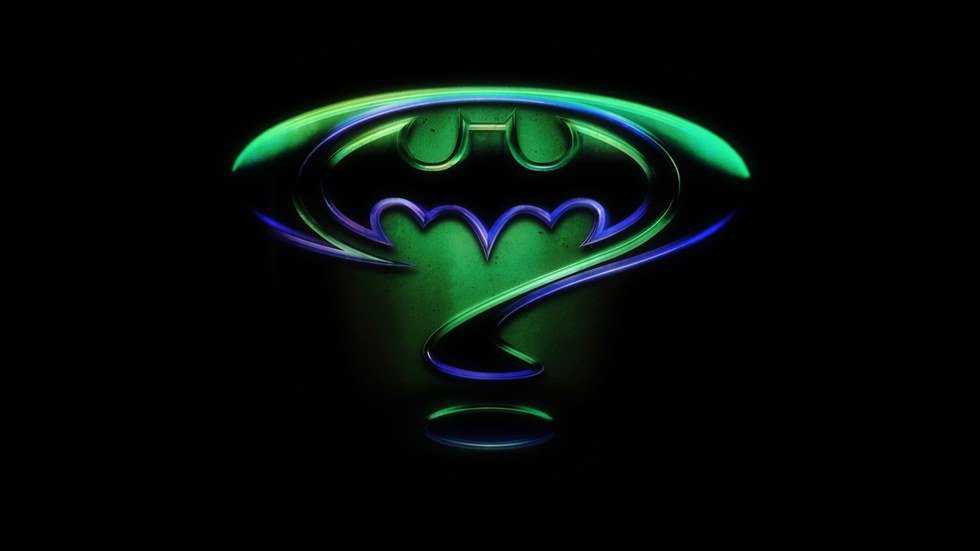
Also, I have to admit, as much as I’ve ragged on this movie for how it looks--and it’s a pretty over-the-top, blatantly ‘90’s-looking movie--I actually like some of the movie’s visual stylings. Maybe I’m just a sucker for anything vaguely cyberpunk, but the night sequences in the heart of Gotham City were always interesting to watch, especially once you notice how the lighting and color change in those scenes to reflect who’s in them. When the Riddler’s involved, you see lots and lots of neon green. When Two-Face shows up, you see more reds and purples. When neither of them are around, the color palette gets subtler, even if it’s still pretty in-your-face, with more natural blues and conventional lighting. And the soundtrack--not the score, the licensed music--is pretty bitchin’ too. I’m sorry, but if you don’t like “Hold Me, Thrill Me, Kiss Me, Kill Me,” then you need to get your head checked. This movie also made “Kiss From a Rose” a smash hit, but my favorite thing about that song is the so-bad-it’s-glorious music video, which gave us the hilariously dissonant image of derp-faced Batman swinging through Gotham while Seal tenderly sings flower metaphors. And finally, any movie that includes both the Offspring and the Flaming Lips, along with Method Man and Sunny Day Real Estate on the soundtrack CD, can’t be that bad.
Flawed as it may be, Batman Forever still makes for an entertaining popcorn flick. It’s not going to blow your mind, but it’s not trying to in the first place. Its goal, first and foremost, is to feel like watching a comic book come to life, and in that respect, it does a good job. It’s definitely not the Batman those of us raised on Christian Bale’s performance are used to, but that’s fine by me. As much as we may pretend Batman has always been a brooding, serious figure, if you look at the history of the character, there’s just as much silliness as there is seriousness. When the darker side of him is so dominant today that its influence can make the entire DC cinematic universe take a turn towards the grim and gritty, a lighter take on things that embraces how bat-guano crazy the whole premise really is can be refreshing. And even if this whole rant hasn’t convinced you that this movie is even a modicum better than you thought it was when you clicked the link here, you have to admit... hey, at least it’s not Batman & Robin.